GRAVÜR DÜNYASI
Digital Engraving Library
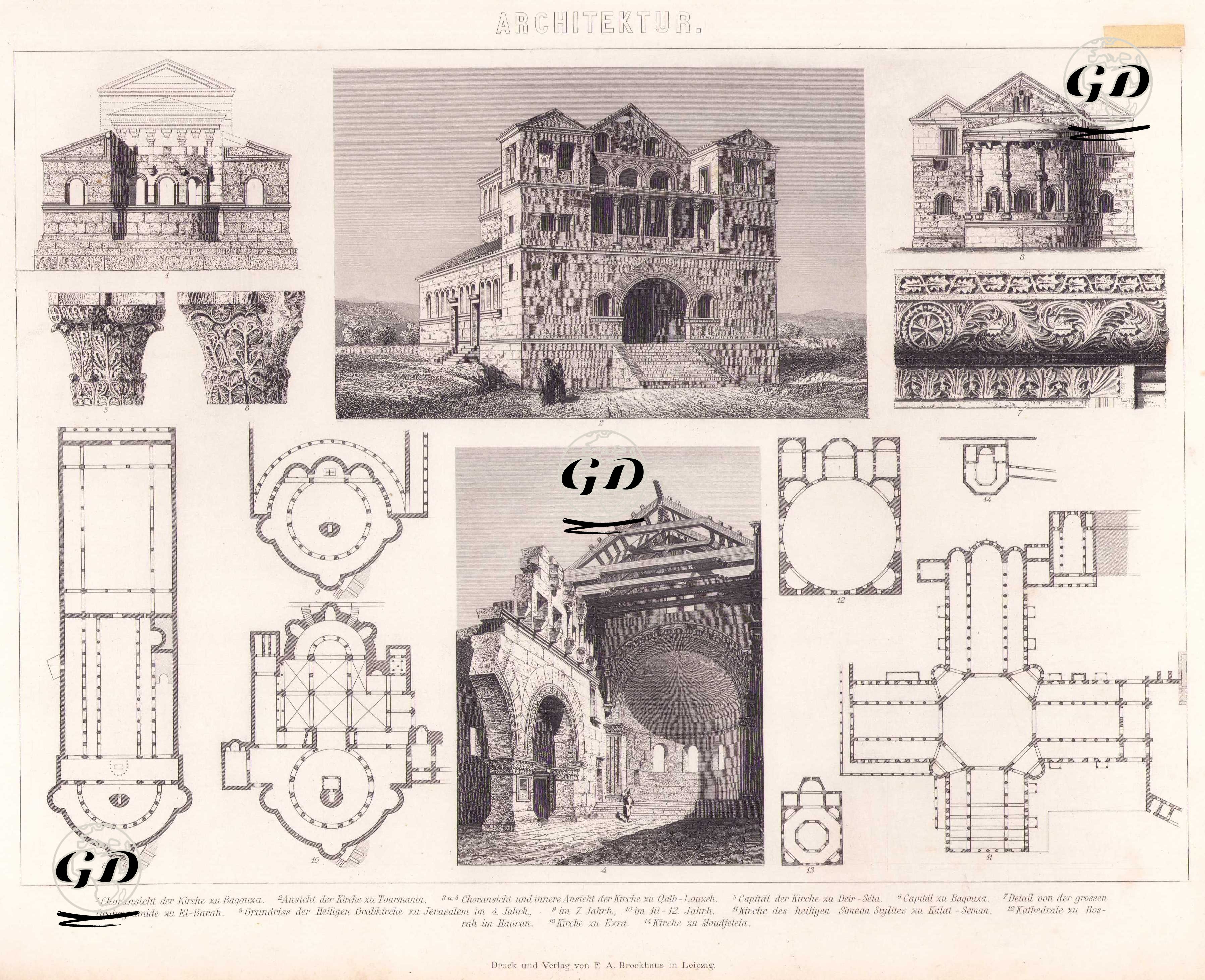
Architektur (Frühchristliche Kirchen - Early Christian Churches) 1.Choranschnit der Kirche zu Baqouxa (Choir section of the church at Baqouxa) 2.Ansicht der Kirche zu Tourmanin (View of the church at Tourmanin) 3. 4. .Choranschnit und innere Ansicht der Kirche zu Qalb-Louzeh (Choir section and interior view of the church at Qalb-Louzeh) 5.Capital der Kirche zu Der-Sita (Capital of the church at Der-Sita) 6.Capital zu Baqouza (Capital at Baqouxa) 7.Detail von der grossen Grabpyramide zu El-Barah (Detail from the large funerary pyramid at El-Barah) 8.Grundriss der heiligen Grabkirche zu Jerusalem im 4 Jahrh (Ground plan of the Church of the Holy Sepulchre in Jerusalem in the 4th century) 9.im 7. 10.Jahr (In the 7th and 10th centuries) 10. im 12. Jahrh (in the 12. century) 11.Kirche des Heiligen Simeon Stylites zu Kalat-Seman (Church of Saint Simeon Stylites at Kalat-Seman) 12.Kathedrale zu Bos-rah im Hauran (Cathedral at Bosrah in the Hauran) 13.Kirche zu Exra (Church at Exra) 14.Kirche zu Moudjelia (Church at Moudjelia) -  - 1875
GMS22201
For high resolution images, please contact us.

Architektur (Frühchristliche Kirchen - Early Christian Churches) 1.Choranschnit der Kirche zu Baqouxa (Choir section of the church at Baqouxa) 2.Ansicht der Kirche zu Tourmanin (View of the church at Tourmanin) 3. 4. .Choranschnit und innere Ansicht der Kirche zu Qalb-Louzeh (Choir section and interior view of the church at Qalb-Louzeh) 5.Capital der Kirche zu Der-Sita (Capital of the church at Der-Sita) 6.Capital zu Baqouza (Capital at Baqouxa) 7.Detail von der grossen Grabpyramide zu El-Barah (Detail from the large funerary pyramid at El-Barah) 8.Grundriss der heiligen Grabkirche zu Jerusalem im 4 Jahrh (Ground plan of the Church of the Holy Sepulchre in Jerusalem in the 4th century) 9.im 7. 10.Jahr (In the 7th and 10th centuries) 10. im 12. Jahrh (in the 12. century) 11.Kirche des Heiligen Simeon Stylites zu Kalat-Seman (Church of Saint Simeon Stylites at Kalat-Seman) 12.Kathedrale zu Bos-rah im Hauran (Cathedral at Bosrah in the Hauran) 13.Kirche zu Exra (Church at Exra) 14.Kirche zu Moudjelia (Church at Moudjelia)

Date1875
TechniqueSteel Engraving
CategoryArchitecture And Design
SourceBilder-Atlas: Ikonographische Encyklopädie der Wissenschaften und Künste ; ein Ergänzungswerk zu jedem Conversations-Lexikon ; 500 Taf. in Stahlstich, Holzschnitt u. Lithographie ; in 8 Bd.. 5 by bearb. von Karl Gustav Berneck … - Druck und Verlag von F. A. Brockhaus in Leipzig

Description

This engraving depicts the typologies of basilica, cruciform plan, and central plan that shaped the Christian understanding of sacred space in the period following the collapse of the Roman Empire (4th-7th centuries). The architectural facade drawings in the upper part of the engraving represent structures such as the Basilica of San Apollinare Nuovo in Ravenna, Qal'at Sem'an (Monastery of Simeon Stylites), and the church of Der-Sita. These structures are typical examples of the stonework, arcaded entrance layout, and apse compositions of early Christian churches derived from the Roman basilica plan. The detailed stone ornamentation and capital engravings in the central section demonstrate the acanthus-leaf Corinthian capitals and vegetal frieze compositions prominent in Byzantine architecture. The plan drawing in the lower left corner reflects the original 4th-century plan of the Church of the Holy Sepulchre (Anastasis) in Jerusalem. This plan, with its central dome and eastward-oriented cross-shaped structure, is one of the fundamental examples that defines the liturgical order of Byzantine architecture. The engraving of the vaulted interior in the central area demonstrates the early construction techniques of Christian basilicas (including brickwork, arches, and vault systems). The cruciform church layout in the lower right represents a mature example of centrally planned churches from the Byzantine period. This plan type laid the foundations for the dome-centered spatial concept that would later reach its zenith in structures like the Hagia Sophia in Istanbul.