GRAVÜR DÜNYASI
Digital Engraving Library
| Date | 1875 |
| Technique | Steel Engraving |
| Category | Architecture And Design |
| Source | Bilder-Atlas: Ikonographische Encyklopädie der Wissenschaften und Künste ; ein Ergänzungswerk zu jedem Conversations-Lexikon ; 500 Taf. in Stahlstich, Holzschnitt u. Lithographie ; in 8 Bd.. 5 by bearb. von Karl Gustav Berneck … - Druck und Verlag von F. A. Brockhaus in Leipzig |
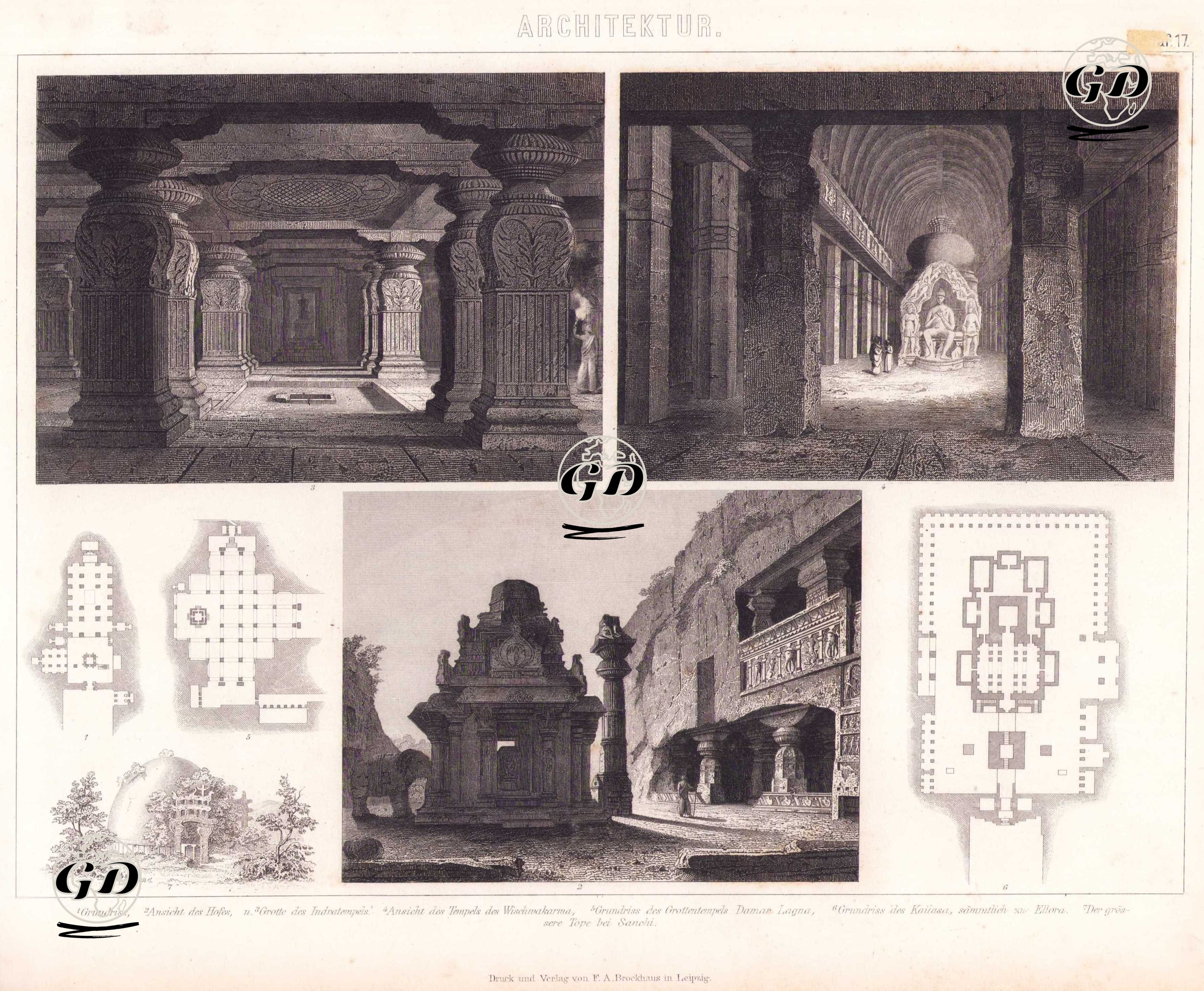
This engraving, titled "Architecture," depicts early rock-cut temples in India. It presents plans and perspectives of the Ellora cave complex, reflecting the intertwining of different religious traditions (Hinduism, Buddhism, and Jainism) within the same geography. The Sanchi stupa, one of the earliest examples of Buddhist architecture, is also included in the composition. The two large scenes in the upper section depict the pillared hall of the Indra Temple at Ellora and the vaulted chaytia (prayer hall) of the Vishwakarma (Wishwakarma) Temple. These structures are monolithic structures carved from a single piece of basalt rock and were constructed between the 6th and 9th centuries AD. The vaulted scene on the right, in particular, shows monks praying before the stupa and the Buddha statue, central to Buddhist iconography. The lower section displays three different temple plans (Grundriss) and their exterior elevations: On the left, the central plan and entrance structure of the Indra Temple; in the center, the façade of the rock-cut temple of Dumar Lena (Damar Lagna); and on the right, the detailed plan of the Kailasa Temple (the great temple dedicated to Shiva). These plans are rare examples documenting the principles of axial symmetry, sacred space hierarchy, and ritual orientation seen in early Indian architecture. The engraving reflects not only the architecture but also the ritual and cosmological significance of these temples. In Hindu temples, the central sacred space (garbhagriha) symbolizes the center of the universe, while Buddhist stupas symbolize the path to enlightenment. These temples at Ellora combine both the power of stone architecture and the transformation of spiritual contemplation into space.