GRAVÜR DÜNYASI
Digital Engraving Library
| Date | 1883 |
| Technique | Lithography-Original Hand Colored |
| Category | Fashion |
| Source | Journal des Demoiselles - Falconer imp. Rue Drouot 2, Paris |
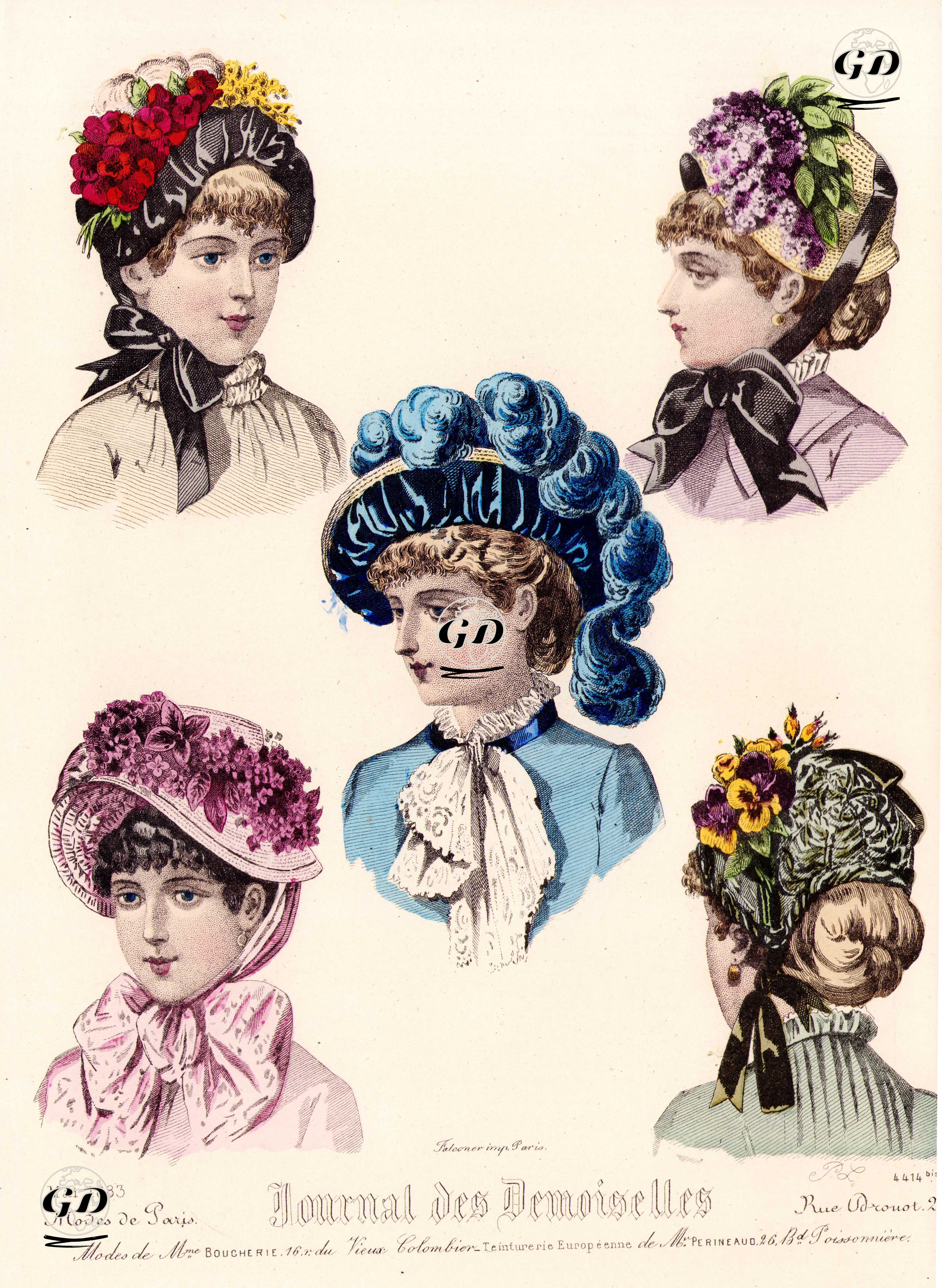
Journal des Demoiselles was one of the most renowned women’s magazines published in 19th-century France. Founded in Paris in 1833, it appealed primarily to young girls (demoiselles). While covering topics such as fashion, literature, music, morality, education, and social etiquette, the magazine also served as a cultural guide shaping the era's understanding of female identity and elegance. It was noted for its colorful fashion engravings, sewing patterns, and illustrations of European fashion. Published for nearly a century (1833-1922), the Journal des Demoiselles emphasized themes of female education, elegance, and moral refinement in French bourgeois society and, like other magazines of the period (La Mode Illustrée, Le Follet, Les Modes Parisiennes, etc.), played a pioneering role in the development of the women's press. This elegant fashion engraving was published in the Journal des Demoiselles in May 1883. The composition catalogs the world of hats/headwear (chapeau-coiffure), one of the fastest-changing areas of fashion in Paris in the early 1880s, through various examples. Instead of a full-length figure, the engraving presents five separate portrait headwear models. Two portraits are shown in profile (side view), demonstrating the volume of the headwear and the lacing/ribbon system. One portrait is shown from behind, revealing the hair bun (chignon), the fit of the hat, and the back decorations. The central portrait is structured as a central model, more showy, voluminous, and a "showcase of fashion." Many of the hats feature dense floral bouquets (in shades of red, purple, and yellow) and masses of green leaves. This is consistent with the use of artificial flowers and botanical embellishments as a "seasonal" signature in hatmaking of the time. This intense botanical emphasis is particularly significant in a May issue: spring fashion. Large ribbon bows ending below the neck or at the chin line serve as a sign of both "youth" and "elegance" in hat fashion. It is also a practical element that secures the headdress, and the engraving makes this particularly visible. The portraits feature the typical hair silhouette of the 1880s: short bangs and a bun at the back. This hair architecture acts as a "skeleton" supporting the back of the hat, and the inclusion of a rear view in the engraving is therefore important. In some models (especially the blue-toned headdress in the center), the hat creates a high-volume form that grows like a "halo" not only at the top but also around it. This shows that the same aesthetic logic as the volumetric effects in clothing (skirt-silhouette) of the 1880s is transferred to the headdress, and the visual weight is balanced up and down. Such fashion engravings imply the material through imagery rather than directly describing it in writing. The glossy surfaces and folds in the engraving suggest satin-silk-like fabrics. Matte and firm-looking areas give a velvet-felt effect. Light-colored, woven textures create the impression of a straw or finely knitted hat body. Flower clusters and leaves are the most expensive and labor-intensive part of millinery hatmaking, and this elaborate ornamentation appeals to the urban upper-middle-class taste of the target audience. This engraving shows not only "what was worn" but also the image of a woman that was constructed. The headdress is a "code" that signals age, status, time of day, and social setting (outing, visiting, invitation). The use of flowers, ribbons, and color supports the public representation of femininity at that time, which was constructed around the axis of "elegance-manners-visibility."