GRAVÜR DÜNYASI
Digital Engraving Library
| Artist | Joseph Mallord William Turner (1775-1851) |
| Engraver | Samuel Bradshaw (Active 1832-1880) |
| Date | 1862 |
| Technique | Steel Engraving |
| Category | Mythology |
| Source | The Art Journal |
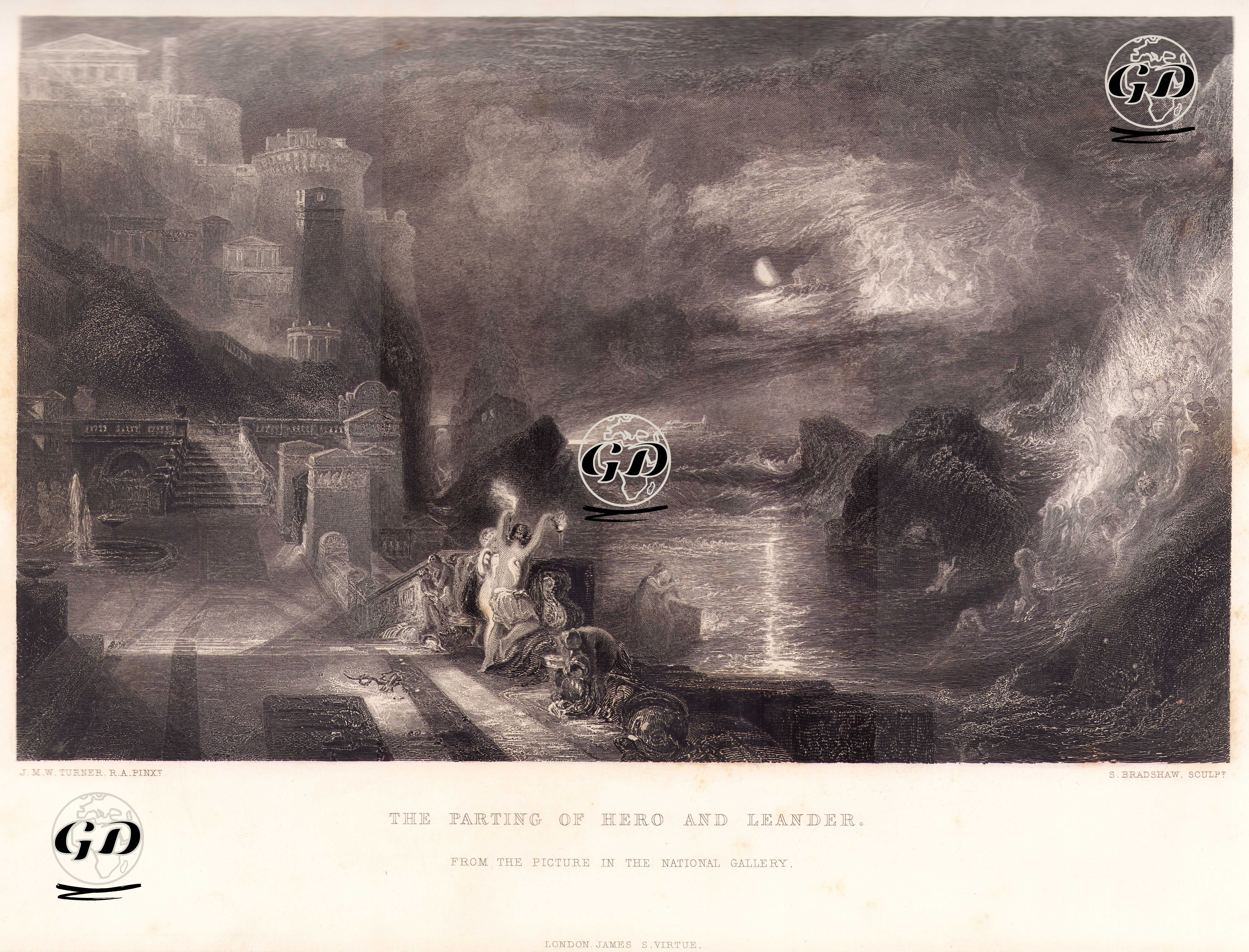
This engraving is based on Joseph Mallord William Turner's "The Parting of Hero and Leander," and the engraving was made by Samuel Bradshaw. It depicts one of the most tragic love stories of ancient Greek mythology, retold by later writers, including the English Romantic poet Lord Byron. Hero, a priestess of Aphrodite who lived in a tower in Sestos on the Dardanelles, was in love with Leander, a young man from Abydos (Mysia) on the Asian side. Each night, Leander would swim across the water to be with her, while Hero would guide him with a torch lit from a high tower. One night, during a fierce storm, Leander drowned in the waves, and Hero, in despair, threw herself from the tower, sharing her lover's fate. Rather than recounting this story faithfully to the mythological narrative, Turner opted for the version of the 5th-century AD poet Musaeus. Thus, the scene is set not at night but at sunrise. Instead of presenting the story with large central figures, as in the tradition of classical history painting, Turner deliberately disrupts conventional compositional conventions by concealing Hero and Leander in the shadows of the scene. Hero and Leander are depicted small and indistinct, preparing to part by the sea. Above them, on a terrace, on which he has cast down his bow and quiver, holding a lamp and a torch, are the winged god of love (Cupid/Eros), Hymen (the god of marriage), and the nymphs, allegorically added to the scene. Thus, rather than simply recounting a mythological story verbatim, Turner reflects its universal meanings (love, separation, death, and fate) within a symbolic whole. Furthermore, Turner constructed an imaginary setting around them using various classical architectural elements. On the right of the painting, an exotic "Moorish" tower, representing Abydos on the Turkish coast, looms just beyond the large, rugged rocks where ghostly sea nymphs gather. Turner used darkness and deep shadows to heighten the drama of the scene and perhaps hint at the tragedy that will follow when Leander abandons Hero, never to return. The engraving powerfully reflects Turner's dramatic use of light and shadow. The heavy clouds in the sky, the rising waves, and the refraction of light on the sea surface emphasize the destructive power of nature while simultaneously creating a dramatic stage setting. The torchlight in the engraving, while a symbol of hope and guidance in the mythological narrative, becomes an ironic element here, signaling the inevitability of impending disaster.