GRAVÜR DÜNYASI
Digital Engraving Library
| Artist | Sebastian Munster (1489-1552) |
| Engraver | Georg Scharffenberg (1530-1607) |
| Date | 1628 |
| Technique | Wood Engraving |
| Category | Portraits |
| Source | Cosmographia Universalis, Omnium Orbis Terrarum Regionum et Insularum Veteribus cognitarum descripsit P. Sebastianus Munsterus. This translates to Universal Cosmography, Describing All the Regions and Islands of the World, Known to the Ancients, by P. Sebastian Munster |
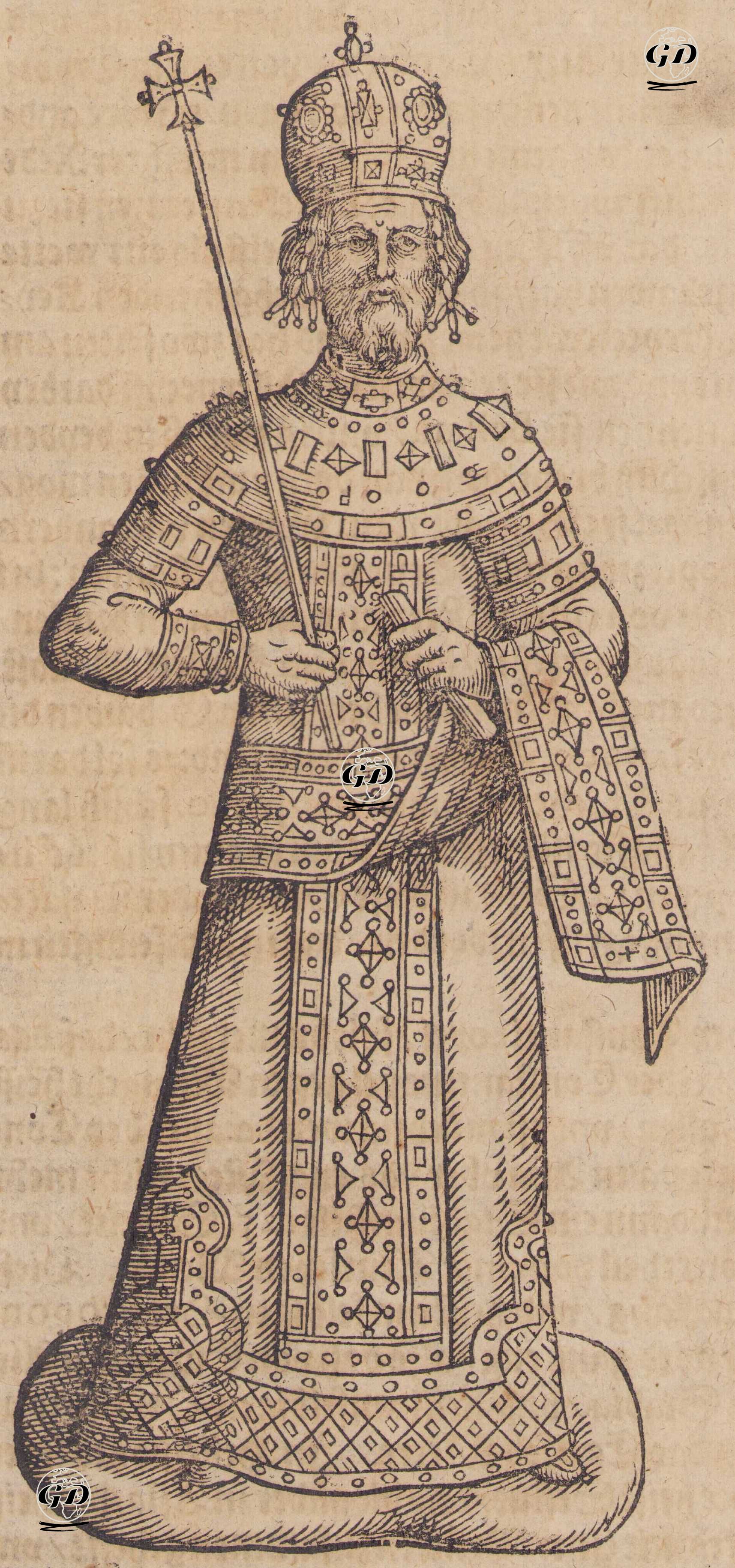
This woodcut engraving is a schematic portrait of Constantine XI Palaiologos (Konstantin Dragases), the last ruler of the Byzantine Empire, reflecting the tradition of representation in early modern Europe. While not a true historical portrait, the figure in the engraving is the product of a visual understanding that reinterprets 16th-century Europe's memory of Byzantine emperors through iconographic patterns and symbolic elements. The emperor's Byzantine imperial crown (a stemma with a cross), the dangling pearl-studded earrings (pendilia), and his ceremonial garb—a blend of loros and sakkos, adorned with dense geometric motifs—are schematic European counterparts of late Palaiologan court iconography. The ceremonial staff (a long, cross-like staff resembling a labarum) in the figure symbolizes the emperor's temporal and spiritual authority, while the caftan, with its dense geometric decoration, represents Byzantium's former grandeur and the symbolic continuity of a lost imperial culture. However, the striking point here is that European artists reinvented the Byzantine costume according to their own perceptions. Therefore, rather than being historically accurate, the robe and crown are a visual reflection of Europe's image of Byzantium as "distant, alien, and ancient." In genuine Byzantine miniatures and mosaics, this attire appears in a much more elaborate ceremonial dress. The emperor's face is depicted as aged, bearded, dignified, and somewhat melancholic. This choice is a visual extension of narratives in the West that romanticize the tragic and heroic figure associated with Constantine XI's identity as the "last emperor." In post-conquest Europe, Constantine was idealized both as a symbol of a lost empire and as a "martyr-emperor" lost by the Christian world in the East. Influenced by this iconography, it is common in contemporary engravings to depict him as a wise and resigned ruler. In 16th-century Europe, when this engraving was produced, Byzantine emperors were now seen as figures of a historical past and, ranked alongside Ottoman sultans in the lineage of rulers, were conceptualized as part of the "tradition of Eastern sovereignty." Constantine XI's status as the last representative of an empire that ended with the rise of the Ottomans made his figure a symbolic turning point, particularly in Western Europe. This engraving was first published in Sebastian Munster's Cosmographia Universalis … in 1544. Over the years, the book has undergone numerous editions and revisions, becoming one of the most important works of geography and history of the 16th century. Containing rich information in the fields of geography, cartography, natural history, and anthropology, the book has been widely used as a reference source by scientists, explorers, and cartographers for centuries. This engraving, which is in our library, was published in the 1628 edition of Sebastian Munster's Cosmographia Universalis ….