GRAVÜR DÜNYASI
Digital Engraving Library
| Artist | Theodule Ribot (1823-1891) |
| Engraver | Emile Masson |
| Date | 1880's |
| Technique | Etching |
| Category | Portraits |
| Source | Alfred Salmon, Paris |
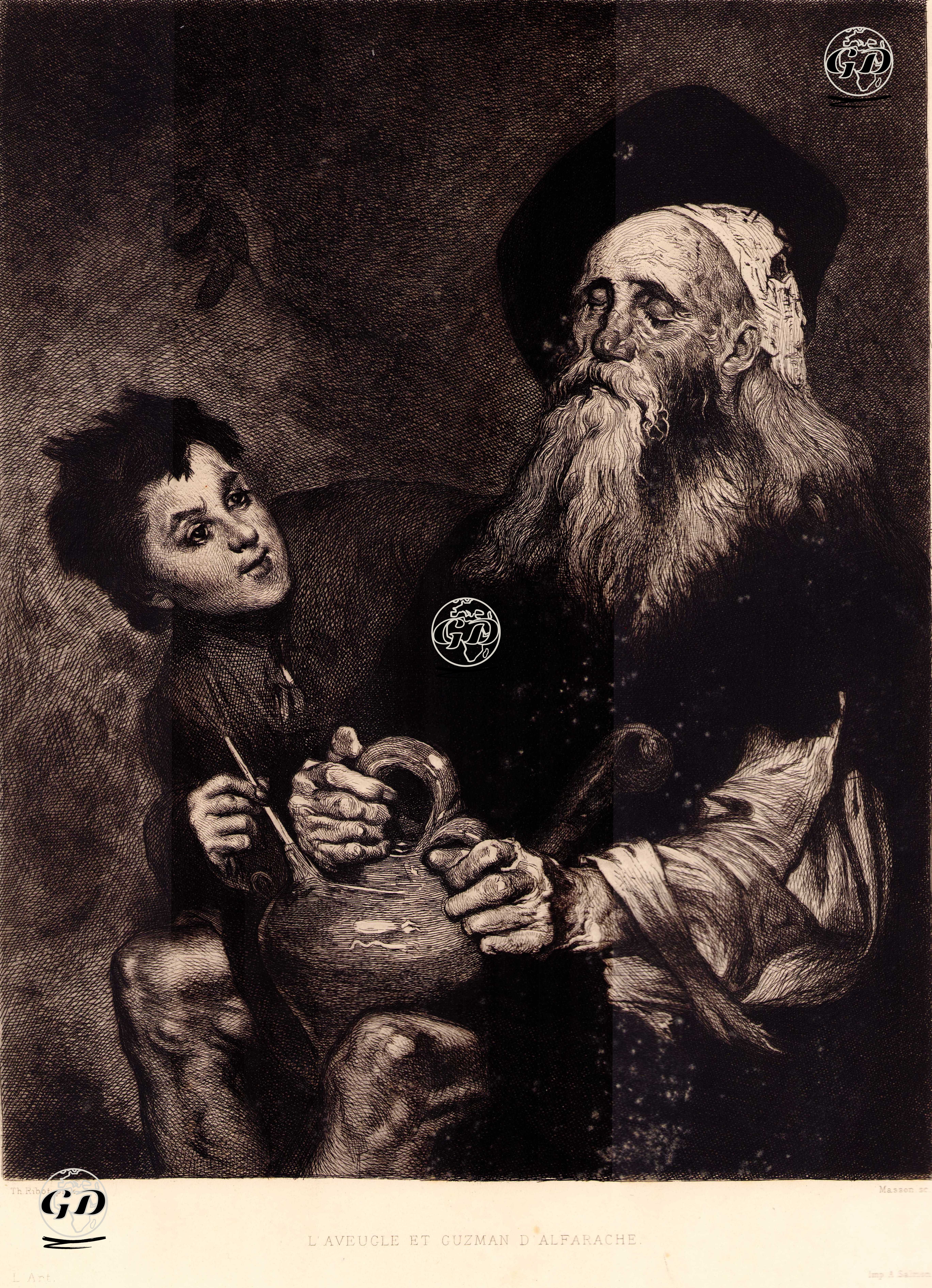
This engraving is based on a 19th-century composition by French artist Théodule Ribot and engraved by engraver Emile Masson; the scene it depicts is directly taken from the 16th-century Spanish novel "Lazarillo de Tormes." The novel depicts a young boy struggling to survive in poverty, serving a blind beggar, and this scene depicts the moment when Lazarillo secretly steals wine from his master's jug. The image depicts an old blind man groping for a jug, while the young boy (Lazarillo) leans carefully beside him, his face both alert and cunning, and directed towards the jug. This scene conveys not only an individual story but also the expression of a child's intelligence and survival instinct in the face of social injustice. This engraving should also be read within the context of the "espagnolisme" movement, which was influential in mid-19th-century French culture. Espagnolisme is the name given to the interest of French artists and writers in 16th and 17th century Spanish literature, particularly realistic stories featuring lower-class, marginalized, and excluded characters. This trend, which became widespread in France in the 1850s, was brought to visual art through artists like Ribot. In this composition, Ribot avoided caricaturing characters like Lazarillo; instead, he approached their desperation, social exclusion, and harsh living conditions with human depth. The engraving's dark tones, Rembrandt-like use of chiaroscuro, and the characters' intense expressions demonstrate that Ribot established an empathetic connection with these characters and developed a perspective that glorified their struggle for survival. The title beneath the engraving is "L'Aveugle et Guzman d'Alfarache" (The Blind Man and Guzman d'Alfarache), suggesting that the work alludes to Mateo Aleman's 1599 "Guzman de Alfarache," a picaresque novel from the Spanish Golden Age. Although this title appears beneath the engraving, it does not fully correspond to the visual content. The narrative of the scene is clearly based on the wine theft scene from “Lazarillo de Tormes.” This title confusion likely stems from the frequent confusion of different examples of the picaresque genre in the 19th century, or from publishers opting for a more recognizable title. While both "Lazarillo" and "Guzman" lead similar lives, the unique scene with the blind master belongs solely to Lazarillo. Consequently, this engraving offers a multilayered narrative, both literary and artistic. The intelligence of a child struggling to survive amidst poverty and social inequality, combined with the sensitivity of French realism and the influence of espagnolisme, tells the viewer not only a dramatic scene but also a historical class narrative. This image, a collaboration between Ribot and Masson, conveys the echo of Spanish lower-class literature in French art to the present day through a powerful naturalistic expression imbued with empathy.