GRAVÜR DÜNYASI
Digital Engraving Library
| Artist | Carlo Pellegrini (Ape) ( (1839-1889)) |
| Engraver | Vincent Brooks, Day & Son Lith. |
| Date | 1880 |
| Technique | Chromolithography |
| Category | Uncategorized |
| Source | Vincent Brooks Day & Son Lith. - Vanity Fair, London |
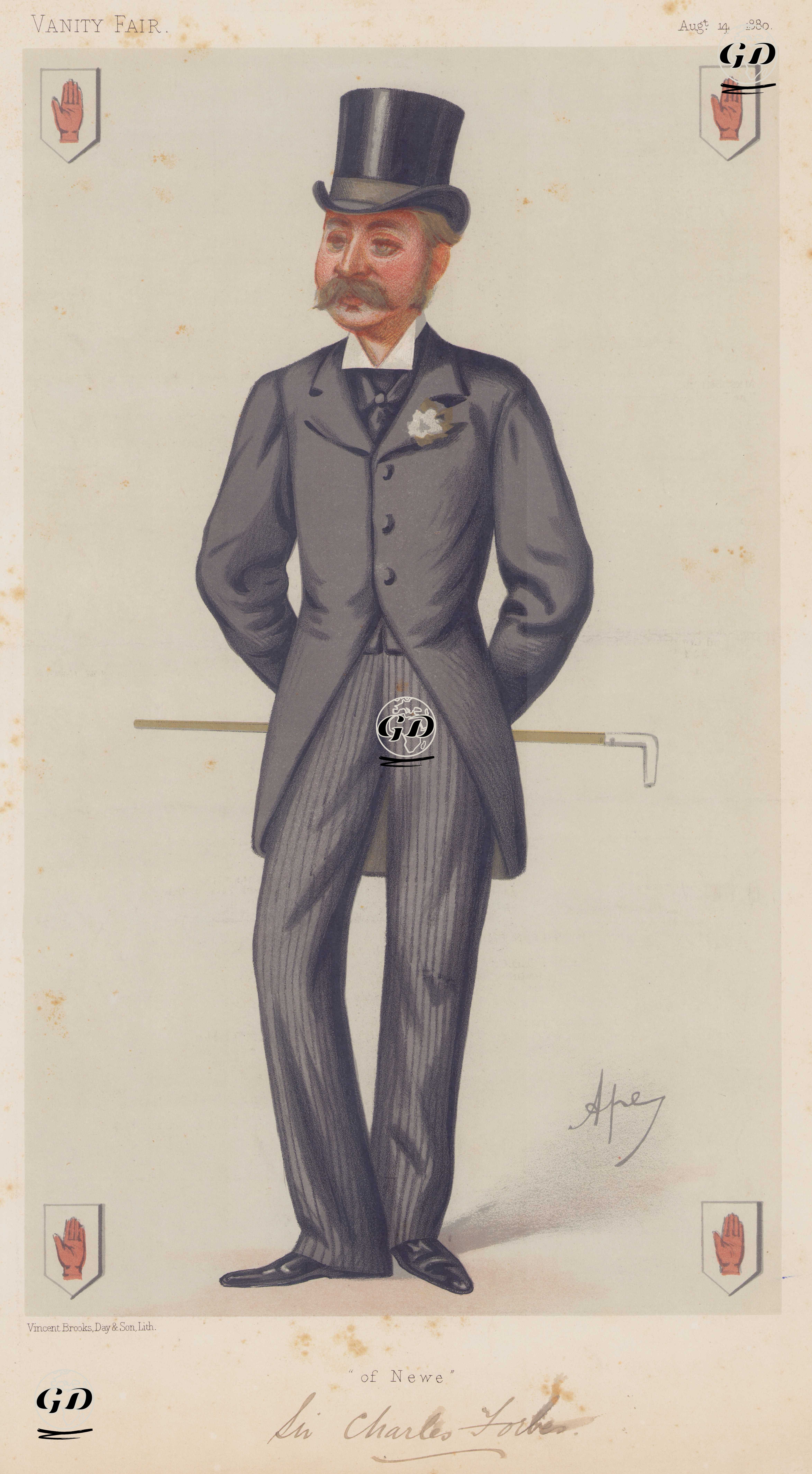
Vanity Fair was a weekly magazine published in England between 1868 and 1914, known for its high-quality lithographs depicting political, social, and aristocratic figures of the era in caricatural yet identifiable forms. The series aimed to "portray" public figures of the Victorian and Edwardian eras with an ironic eye, while also demonstrating the power structure of the period. Additionally, Vanity Fair portrait cartoons often have a humorous or playful subtitle beneath them. Rather than directly identifying the person or their title, these subtitles often reference the person's social circle or association through an allusion, a joke, a nickname, or a play on words. Two of the most famous artists to work for Vanity Fair were "Ape" (Carlo Pellegrini) and "Spy" (Leslie Ward). This Vanity Fair cartoon portrays Sir Charles Lanyon (1813-1889), one of the most important engineers and architects of 19th-century Belfast, in a satirical tone. Lanyon is known as an architect and planner of the urban fabric of 19th-century Ireland, particularly Belfast, which was rapidly transformed by the Industrial Revolution. Having received his formal education in England and subsequently trained under Jacob Owen at the Board of Public Works Ireland, Lanyon oversaw numerous large-scale projects in both civil engineering and architecture. During this period, Belfast's port infrastructure, public buildings, bridges, and rail links bear his signature. The phrase "of newe" in the caption is the Old English spelling of "new," a play on ironic words frequently used in Vanity Fair cartoons of the period. This short word subtly refers to Lanyon as "one of Belfast's new class," meaning "one of the architects of the new order." Furthermore, the red hand motif (Red Hand of Ulster) seen in the corners of the engraving serves as a subtle reference to the local symbolism of Northern Ireland and Lanyon's geographical and professional identity. For these very reasons, Lanyon's identity is emphasized in this engraving not only as an individual but also as a founding figure of the "new Belfast."