GRAVÜR DÜNYASI
Digital Engraving Library
| Artist | S.Wale |
| Engraver | J.Hall |
| Date | 1770`s |
| Technique | Copper Engraving |
| Category | Uncategorized |
| Source | A New, Royal and Authentic System of Universal Geography |
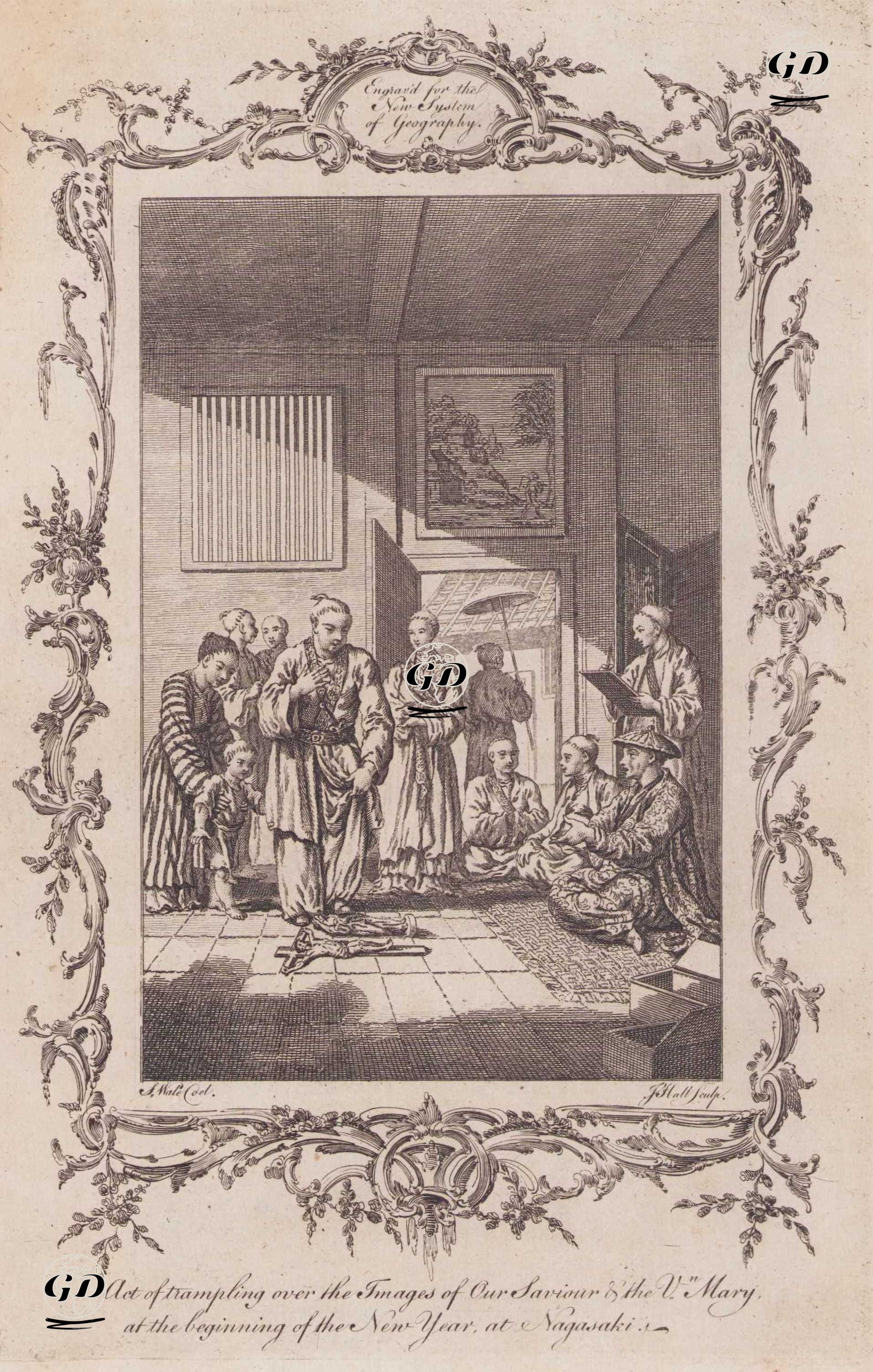
This engraving depicts a scene from the Edo Period (17th–19th centuries), when Christianity was banned in Japan. A Japanese man steps on a cross and Christian icons placed on the ground, while other figures in traditional dress stand around him as the ceremony's organizers. Officials and religious representatives in the background observe the scene with approval. This scene depicts a ritual called "fumie," practiced in Japan since the early 17th century. Fumie was a faith-testing ritual implemented during Japan's Edo Period (1603–1868) to suppress Christianity. Literally, it means "image stepped on." In this practice, a picture or bronze relief, usually of Jesus or the Virgin Mary, was placed on the ground, and suspected Christians were forced to step on it. If a person refused to trample the image, they were considered a secret Christian and were condemned to torture or death.The practice of fumie was particularly prevalent in regions where Western missionaries were active, such as Nagasaki. Therefore, this scene can be considered a symbolic representation of religious oppression policies in early modern Japan. In 18th-century Europe, such engravings were published to reinforce the idea of "eastern barbarism" and the "superiority of European civilization." Therefore, the scene conveys not only a historical event but also an Orientalist ideological discourse. The rococo decorative frame surrounding the engraving combines this dramatic content with an aesthetic of "elegant exoticism."