GRAVÜR DÜNYASI
Digital Engraving Library
| Artist | J.A.Houston (after Laborde) |
| Engraver | E.Radclyffe |
| Date | 1850`s |
| Technique | Steel Engraving |
| Category | Uncategorized |
| Source | Blackie & Son, Glasgow, Edinburgh & London |
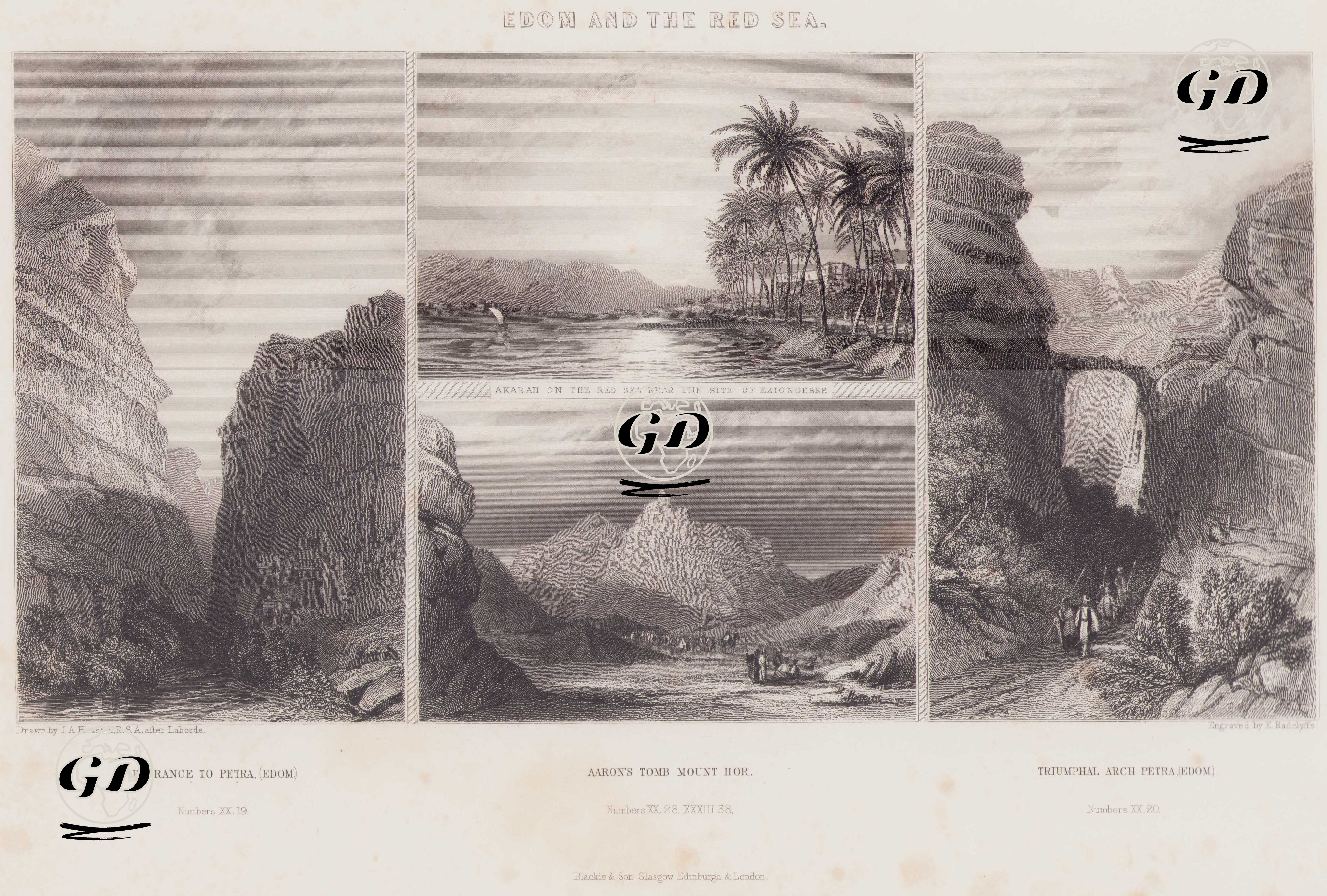
This engraving consists of four separate scenes depicting Edom and the Red Sea region, one of the most dramatic and symbolic regions of biblical geography. In the left scene, "Entrance to Petra (Edom)" depicts the moment of entry into the ancient city of Petra, located in present-day Jordan, through the narrow rock passage (Siq). This monumental façade, carved into the rock by the Nabataeans, is one of the engineering marvels of the ancient world and signifies Petra's central position on trade routes. In the right scene, "Triumphal Arch, Petra (Edom)" depicts a triumphal arch reflecting Roman architectural influences, revealing Petra's cultural interaction during the Hellenistic and Roman periods. The two central scenes hold both religious and geographical significance. In the upper scene, "Akabah on the Red Sea near the site of Eziongeber" depicts the Gulf of Aqaba at the northern end of the Red Sea and the surrounding palm-fringed coastline. It is located near Ezion-Geber, known as the port of King Solomon's fleet, and in ancient times, it served as a crossroads for trade routes between the Arabian Peninsula, Africa, and Palestine. "Aaron's Tomb, Mount Hor," located in the lower scene, depicts Mount Hor, believed to be the site of the tomb of Aaron, Moses' brother. This sacred mountain is located in the land of Edom, near Petra, and is considered a common pilgrimage site in Jewish, Christian, and Islamic traditions. The engraving reflects the 19th-century romantic concept of exploration of the Holy Land. The artist aimed to convey the spiritual dimension of the Biblical landscape by combining the majesty of the natural landscape with the historical traces of religious texts.