GRAVÜR DÜNYASI
Digital Engraving Library
| Artist | H. Warren -After Botta & Layard |
| Engraver | T.Fleming |
| Date | 1850`s |
| Technique | Steel Engraving |
| Category | Uncategorized |
| Source | Published by Blackie & Son, Glasgow, Edinburgh & London |
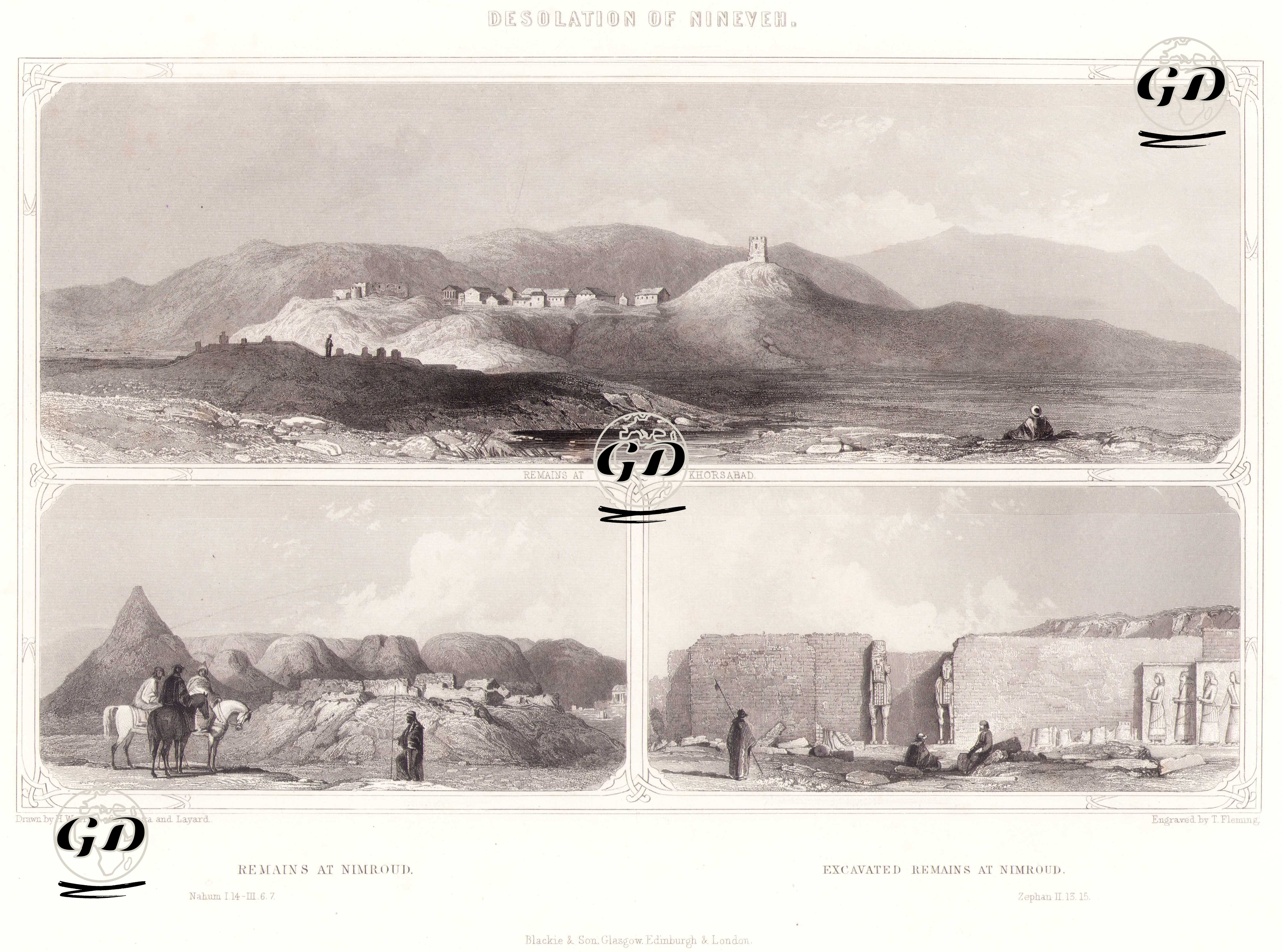
This engraving, titled "Desolation of Nineveh," provides a visual summary of Assyrian archaeological discoveries made in the mid-19th century. The ruins of Khorsabad, located near present-day Mosul, in the upper section depict the ruins of Dur-Sharrukin, the city built as a capital by King Sargon II. This scene shows ruined structures and fortifications located at the foothills of the mountains surrounding the Tigris River valley. The scene in the lower left, titled "Remains at Nimroud," depicts the ancient city of Kalhu and the early archaeological observations conducted there. Nimrud (ancient Kalhu) was a major administrative center of the Assyrian Empire. The engraving depicts the excavation site with mounted observers and archaeologists. The conical mound in the background indicates the city's main temple area. Inspired by Henry Layard's excavations in the 1840s, the "Excavated Remains at Nimrud" in the lower right corner is noteworthy for its relief-decorated walls, reflecting the grandeur of Assyrian palaces, and its colossal winged bull statues (Lamassu). The verse Zephaniah 2:13–15, added below the engraving, interprets the destruction of this ancient city within a sacred context, evoking a religious resonance with the phrase "God will devastate Nineveh like a desert." Overall, the engraving reflects the scientific and theological interest in Mesopotamia in Europe during the dawn of biblical archaeology.