GRAVÜR DÜNYASI
Digital Engraving Library
| Artist | Sebastian Munster (1489-1552) |
| Engraver | Georg Scharffenberg (1530-1607) |
| Date | 1628 |
| Technique | Wood Engraving |
| Category | Uncategorized |
| Source | Cosmographia Universalis, Omnium Orbis Terrarum Regionum et Insularum Veteribus cognitarum descripsit P. Sebastianus Munsterus. This translates to Universal Cosmography, Describing All the Regions and Islands of the World, Known to the Ancients, by P. Sebastian Munster |
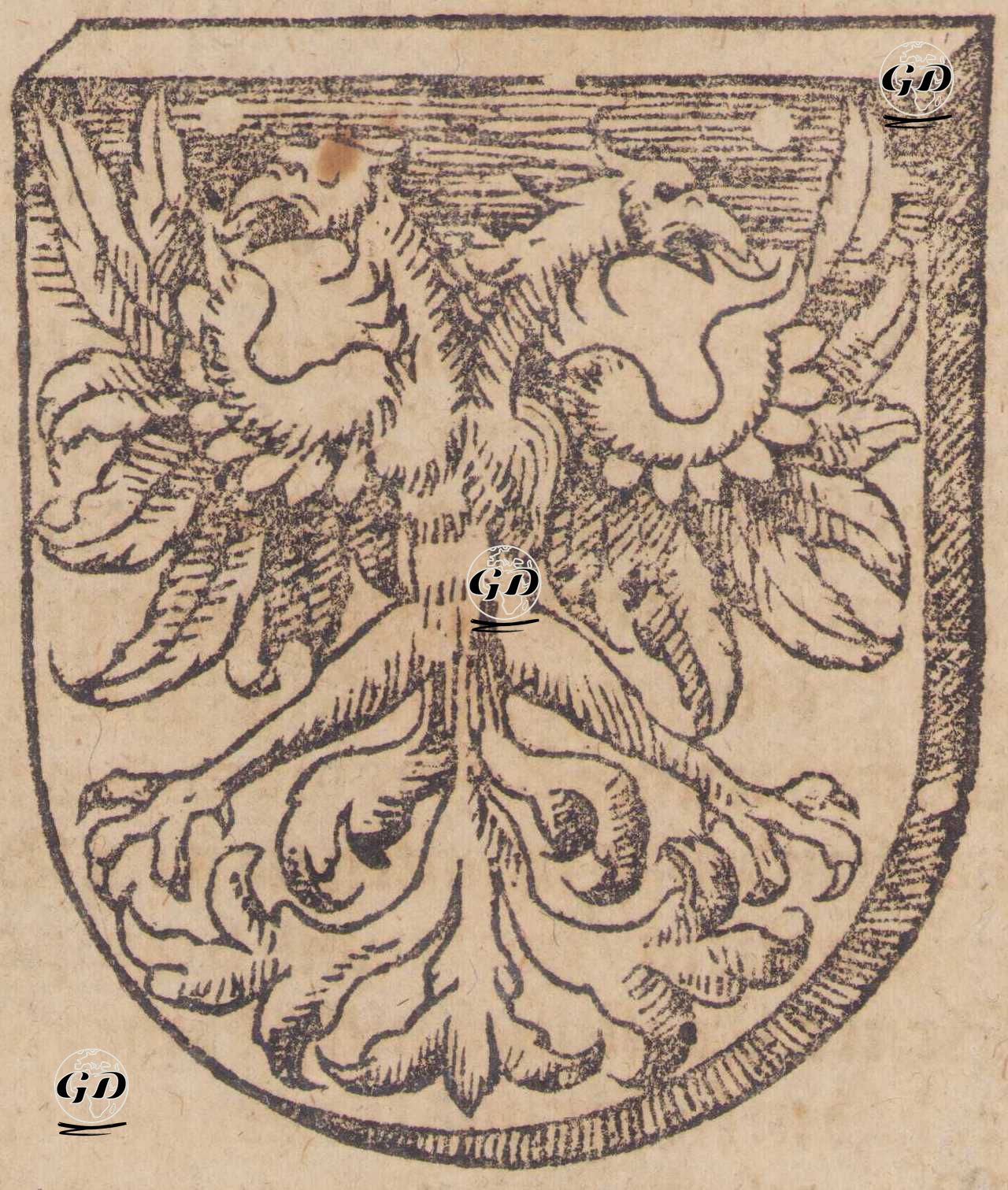
This woodcut depicts the Byzantine Imperial Coat of Arms, the double-headed eagle, frequently used in 16th-century early modern European history texts. The page containing the engraving appears alongside a full-figured portrait of Constantine XI Palaiologos (Konstantin Dragases) in the same work. This context demonstrates that the double-headed eagle was both a Byzantine dynastic symbol and an iconographic element signaling the political legitimacy of Constantine, who was considered the "last representative of the Roman Empire." The double-headed eagle became the imperial symbol of the Byzantine Empire, particularly during the Palaiologan Dynasty (1261–1453). The two heads, facing east and west, ideologically represented Rome's claim to sovereignty over both East and West, the concept of universalis imperium. In the engraving, the eagle's body is surrounded by powerful, broad wings, and its talons are prominent and aggressive. It's no coincidence that the coat of arms appears in the book, right next to the emperor's portrait. With this placement, the chroniclers intended to demonstrate the integration of Constantine XI's reign with the imperial symbol. This use is particularly relevant to the nostalgia for Byzantium in Europe in the 15th and 16th centuries, the remembrance of the "lost empire" through visual symbols. It's striking that this engraving doesn't exactly reflect the actual coat of arms of the Palaiologan Dynasty. For example, the tetragrammatic cross (four fire-steels) of the Palaiologan family crest, P-A-L-E, is absent. Instead, the artist places the double-headed eagle, the motif most strongly associated with Byzantium in Europe, at the center. This clearly demonstrates the characteristic of 16th-century chronicles, which often combined historical accuracy with symbolic representation on the same page. This engraving is therefore not only a depiction of the political symbol of Byzantium, but also reflects the way Western Europe still reproduced the Byzantine legacy as a cultural reference and a symbol of civilization, nearly a century after the conquest of Constantinople. This engraving appears in Sebastian Munster's Cosmographia Universalis..., first published in 1544. Over the years, the book has gone through numerous editions and revisions, becoming one of the most important works of geography and history of the 16th century. Containing a wealth of information on geography, cartography, natural history, and anthropology, the book has been widely used as a reference source by scientists, explorers, and cartographers for centuries. This engraving in our library was published in the 1628 edition of Sebastian Munster's Cosmographia Universalis...