GRAVÜR DÜNYASI
Digital Engraving Library
| Engraver | Augustin Francois Lemaitre (1797-1870) |
| Date | 1845 |
| Technique | Copper Engraving |
| Category | Uncategorized |
| Source | Palestine, Description Geographique, Historique et Archeologique par S.Munk, Firmin Didot Freres, Editeurs, Paris |
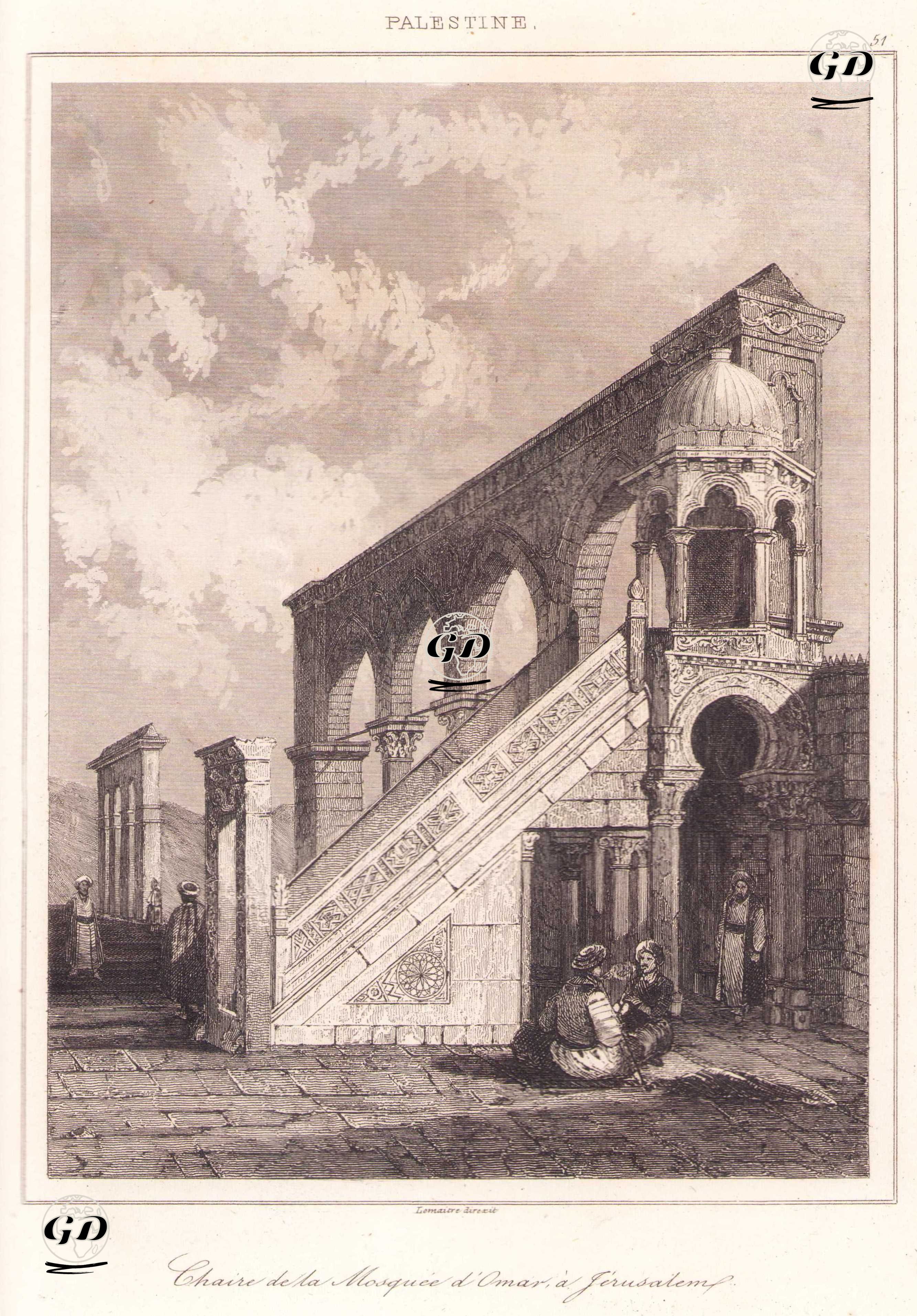
This engraving depicts the structure labeled "Munbar of the Mosque of Omar in Jerusalem." However, this designation, used by 18th- and 19th-century European travelers, reflects a historical tradition that associates the entire Haram al-Sharif with the Caliph Omar, not a single mosque in the modern sense. Therefore, the pulpit seen in the engraving does not directly belong to a mosque commissioned by Omar. It is an idealized depiction of one of the open-air sermon pulpits within the Haram al-Sharif. The architecture in the engraving clearly exhibits the stonework characteristics of the Mamluk period. Geometrically decorated stair railings, pointed arches resting on slender columns, ornamented passages, and the upper platform covered by a small dome reflect the characteristic lines of Jerusalem architecture from the 13th to 16th centuries. These open-air pulpits, unlike the pulpits inside mosques, are "sermon platforms" designed for use during Eid prayers, conquest anniversaries, rain prayers, Ramadan sermons, and large congregational gatherings. The curved staircase in the engraving leads to the domed "sermon pulpit" on the upper level, designed to be elevated so the imam could address a large congregation. The arched galleries and stone walls behind the pulpit hint at the spacious courtyard layout of the Holy Mosque, while the figures in the foreground reflect Muslim social life in 19th-century Jerusalem.