GRAVÜR DÜNYASI
Digital Engraving Library
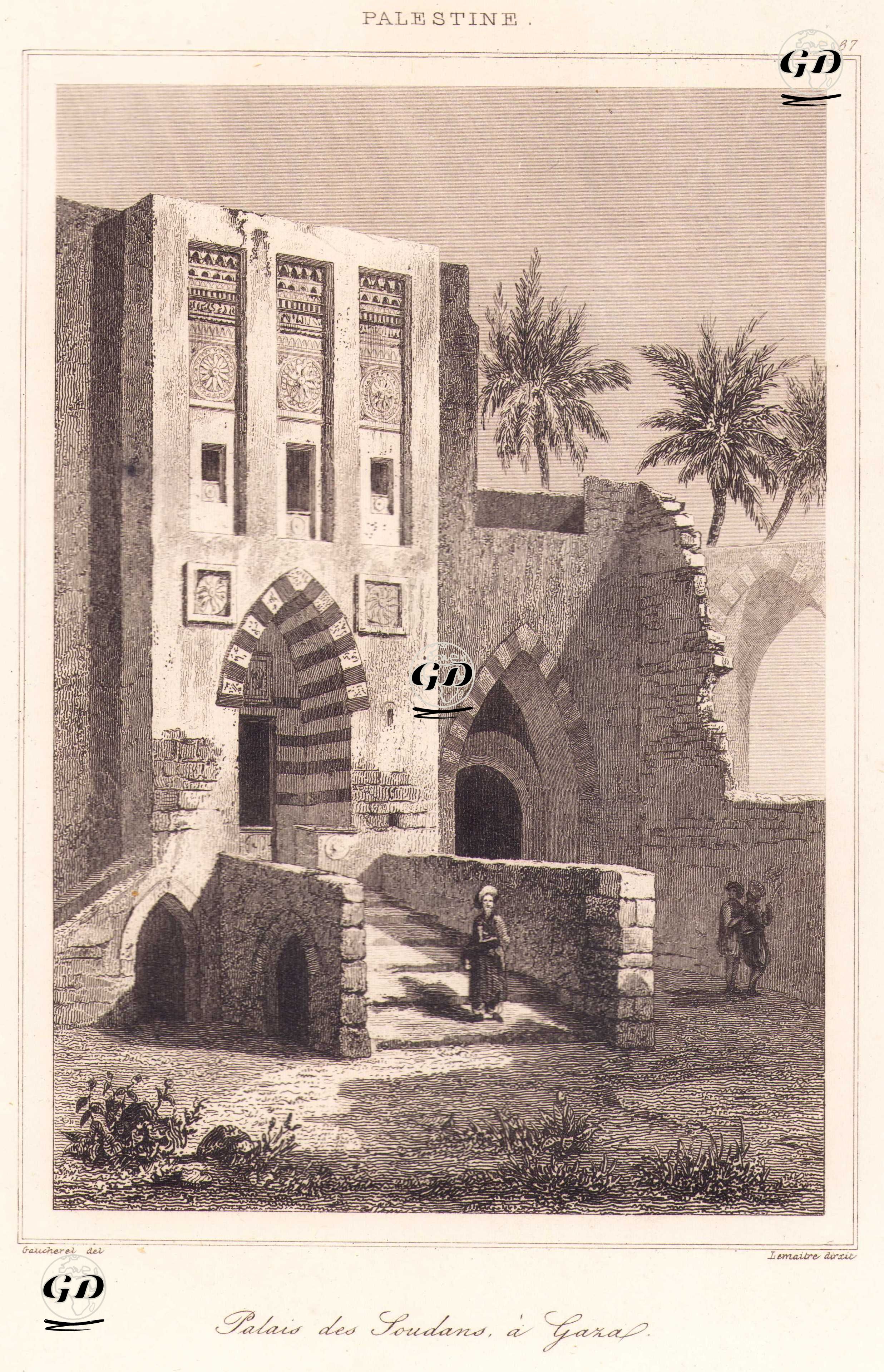
| Artist | Leon Gaucherel (1816-1886) |
| Engraver | Augustin Francois Lemaitre (1797-1870) |
| Date | 1845 |
| Technique | Copper Engraving |
| Category | Uncategorized |
| Source | Palestine, Description Geographique, Historique et Archeologique par S.Munk, Firmin Didot Freres, Editeurs, Paris |
This engraving depicts the Pasha's Palace (Qasr al-Basha). Located in the al-Daraj neighborhood of Gaza's Old City, the Pasha's Palace was one of the most important administrative structures built during the Mamluk period (13th century). Throughout history, the palace has been known by various names, including the Gaza Governor's Mansion, the Pasha's Palace, the Farussaade Palace, the Ridvan Palace, and the Napoleon Castle. It was a prominent structure representing Gaza's political and administrative status, particularly during the Mamluk and Ottoman periods. In the 20th century, the building was restored and converted into a museum, displaying hundreds of artifacts from the Greek, Roman, Byzantine, Mamluk, and Ottoman periods. During the heavy Israeli attacks on Gaza from late 2023 onward, particularly during the December 2023-January 2024 bombings, much of the Pasha's Palace was destroyed. In 2025, urgent interventions were undertaken to salvage the remaining Ottoman artifacts from the museum's collection. Today, the structure is almost completely destroyed. Therefore, the engraving represents not only an architectural piece but also a testimony to a lost cultural heritage and political memory. It also serves as a visual record documenting regional stylistic codes, such as the ablaq (two-colored stone) arch pattern, rosettes, and geometrically ornamented façade details characteristic of Mamluk architecture, as observed by 19th-century European travelers.