GRAVÜR DÜNYASI
Digital Engraving Library
| Engraver | Augustin Francois Lemaitre (1797-1870) |
| Date | 1845 |
| Technique | Copper Engraving |
| Category | Uncategorized |
| Source | Palestine, Description Geographique, Historique et Archeologique par S.Munk, Firmin Didot Freres, Editeurs, Paris |
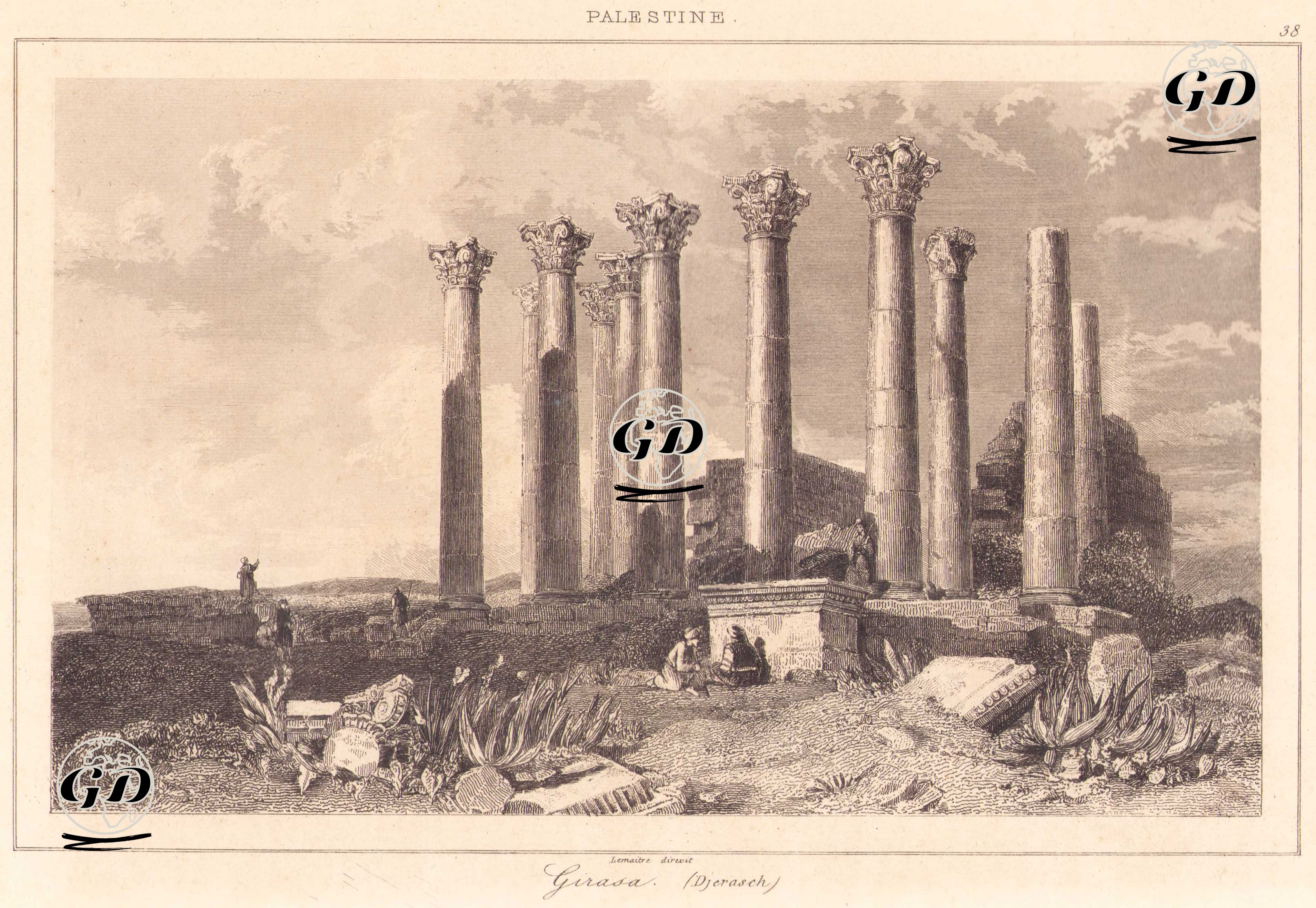
This engraving depicts the ruins of the Temple of Artemis at Jerash (ancient Gerasa), located approximately 50 km north of Amman, Jordan, and considered one of the best-preserved cities of the Roman period. While traces of settlement in the city date back to 7500 BC, the true founding of ancient Gerasa is attributed to the reign of Alexander the Great or his general Perdiccas in the 4th century BC. Under Roman rule, the city underwent significant development as one of the Decapolis (Ten Cities) union cities. The cult of Artemis reached its peak in the city, particularly in the 3rd century AD, and the temple complex became central to the city's religious identity. The columns with high Corinthian capitals seen in the engraving belong to the temple's front entrance (pronaos) and are the most characteristic elements reflecting the ancient structure's grandeur. The city suffered significant destruction in the earthquake of 749 AD and was abandoned for centuries. Following its rediscovery by German orientalist Ulrich Jasper Seetzen in 1806, Jerash became a major subject for 19th-century European travelers and engraving publications. Jerash is now known as the "Pompeii of the Middle East" and has been on the UNESCO World Heritage Tentative List since 2004, with its distinguished structures including Hadrian's Arch, Oval Plaza, Cardo Maximus, Nymphaeum, theaters, and hippodrome. Furthermore, this engraving clearly reflects the contemporary view of the Levant as a single historical basin under the heading "Palestine." Although Jerash (Gerasa) lies within the borders of present-day Jordan, its inclusion under the heading "Palestine" in publications is a typical example of 19th-century geographical and historical classification.