GRAVÜR DÜNYASI
Digital Engraving Library
| Engraver | Augustin Francois Lemaitre (1797-1870) |
| Date | 1845 |
| Technique | Copper Engraving |
| Category | Uncategorized |
| Source | Palestine, Description Geographique, Historique et Archeologique par S.Munk, Firmin Didot Freres, Editeurs, Paris |
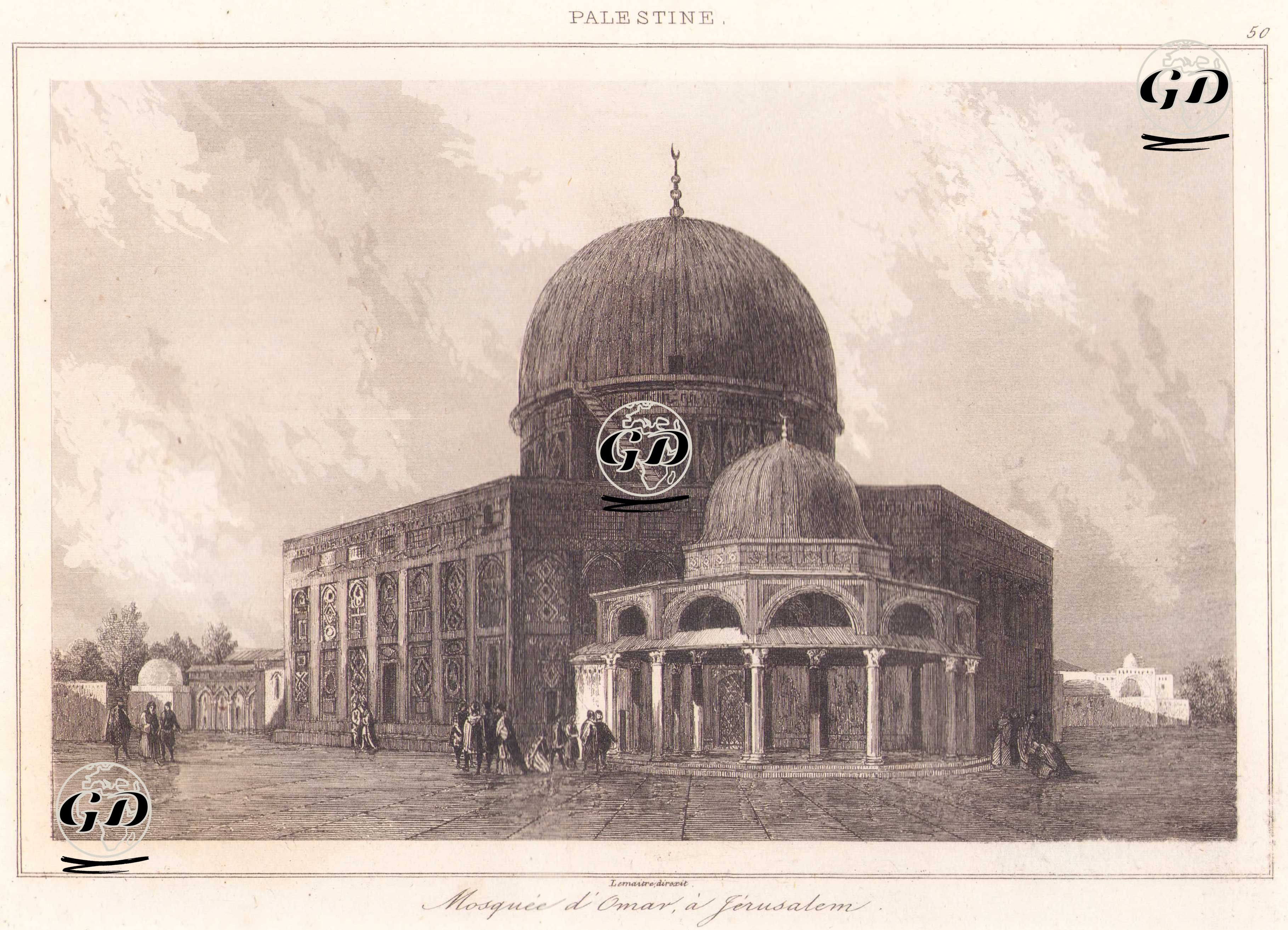
This engraving depicts the Dome of the Rock (Dome of the Rock or Stone), commonly known as the "Mosque of Omar" (Mosque of Omar), a term often used in 19th-century European publications. However, as it is known in modern academic terminology, this structure is not a "Mosque," but rather a domed sacred structure or sanctuary built by the Umayyad Caliph Abd al-Malik I on the Temple Mount in Jerusalem's Old City in the last quarter of the 7th century. The Dome of the Rock, which covers the sacred rock, a key reference point in Islamic cosmology, is considered one of the earliest and most striking examples of Islamic art, both architecturally and iconographically. The period in which the engraving was produced (mid-19th century) coincided with a period in which Western travelers' visual records of the Haram al-Sharif/Temple Mount complex in Jerusalem attracted considerable attention in Europe. However, at that time, the Dome of the Rock was still misnamed by most Europeans as the "Mosque of Omar". This misnomer is a typical manifestation of Orientalist discourse, which confuses the historical moment associated with Caliph Umar's peaceful conquest of Jerusalem in 638 with the structure's true historical identity. However, the structure's architectural details, particularly the geometric ornamentation of the exterior and the positioning of the side scenes, also provide important clues about the Dome of the Rock's appearance before its 19th-century restorations.