GRAVÜR DÜNYASI
Digital Engraving Library
| Artist | Paris Bordone (1500-1571) |
| Engraver | Friedrich John (1769-1843) |
| Date | 1827 |
| Technique | Mezzotint-Steel Engraving |
| Category | Uncategorized |
| Source | Published in the pocket book “Aglaja” by J. B. Wallishausser |
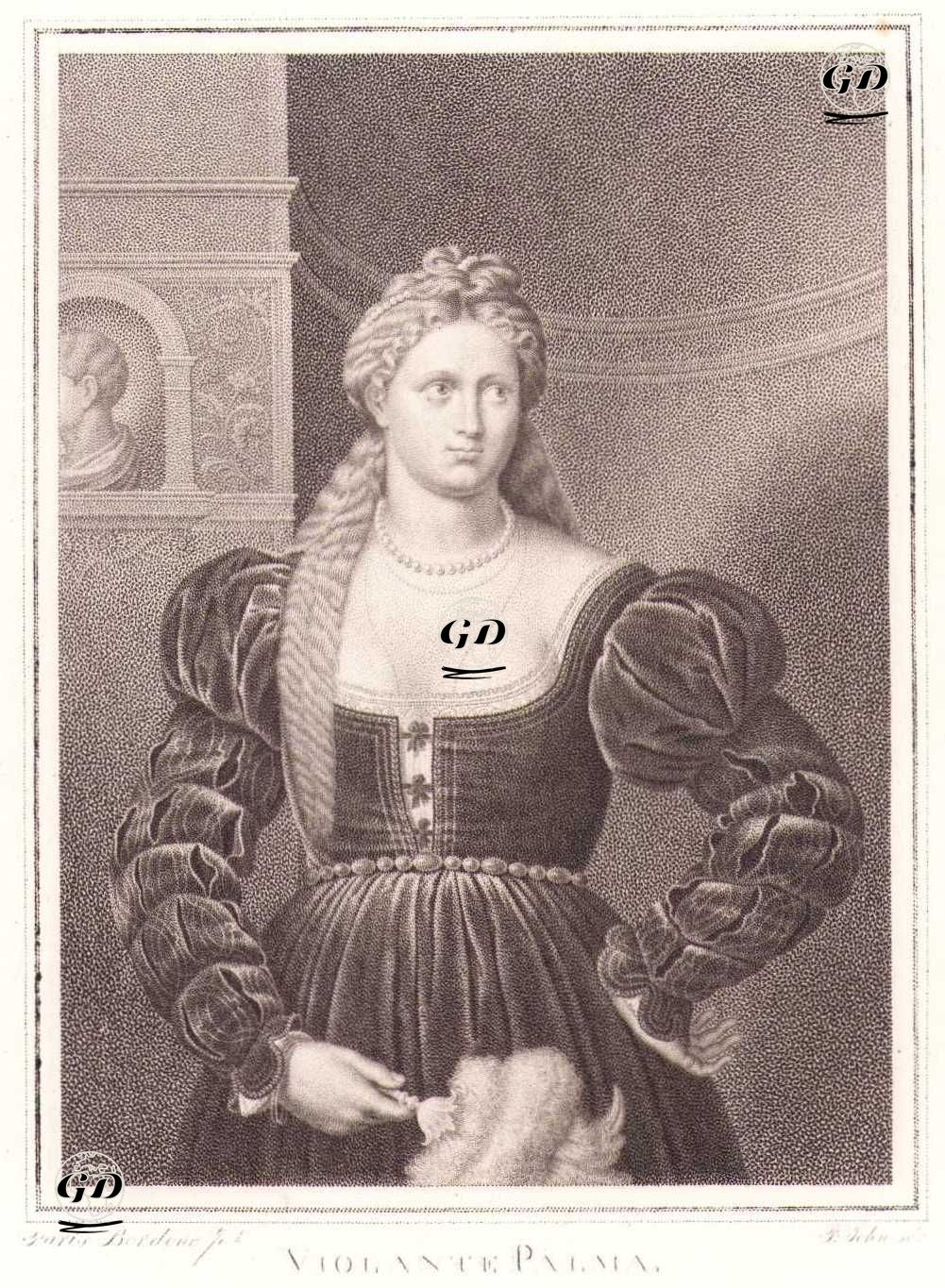
This engraving is based on the painting "Violante Palma," created in 1530 by Paris Bordone (1500-1571), one of the leading masters of the 16th-century Venetian Renaissance. Friedrich John (1769-1843), a leading 19th-century German engraver, reproduced the work using the mezzotint-steel engraving technique. Thus, the engraving is a work of art that combines both the elegant figurative style of Renaissance painting and the technical precision of the 19th century. The figure in the original painting is Violante Palma, daughter of the Venetian painter Palma il Vecchio (1480-1528). This name became a symbol of feminine elegance in 16th-century Venetian portraiture. The woman in the portrait is rendered with the soft color transitions and calm light atmosphere characteristic of Bordone's style. Friedrich John’s engraving adaptation reinterpreted this sensual finesse with tonal depth and linear elegance. The female figure, with her puff-sleeved dark velvet dress, pearl necklace, and braided long hair, embodies the ideal of female beauty during the Renaissance. The calmness of her posture, the measured expression on her face, and the feathered fan in her hand suggest both an inner elegance and social nobility. Technically, the engraving reflects Friedrich John's characteristic style: fine linear treatment, textural precision, and the gradual diffusion of light. This approach successfully brought the "sfumato" influence of Renaissance painting to the language of engraving.