GRAVÜR DÜNYASI
Digital Engraving Library
| Artist | D.Roberts (after Rev. R.Master) |
| Engraver | W.Finden |
| Date | 1850`s |
| Technique | Steel Engraving |
| Category | Uncategorized |
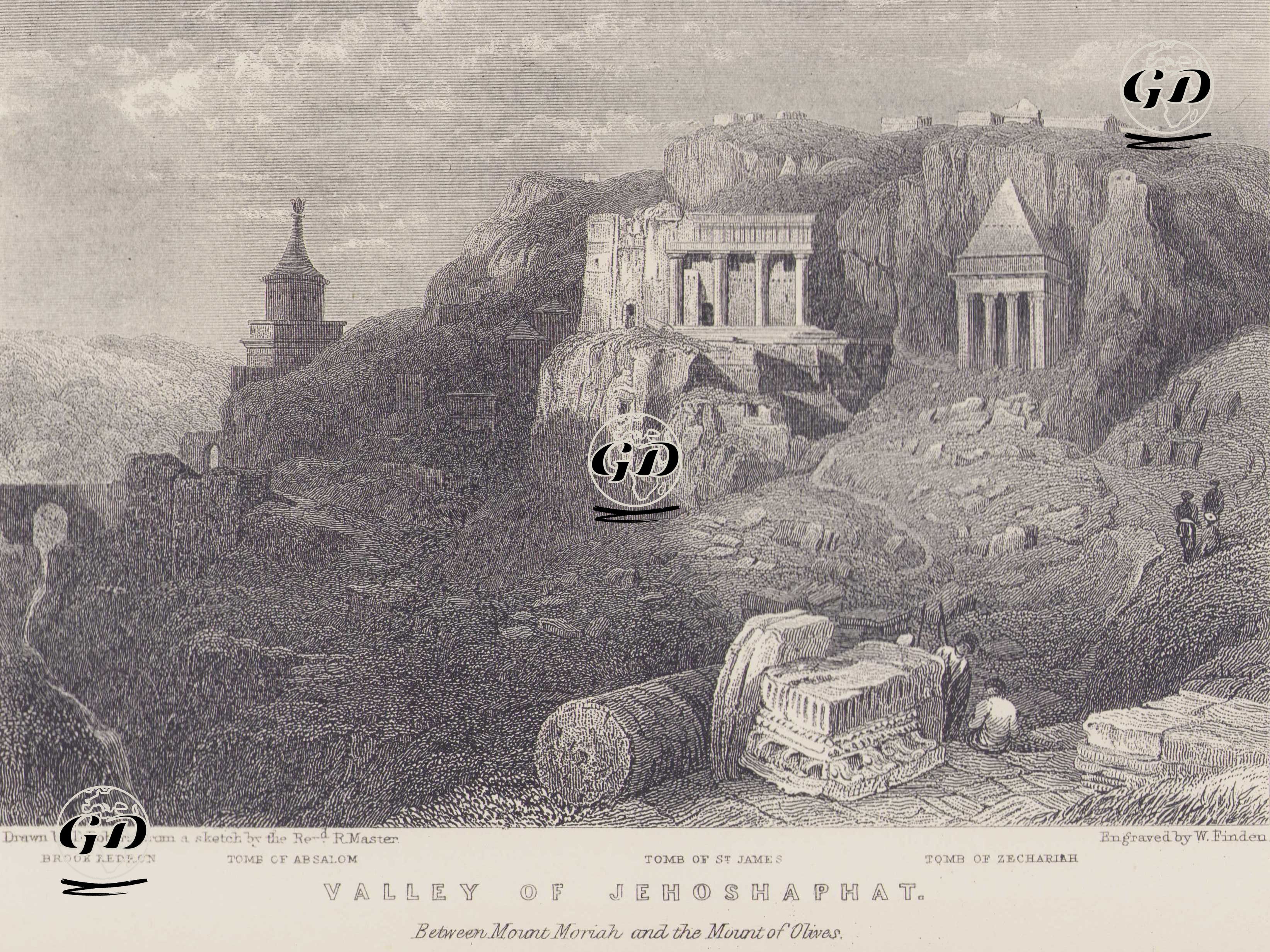
This engraving depicts in detail the sacred Valley of Jehoshaphat (Kidron), located east of Jerusalem, and the ancient rock tombs within. The structures identified by the artist in the lower part of the engraving (Brook Kedron, the Tomb of Absalom, the Tomb of St. James, and the Tomb of Zechariah) form the historical and topographical center of this scene. Lying on the left side of the valley, Brook Kedron is a natural watercourse bordering Old Jerusalem to the east. It is a sacred site frequently mentioned in the Bible and used throughout history as both a ritual purification and burial site. This natural line is one of the three main valleys that define Jerusalem's sacred topography and forms the boundary between the Temple Mount on Mount Moriah and the Mount of Olives. In the engraving, this stream is used as a dramatic element, emphasizing the depth of the valley with a chiaroscuro effect. Just above the stream is the Tomb of Absalom, which attracts attention with its dome. According to Jewish tradition, this monument, attributed to King David's son Absalom, is actually a Hellenistic-Roman rock-cut tomb dating to the 1st century BC. Greek-style pilasters, Doric columns, and a pyramidal roof form represent a unique synthesis of Judeo-Hellenistic architecture. In the engraving, the Absalom Monument is positioned as a visual focal point at the entrance to the valley, reinforcing both its religious and artistic symbolism. The Tomb of St. James, located in the center, is attributed to James, one of Jesus' apostles, in early Christian tradition. Archaeologically, this structure is a rock-cut tomb carved during the Hellenistic period and described as a sacred pilgrimage site in late Byzantine and Crusader sources. The columnar façade in the engraving evokes classical temple architecture. The artist has depicted this structure in a way that combines the aesthetics of Jerusalem's ancient city with its sacred heritage.