GRAVÜR DÜNYASI
Digital Engraving Library
| Artist | H. Warren (from sketches J.Bonomi) |
| Engraver | E.Radclyffe |
| Date | 1850`s |
| Technique | Steel Engraving |
| Category | Uncategorized |
| Source | Blackie & Son, Glasgow, Edinburgh & London |
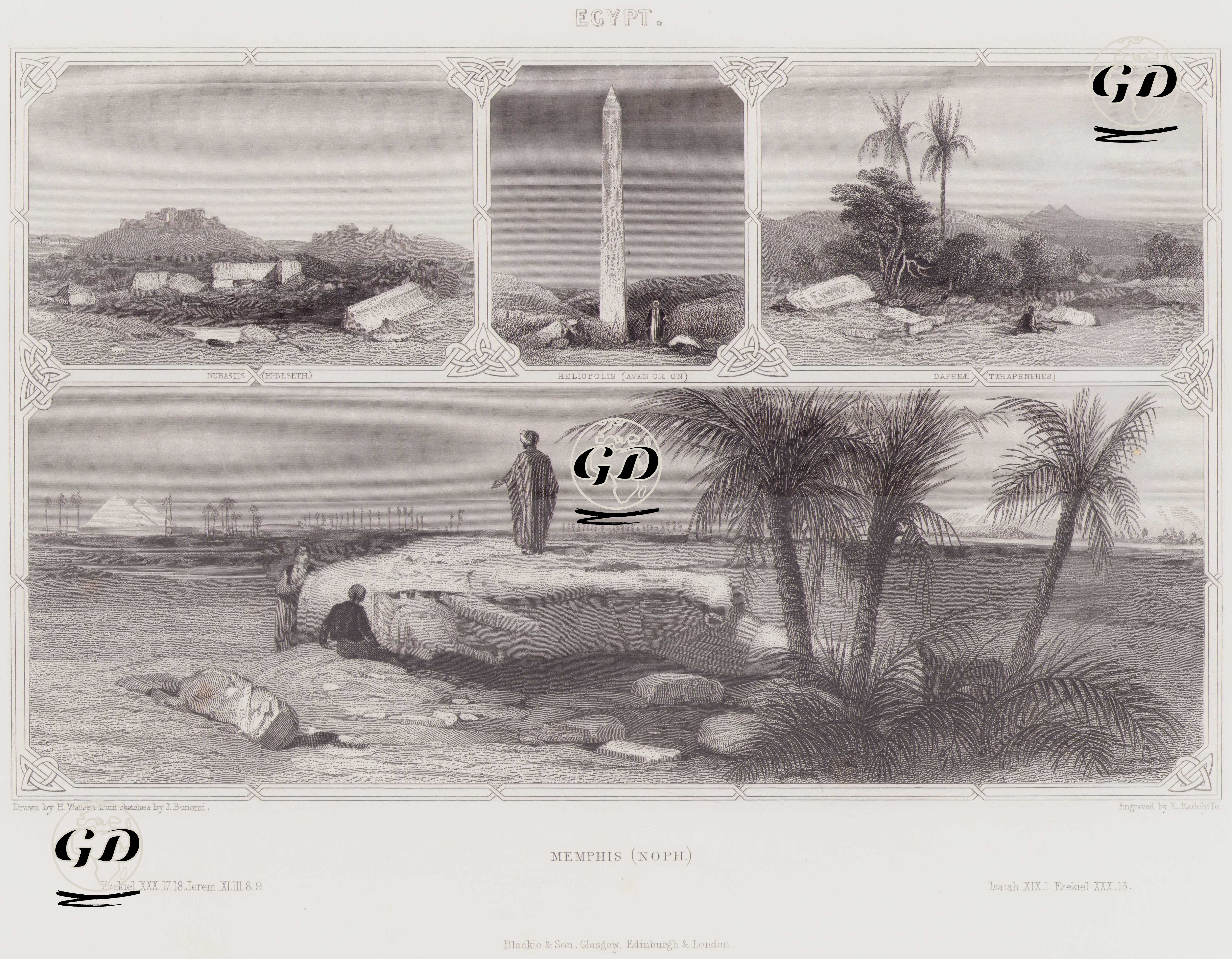
This multilayered and historically rich engraving is an archaeological panorama that visually documents, along with biblical references, the most important sacred and historical cities of Ancient Egypt: Bubastis, Heliopolis, Daphne (Tahpanhes), and Memphis (Noph). The quotations at the bottom of the engraving, "Ezekiel XXX.17–18, Jeremiah XLIII.8–9, Isaiah XIX.1," refer to the biblical prophecies of destruction for these cities and are crafted in accordance with the 19th-century tradition of sacred geography. The scenes in the upper section, from left to right, depict Bubastis (Pbeseth), Heliopolis (Aten/On), and Daphne (Tahpanhes). Bubastis represents the sacred city dedicated to the goddess Bastet at the site of Tell Basta, near present-day Zagazig. As the cult center of Bastet, the patron goddess of cats, fertility, music, and the home, Bubastis served as the capital of ancient Egypt during the 22nd Dynasty (10th–9th centuries BC), particularly during the reign of Pharaoh Shoshenq I, and became one of the religious centers of ancient Egypt. The Heliopolis (Aten or On) scene in the central panel depicts one of ancient Egypt's oldest and most sacred cities. Heliopolis, the cult center of the Sun God Ra, became the heart of cosmogonic thought and astronomical knowledge from the 3rd millennium BC onward. The towering obelisk depicted in the engraving reflects the tradition of the benben stone, which symbolized the sacred light of the Sun. One of these obelisks still stands today in the Matariya district of Cairo and is considered the sole physical witness to the legacy of ancient Egypt's solar cult. The city, referred to as "On" in the Bible, was a significant religious center during the time of Moses. The Daphne (Tahpanhes) scene in the upper right represents the Tell Defenneh region, between Egypt's eastern delta and the Suez Canal. The city was founded as a Greek mercenary garrison by Pharaoh Psammetichus I during the 26th Dynasty in the 7th–6th centuries BC, making it one of the first settlements to experience Greek influence in Egypt. In the Bible, Tahpanhes is also mentioned as the city where the Jews took refuge with the Prophet Jeremiah, escaping from the Babylonian invasion. The Memphis (Noph) scene in the lower section is the most comprehensive representation at the center of the engraving. Considered the first capital of Egypt, Memphis was founded, according to legend, by King Menes (Narmer) and, as the cult center of the god Ptah, formed the administrative, religious, and cultural heart of Egypt. Located on the west bank of the Nile, approximately 20 km south of present-day Cairo, the city, with its strategic location connecting Upper and Lower Egypt, was renowned during the Old Kingdom for its large temple complexes built in honor of Ptah, the patron god of craftsmen, sculptors, and architects. The ruined statue remains seen in the engraving are reminiscent of a portion of the colossal colossus of Ramses II. The pyramids and date palms in the background allude to the presence of the Giza and Saqqara necropolises surrounding Memphis, and this landscape juxtaposes the "immortal stone heritage" of Egyptian civilization with the continuity of nature. Feedback