GRAVÜR DÜNYASI
Digital Engraving Library
| Artist | Gerrit Van Honthorst(1592-1656) |
| Engraver | Albert Henry Payne (1812-1902) |
| Date | 1850's |
| Technique | Steel Engraving |
| Category | Religion |
| Source | Published For The Proprietors By A.H.Payne, Dresden & Leipzig |
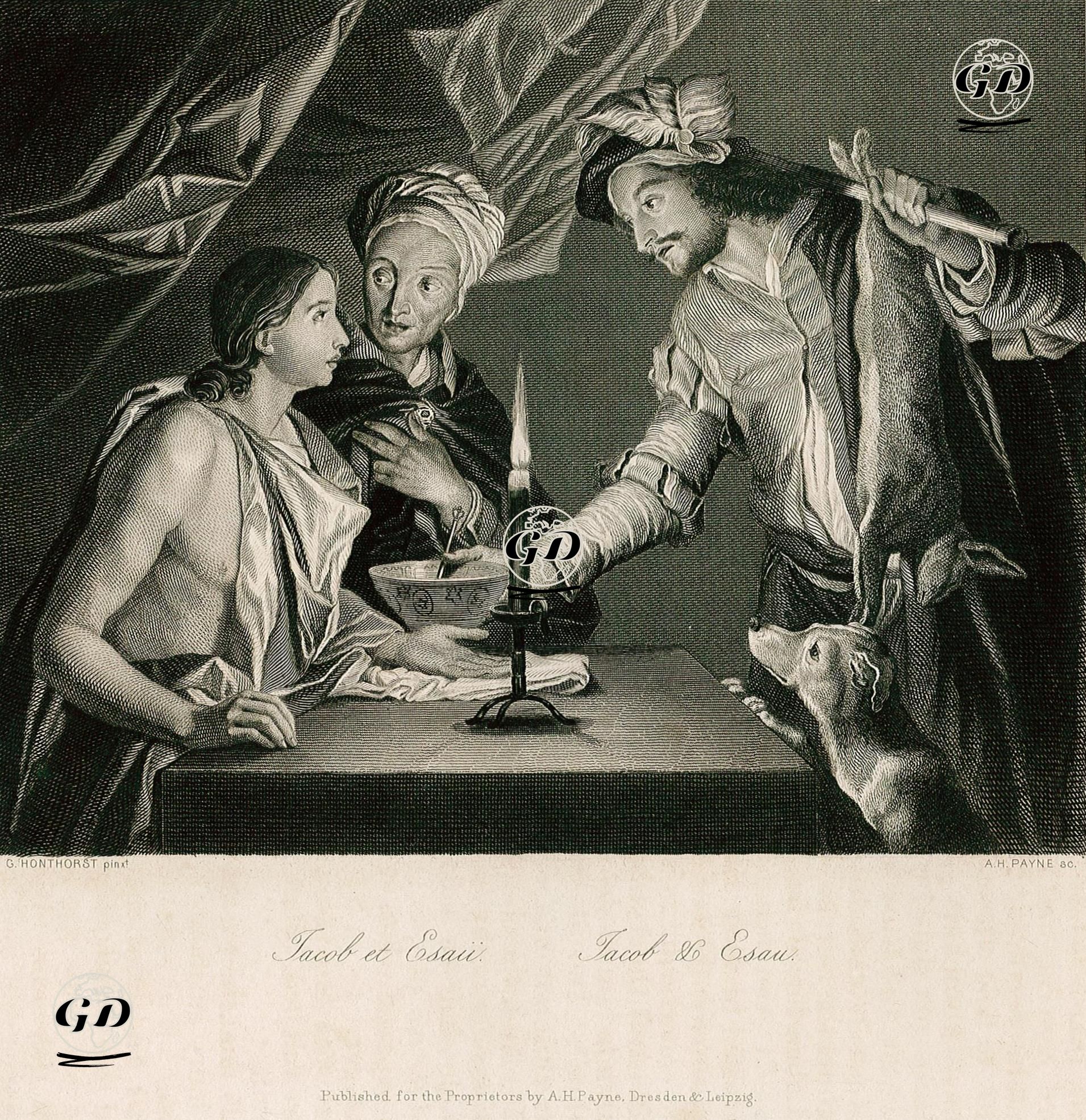
This engraving depicts a scene depicting Jacob receiving his birthright from his brother Esau in exchange for a bowl of soup. This narrative is based on verses 29-34 of Genesis, chapter 25, of the Old Testament. Jacob and Esau were the twin sons of Isaac and Rebekah. Isaac was Abraham's son, and thus these two brothers were the third generation to continue Abraham's lineage. Esau was the firstborn. He was born reddish and hairy. He is depicted as physically strong, a hunter, and close to nature. Jacob, on the other hand, is described as a domestic, intelligent, and strategic character, closer to his mother, Rebekah. At the time of their birth, Jacob is described as holding Esau's heel. This detail is interpreted as a sign that Jacob was naturally "grasping" and would later claim his brother's right. In Old Testament culture, the concept of birthright holds profound significance. The firstborn son receives most of his father's inheritance (usually two-thirds). After the father's death, spiritual and social leadership within the family usually passes to the firstborn. Most importantly, the right to share in God's promise and to continue the chosen people is often granted to the firstborn. In the engraving, Jacob hands Esau a bowl of soup while their mother, Rebekah, observes the scene intently in the background. Her expression seems to sense the grand plan behind this exchange and guide her son accordingly. Esau, fresh from hunting, readily abandons a spiritual right to satisfy his hunger, symbolizing worldly desires. Jacob, on the other hand, is the introverted, calculating figure, more in tune with God's plan.