GRAVÜR DÜNYASI
Digital Engraving Library
| Artist | J.Clark |
| Engraver | James Charles Armytage ( ….-1897) |
| Date | 1863 |
| Technique | Steel Engraving |
| Category | Religion |
| Source | The Art Journal |
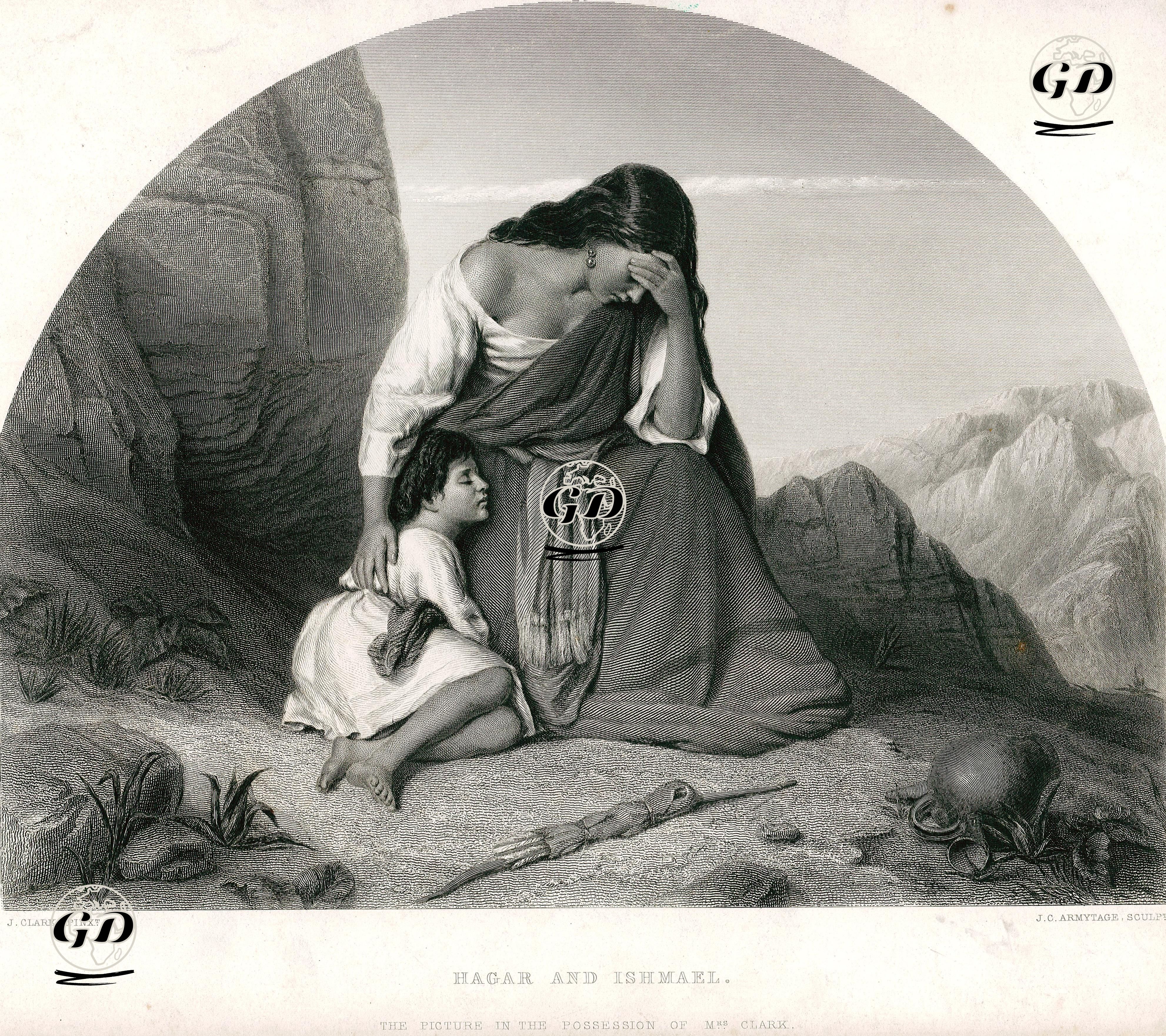
This engraving depicts the scene of Hagar and her son Ishmael's abandonment in the desert, recounted in verses 14-21 of Genesis, chapter 21, of the Old Testament. In the image, a distraught Hagar takes refuge under the shade of a rock, while her young son Ishmael, who has collapsed from thirst, prays to God beside her. Hagar's inability to look directly at her son symbolizes both her helplessness and her submission to God. This composition depicts not only the feeling of being lost in a physical desert, but also a spiritual desert where divine providence and mercy are tested. Details such as Hagar's exhausted body, her collapse, and her hands clasped over her head further emphasize the ancient text's statement that "God heard the child's voice." This narrative, which is also included in the Holy Quran, has deep symbolic meanings in Islamic belief, with Ishmael writhing with thirst and Hajar running seven times between the hills of Safa and Marwa in search of water. Ultimately, God answers Hagar's prayers, and with the miraculous gush of Zamzam water to the earth, both biological and spiritual salvation takes place. Therefore, this engraving symbolizes not only a mother's suffering, but also the sublimity of divine forgiveness, submission, and patience hidden in the depths of destiny. Hagar's bowed posture embodies a human humility in the face of divine providence, while young Ishmael's refuge in his mother conveys the visual expression of innocence and a yearning for protection.