GRAVÜR DÜNYASI
Digital Engraving Library
| Artist | William Hamilton (1751-1801) |
| Engraver | Robert Wallis (1794-1878) |
| Date | 1830's |
| Technique | Steel Engraving |
| Category | Religion |
| Source | The London Printing And Publishing Company |
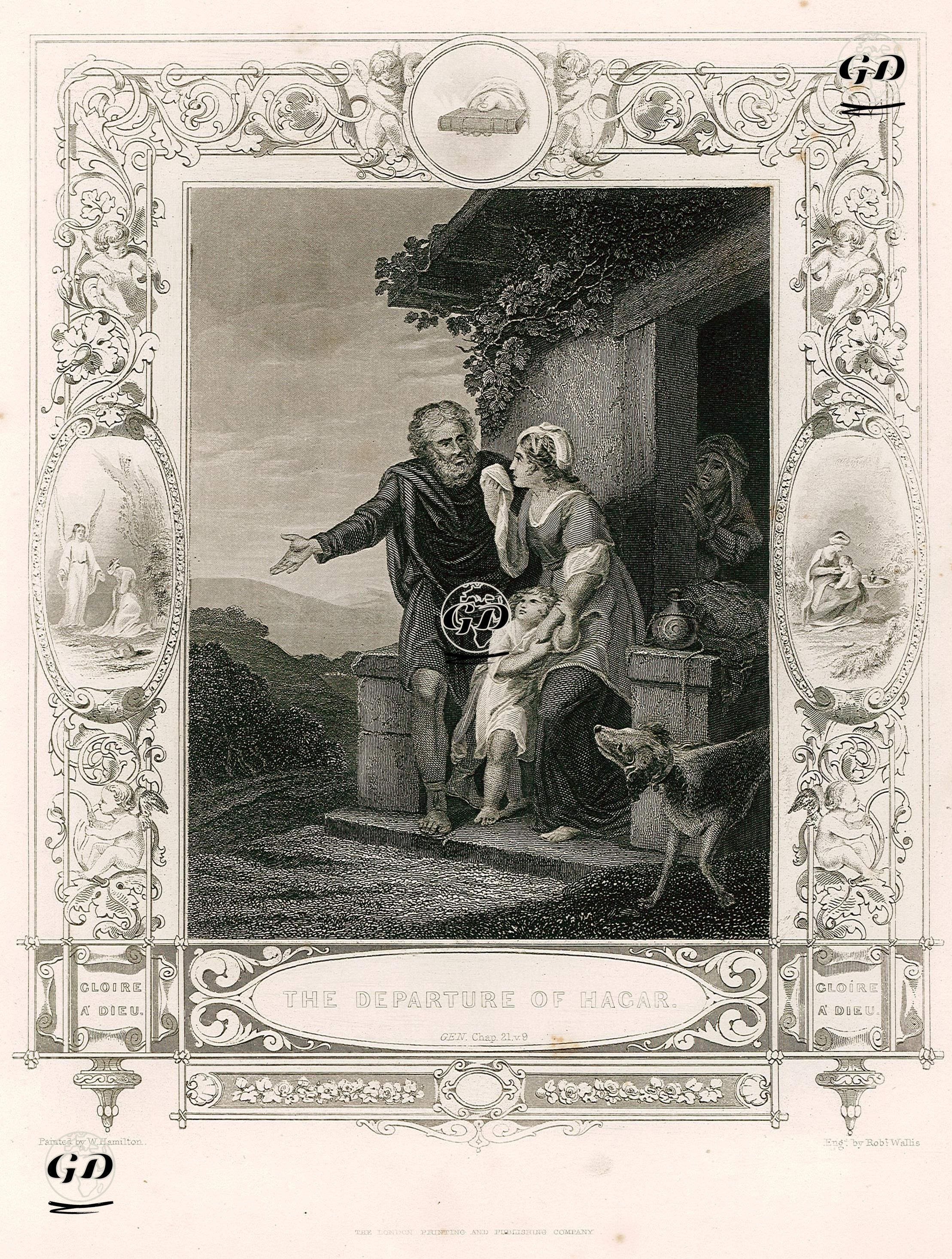
This engraving depicts the scene of the expulsion of Hagar and her son Ishmael from their home, described in verses 9-14 of the Book of Genesis, chapter 21, of the Old Testament. When Abraham's wife, Sarai, became jealous of his son Ishmael, born to his Egyptian slave Hagar, Abraham, with God's approval, expelled Hagar and Ishmael from their home. The gesture Abraham makes with his hand in the engraving reflects both the inner pain of obeying God's command and a kind of divine reliance on Hagar. This gesture also suggests that Hagar's fate is no longer in her own hands, but in God's. Hagar is depicted as a barefoot, tearful mother, embracing her child. Hagar's departure is not merely a physical separation, but a symbol of social exclusion and exile to an unknown future. This scene symbolizes not only a family drama but also submission to God's will, the fragile position of women, and the absolute influence of the celestial order over humanity. It also points to the fateful separation of Isaac and Ishmael. Through this separation, Isaac will become the ancestor of the Israelites, and Ishmael the ancestor of the Arabs. Another striking element of the engraving's religious iconography is the miniature scenes in the carved frame surrounding the scene. On the right, the angel appears to Hagar, and on the left, Hagar and her son find water in the desert. These details embody textual narratives such as God telling Hagar, "Do not fear," and showing her a well, and the promise that Ishmael will become the ancestor of a great nation.