GRAVÜR DÜNYASI
Digital Engraving Library
| Artist | Anthony Van Dyck (1599-1641) |
| Engraver | William French (1815-1898) |
| Date | 1840's |
| Technique | Etching-Mezzotint-Original Hand Colored |
| Category | Religion |
| Source | The Holy Bible containing the Old and New Testaments, The Rev H. Philip & The Rev J. Brown-Printed And Published By A.H.Payne, Leipzig & Dresden -James Hagger, Paternoster Row, London |
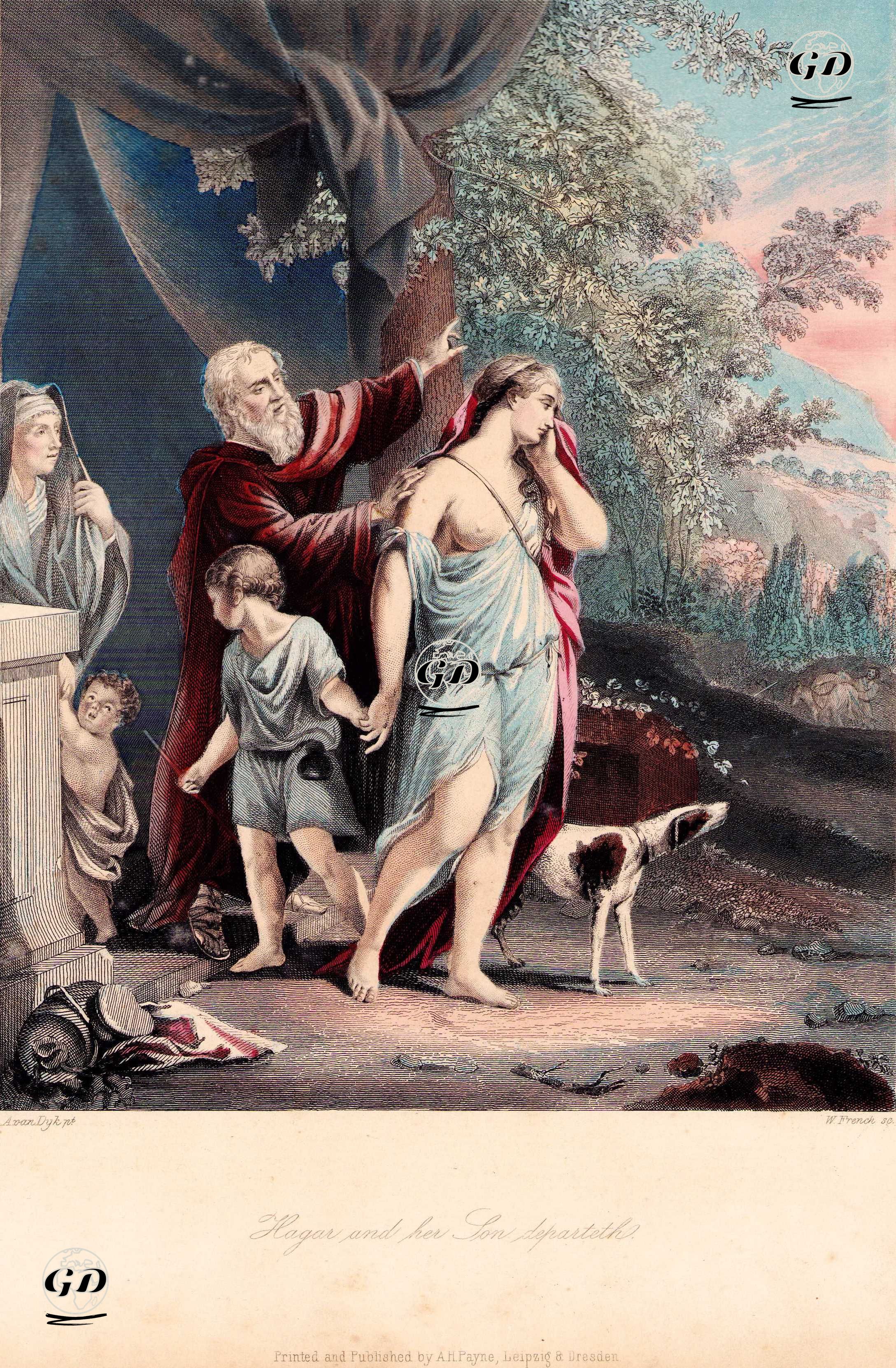
This engraving depicts the scene of the expulsion of Hagar and her son Ishmael from their home, described in verses 9-14 of the Book of Genesis, Chapter 21, of the Old Testament. Abraham's wife, Sarai, became jealous of his son Ishmael, born to his Egyptian slave Hagar. With God's approval, Abraham expelled Hagar and Ishmael from their home. The engraving depicts an old and sorrowful Abraham touching Hagar's shoulder to bid her farewell. Hagar is depicted as a barefoot mother, her face turned anxiously back, holding her child in her arms. Just in front of them, the child Ishmael turns to his father, as if to hold on to his hand, but is forced to leave by his mother. The composition is dominated by heavy curtains and natural elements in the background, while the emotional intensity of the scene is emphasized through the use of dramatic lighting. Abraham's statement reflects an inner conflict not only as a father but also as a prophet who submits to God's command. The garment wrapped around Hagar's half-naked body and her dramatic pose represent a mother's helplessness and the uncertainty surrounding the future. This scene symbolizes not only family drama but also submission to God's will, the fragile position of women, and the absolute influence of the celestial order on humanity. It also points to the fateful separation between Isaac and Ishmael. Through this separation, Isaac will become the ancestor of the Israelites, while Ishmael will become the ancestor of the Arabs.