GRAVÜR DÜNYASI
Digital Engraving Library
| Artist | Marie Gabriel Florent Auguste de Choiseul Gouffier (1752-1817) |
| Engraver | J.Perrier |
| Date | 1776 |
| Technique | Copper Engraving |
| Category | Maps |
| Source | Voyage Pittoresque De La Grece |
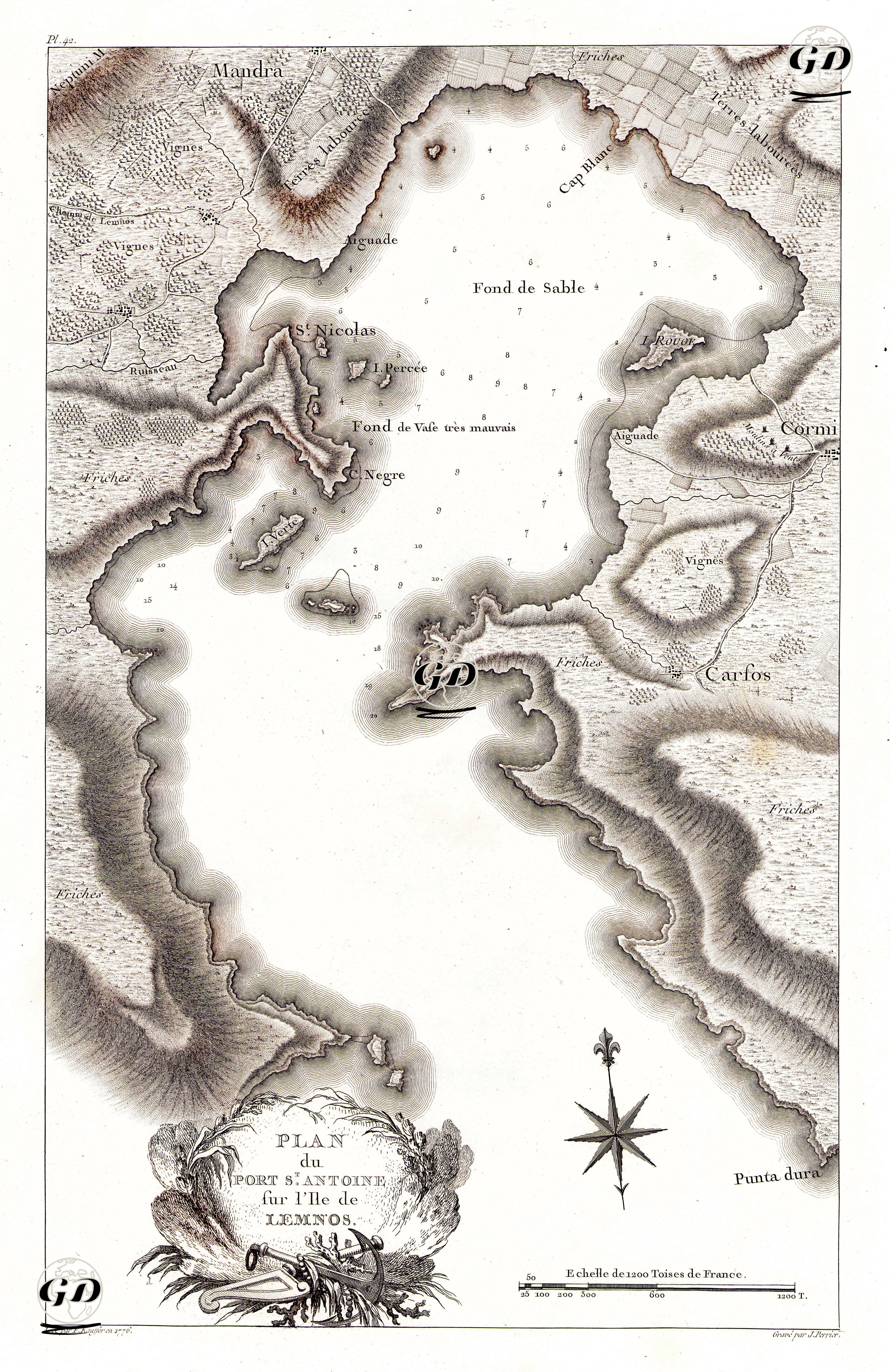
This engraving, titled "Plan du Port S. Antoine sur l’ile de Lemnos" (Plan of the Port of St. Antoine on the Island of Lemnos), shows in detail the important natural harbor area on the island of Lemnos, located in the Aegean Sea off the coast of northeastern Greece. The 1776 map was prepared in French. A decorative title cartouche decorated with nautical symbols appears in the lower left corner of the engraving, and a scale in French toises (toises de France) is given in the lower margin. Among the notable place names and geographical features on the map are the following: coastal points such as Cap Blanc (White Cape) and Cap Negre (Black Cape) around the harbor; and settlements and localities such as Cornil, Carfos, Mundra, Aiguade, and St. Nicolas in the interior. In the middle of the harbour, the phrase Fond de Sable (sand bottom) indicates that the sea bottom is soft sand, while the phrase Fond de Vase tres mauvais (very bad clay bottom) indicates dangerous or risky areas for ship anchoring. Such bathymetric marks provide navigational information regarding harbor use. Numerical depth measurements (probably in meters or toises) provide a layer-by-layer representation of the harbor's depth. The map also includes small islets such as Ile Percee, promontories such as Punta Dura, and land use designations such as "Vignes" (vineyards) and "Friches" (uncultivated lands). Port Saint Antoine, considered a natural harbor of high military and strategic importance, was a naval stopover actively used during the Ottoman Empire.