GRAVÜR DÜNYASI
Digital Engraving Library
| Artist | Charles V.Monin (Active 1830-1870)- Christian Gottlieb Reichard (1758-1837) |
| Date | 1839 |
| Technique | Copper Engraving-Original Hand Colored |
| Category | Maps |
| Source | Atlas Classique De La Geographie Ancienn Du Moyen Age Et Moderne, A l'Usage Des Colleges Et Des Pensions, Pour Servir A L'Etude De La Geographie Et De L'Histoire |
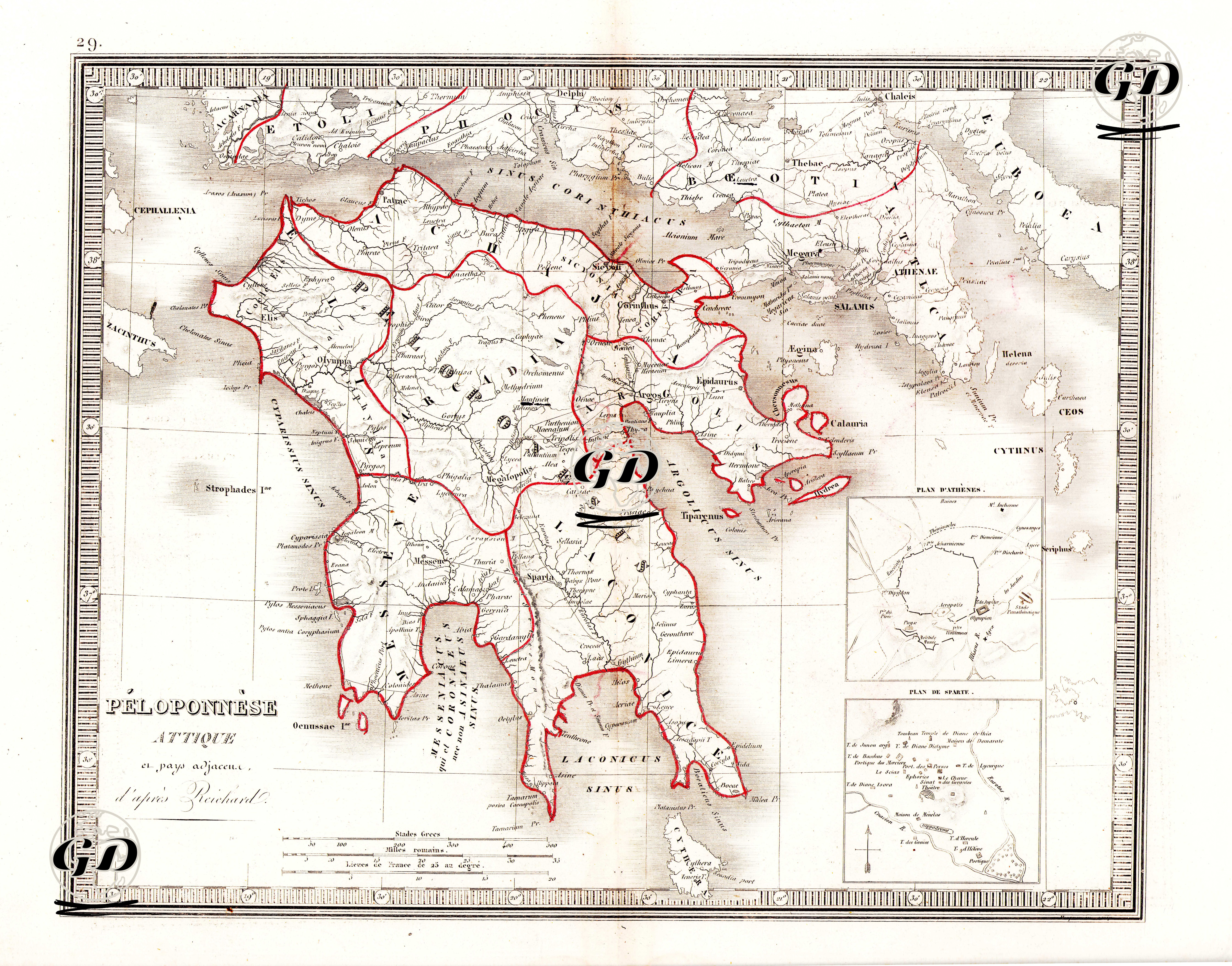
This ancient map, dated 1839 and titled "Peloponnese et Attica," shows in detail the Peloponnesian Peninsula, which constitutes southern Greece, and Attica in the northeast. The red lines on the map correspond to the regions based on city-states (polises) in ancient Greece, unlike modern administrative units. One of these regions, Laconia, is home to the famous city of Sparta and was the main settlement of the Spartans. It was known for its military discipline, austere lifestyle, and hierarchical social order. Located just west of Laconia, Messenie is known for its rich plains and fertile lands. Messenia was occupied by Sparta, and its people were kept in helot (semi-slave) status for a long time. However, in the 4th century BC, with the help of Epaminondas, it was liberated, and the new city of Messene was founded. Argolide, represented by the city of Argos, was prominent in the Greek world for both its military establishment and its architectural and artistic production. The western region of Elide (Elis), identified with Olympia, the birthplace of the sacred Olympic Games, became a religious and sporting center with its Temple of Zeus and sports complexes. Arcadia, located in the peninsula's mountainous interior, is a pastoral region steeped in legends. Famous for its rural life and shepherds, Arcadia also means "utopia" in literature. It was inhabited by independent, mountainous tribes. Achaea, in the north, was home to the Achaean League, a significant confederation before the Roman Empire, and was noted for its collective defense and shared governance model. Corinthia, meanwhile, centers on the strategically important city of Korinth, with its land and naval power. Founded at the intersection of trade routes, it became one of the leading maritime centers of the ancient world. Attique, located in the northeast of the map, is particularly identified with Athens and represents the pinnacle of Greek culture in democracy, philosophy, art, and architecture. The map also provides information about the topographical layout of important ancient cities such as Sparta and Patras by presenting their plans as insets (small additional maps) in the lower corners. This work by Christian Gottlieb Reichard is a cartographic document that provides a detailed map of not only the boundaries of classical-era cities but also the political, cultural, and religious centers of the Hellenistic world. These regions, specifically marked by red lines, reveal the structure of ancient Greece, comprised of independent city-states with their own laws and military systems.