GRAVÜR DÜNYASI
Digital Engraving Library
| Artist | George Washington Bacon (1830-1922) |
| Date | 1912 |
| Technique | Lithography-Colored |
| Category | Maps |
| Source | Bacon's Atlas Of The World by George Washington Bacon - G.W. Bacon & Co, London |
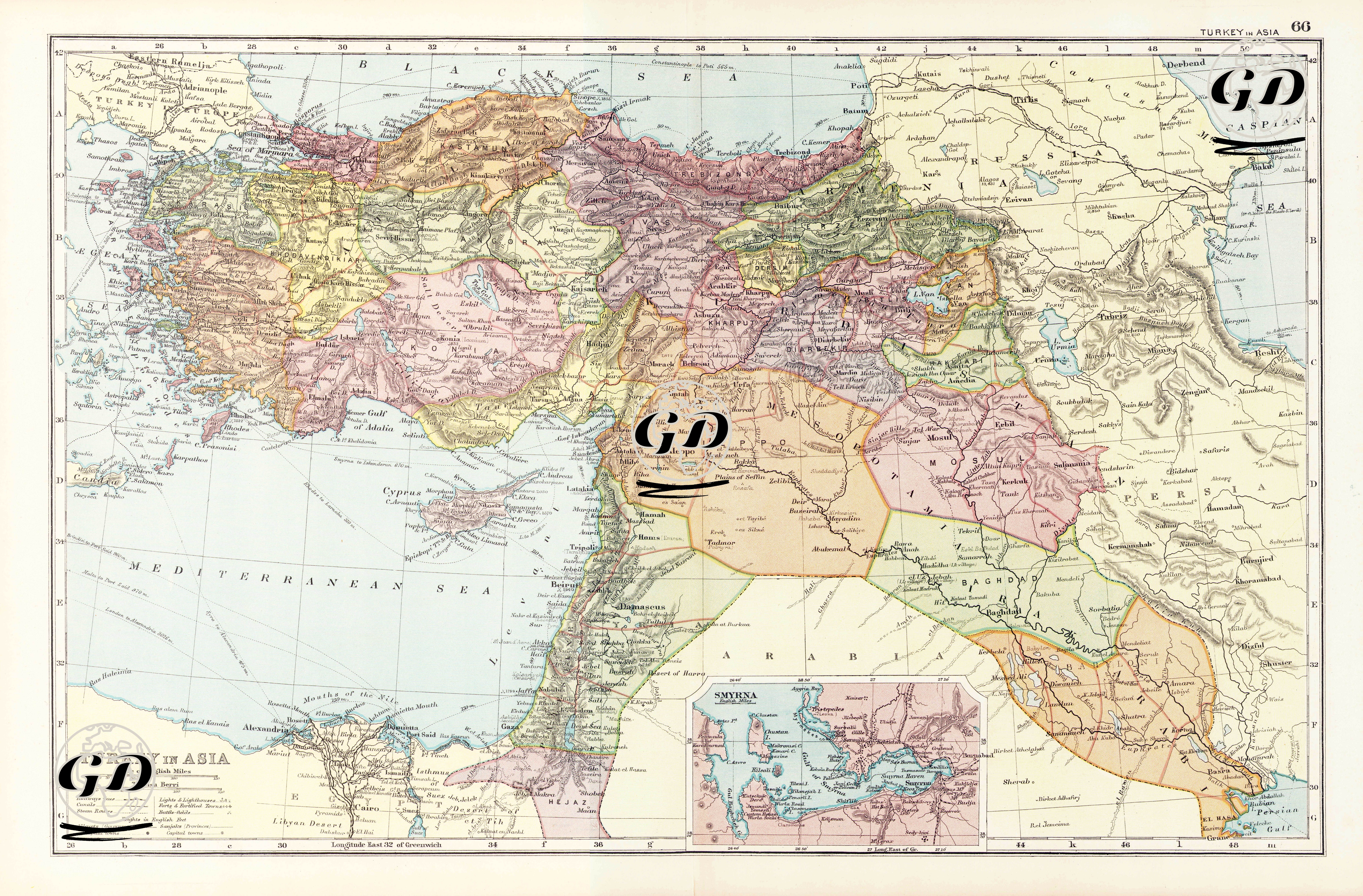
The map, dated 1912, reflects the Ottoman Empire’s lands in Asia before World War I, its administrative structure, borders and geopolitical presence recorded through a Western perspective. The title “Turkey in Asia” refers to a vast region encompassing Anatolia, Mesopotamia, Syria and Arabia, which were distinguished from the Ottoman lands in Europe by the orientalist terminology of the period. The map shows the vast Ottoman lands extending from Anatolia to Mesopotamia, from the Levantine coast to the Persian Gulf in detail within the framework of the province system of the period. At the bottom of the map, there is a detailed cartridge map (inset) of Izmir and the Gulf of Izmir. It was prepared according to the administrative system of the period; Anatolian provinces (such as Ankara, Sivas, Konya, Aydın), provinces such as Erzurum, Van and Mosul in the east, and Aleppo, Damascus, Beirut, Jerusalem, Hejaz and Yemen in the south are clearly classified according to administrative borders, separated by different colors. Natural elements (mountains, rivers, lakes) are depicted in detail with light shading using topographic engraving. Railways, ports and main transportation lines are also shown. However, apart from the railways going west from Istanbul, only the İzmir-Aydın Railway, the Smyrna-Cassaba (İzmir-Turgutlu) line, the Mersin-Adana line and the local railways in Western Anatolia and Çukurova are shown on the map. Apart from this, the Baghdad Railway (Berlin-Baghdad line), the Hejaz Railway, the railway plans extending from Konya to the east or to Mosul, and the lines coming through Syria are not drawn or visually represented on the map.