GRAVÜR DÜNYASI
Digital Engraving Library
| Engraver | J. & C.Walker (Active 1820-1895) |
| Date | 1840's |
| Technique | Steel Engraving-Original Hand Colored |
| Category | Maps |
| Source | London, Edward Stanford 6 Charing Cross |
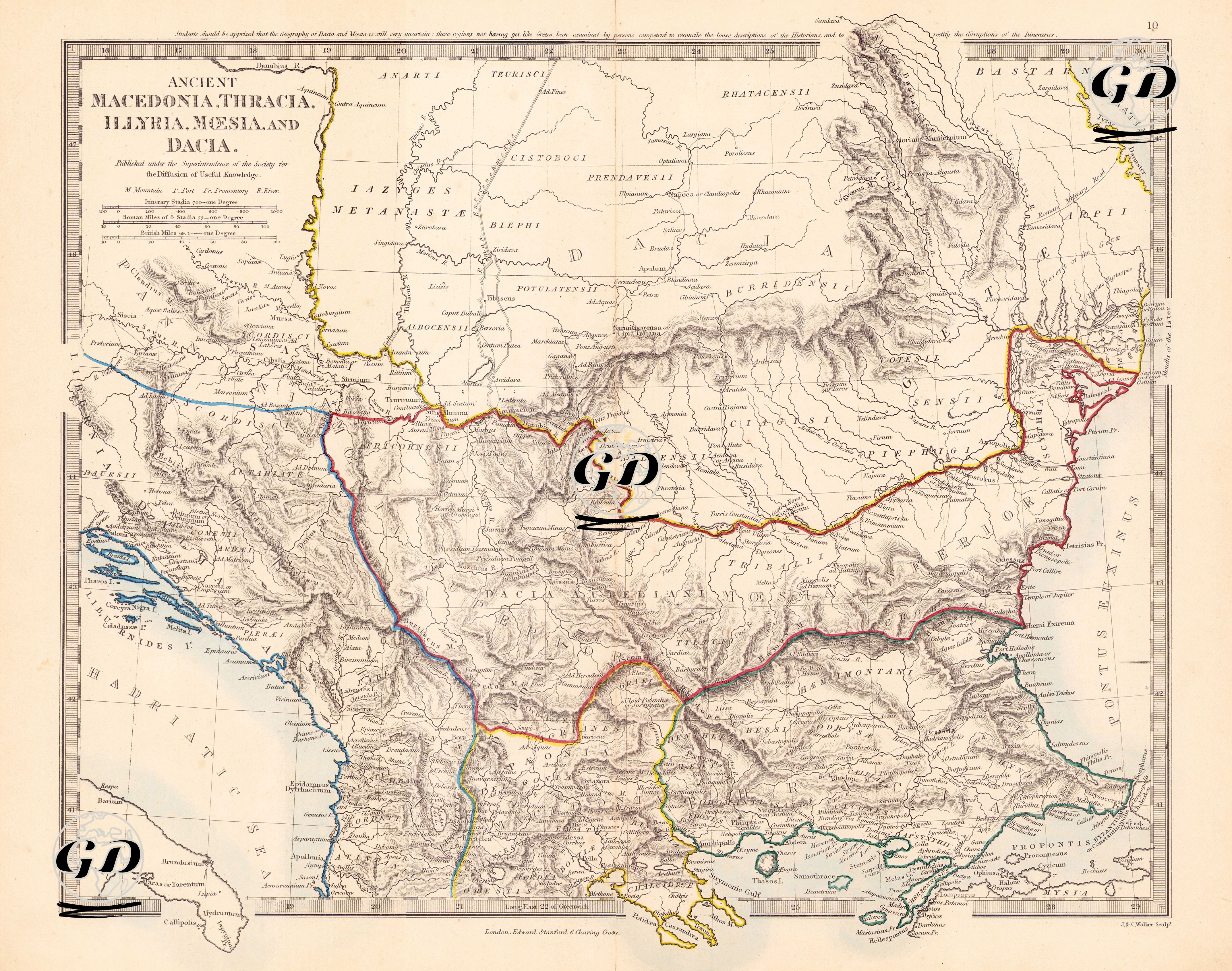
This map was published in the 1840s under the supervision of the British organization Society for the Diffusion of Useful Knowledge (SDUK), which aimed to disseminate information. It is one of the cartographic documents that shed light on the geography of the Balkans and the Black Sea region in ancient times and especially reveals the provincial structure and borders of the Roman Empire in the Balkans during the classical period. The map shows ancient tribal regions, Roman provincial borders, river systems, mountain ranges, roads and settlement centers in detail. The regions highlighted by hand-painted border lines in different colors, namely Macedonia, Thracia, Illyria, Moesia and Dacia, correspond to the lands of today's modern states such as Macedonia, Greece, Bulgaria, Romania, Albania and Serbia. In the upper part of the map, Dacia, a short-lived province conquered by Emperor Trajan during the Roman period, is located north of the Danube River and is detailed with ancient tribal names. Moesia, located in the south, is a strategically important region lying between the Danube River and the Balkan Mountains and is known for the military garrisons established by Rome to protect its eastern borders. In the east, the Thrace region attracted attention with its political and cultural importance during the Roman and Hellenistic periods, while the capital Byzantium (Istanbul) and its surroundings are located in the lower right corner of the map together with the "Propontis" (Sea of Marmara), emphasizing that it played a central role in the east-west axis of the ancient world. While Illyria, which covers the Adriatic coast, is known for its mountainous structure and pre-Roman tribes, the Macedonia region reflects its strategic and historical importance as the homeland of Alexander the Great. The map helps understand the geopolitical structure of the period by showing ancient Roman roads, ancient cities (e.g. Philippopolis, Nicopolis, Apollonia, Tomi) and natural geography (mountains, rivers, valleys) with topographic drawing techniques. Published within the framework of the educational mission of the Society for the Diffusion of Useful Knowledge, this work is the product of a scientific approach that aims to both increase the public's knowledge of geography and to build a bridge between the classical period and modern geography.