GRAVÜR DÜNYASI
Digital Engraving Library
| Date | 1882 |
| Technique | Woodblock Engraving-Colored (Newspaper-No Text on Reverse) |
| Category | Maps |
| Source | The Graphic (September 2 1882) |
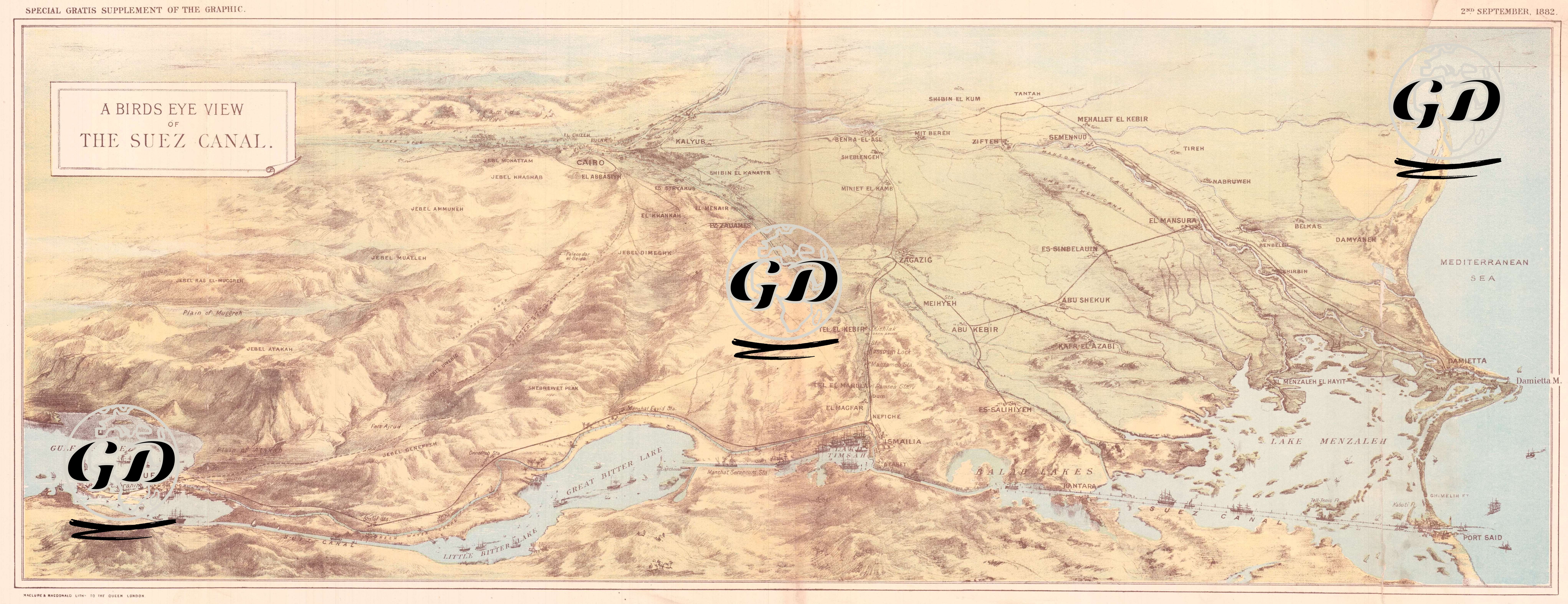
This bird's eye view map was published as a supplement to The Graphic newspaper on September 2, 1882, and depicts the strategic route of the Suez Canal from Port Said on the Mediterranean coast in the north to the Port of Suez in the south. The Anglo-Egyptian War was a short-lived but far-reaching war between England and Egypt, which took place between July and September 1882. In this war, England effectively occupied Egypt, thus taking control of the Suez Canal and the Nile Delta, thus consolidating its influence over Egypt. This bird's eye view engraving, drawn with a high artistic technique, was prepared to make the strategic location of the Suez Canal understandable to the public and readers during the British intervention in Egypt. The map shows the military and commercial transit routes along the canal in a three-dimensional view. The city of Cairo and the delta of the Nile River are seen in the west, and the borders of the Sinai Peninsula are evident in the east. Important settlements (such as Ismailia, Zagazig, Tel el-Kebir, Abu Keşeyb), military routes, railways and mountainous areas are carefully depicted on the map. In addition, natural water areas connected to the canal, such as the Great Bitter Lake and Little Bitter Lake, are prominently located in the center of the map. The ships shown along the canal symbolize the intense maritime traffic in international trade of the period. The mountainous areas around the canal (such as Jebel Attaka and Jebel Mualeh) hint at the difficulties encountered in digging the canal. Given the vital role of the Suez Canal in world trade, this map is an extremely important document for understanding the geopolitical balances of the period.