GRAVÜR DÜNYASI
Digital Engraving Library
| Artist | Salomon Munk (1803-1867) |
| Date | 1845 |
| Technique | Copper Engraving |
| Category | Maps |
| Source | Palestine, Description Geographique, Historique et Archeologique par Salomon Munk - Firmin Didot Freres (Paris) |
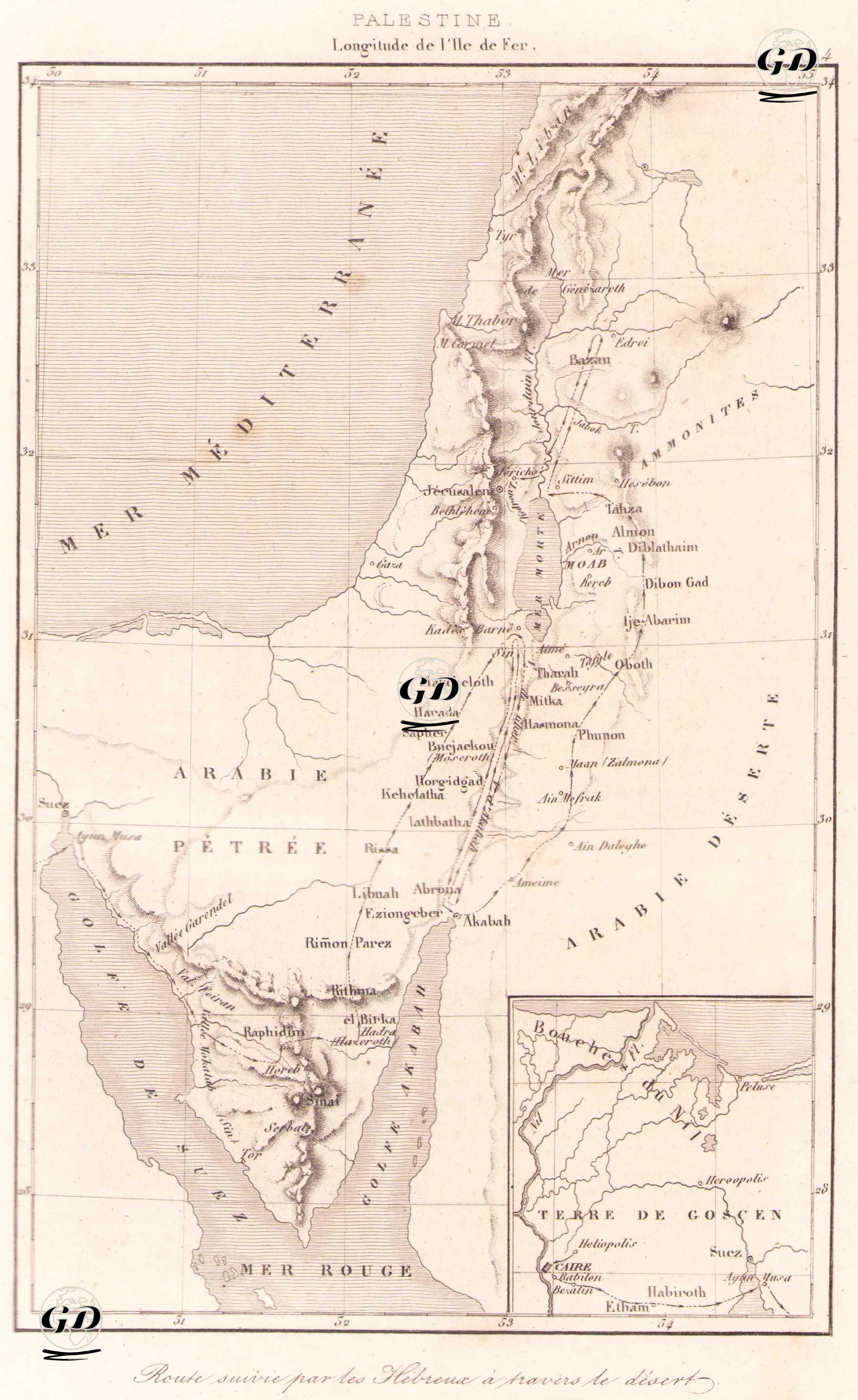
This map is a historical biblical geography map showing the ancient lands of Palestine together with the Sinai Peninsula, the Arabian Desert and the Red Sea region. The general purpose of the map is to geographically depict the Exodus of the Israelites from Egypt and the period they spent in the desert afterwards. Therefore, this map is not only a geographical document but also a theological document that visualizes the physical locations of the events in the religious texts. It was prepared in French and has the title “Palestine – Longitude de l’Ile de Fer” on its upper part; in other words, El Hierro (Ferro Island in the Canary Islands) is taken as the zero meridian. The map focuses particularly on depicting the route followed by the Israelites in the desert after their Exodus from Egypt under the leadership of Moses. In the northern part of the map, the classical cities of Palestine are seen: Jerusalem, Bethlehem, Jericho and Gaza are marked in detail. The settlements around the Jordan River and the Dead Sea (Mer Morte) and the regions belonging to ancient communities such as the “Ammonites” and “Moab” are also shown. To the southeast, the Arabian Desert and the region known as Arab Petre (Arabie Pétrée), or “Rock of Arabia,” are covered in detail in this section: many biblical stops, such as Kadès Barnéa, Eziongeber, Rissah, Hazeroth, Moseroth, Oboth, reflect the traces of the exodus led by Moses. One of the most striking elements is the map in the small box at the bottom of the map. This section shows the region of “Terre de Gosen,” or Goshen, in Egypt, and shows the location of Gosen, the supposed place where the Israelites lived, and the route of their departure from there. Also marked here are places frequently mentioned in the Old Testament, such as the Nile Delta, Suez, Héliopolis (On), and Ramses.