GRAVÜR DÜNYASI
Digital Engraving Library
| Date | 1878 |
| Technique | Lithography-Colored |
| Category | Maps |
| Source | The Collegiate Atlas - William Collins Sons & Co. Limited, Glasgow & London |
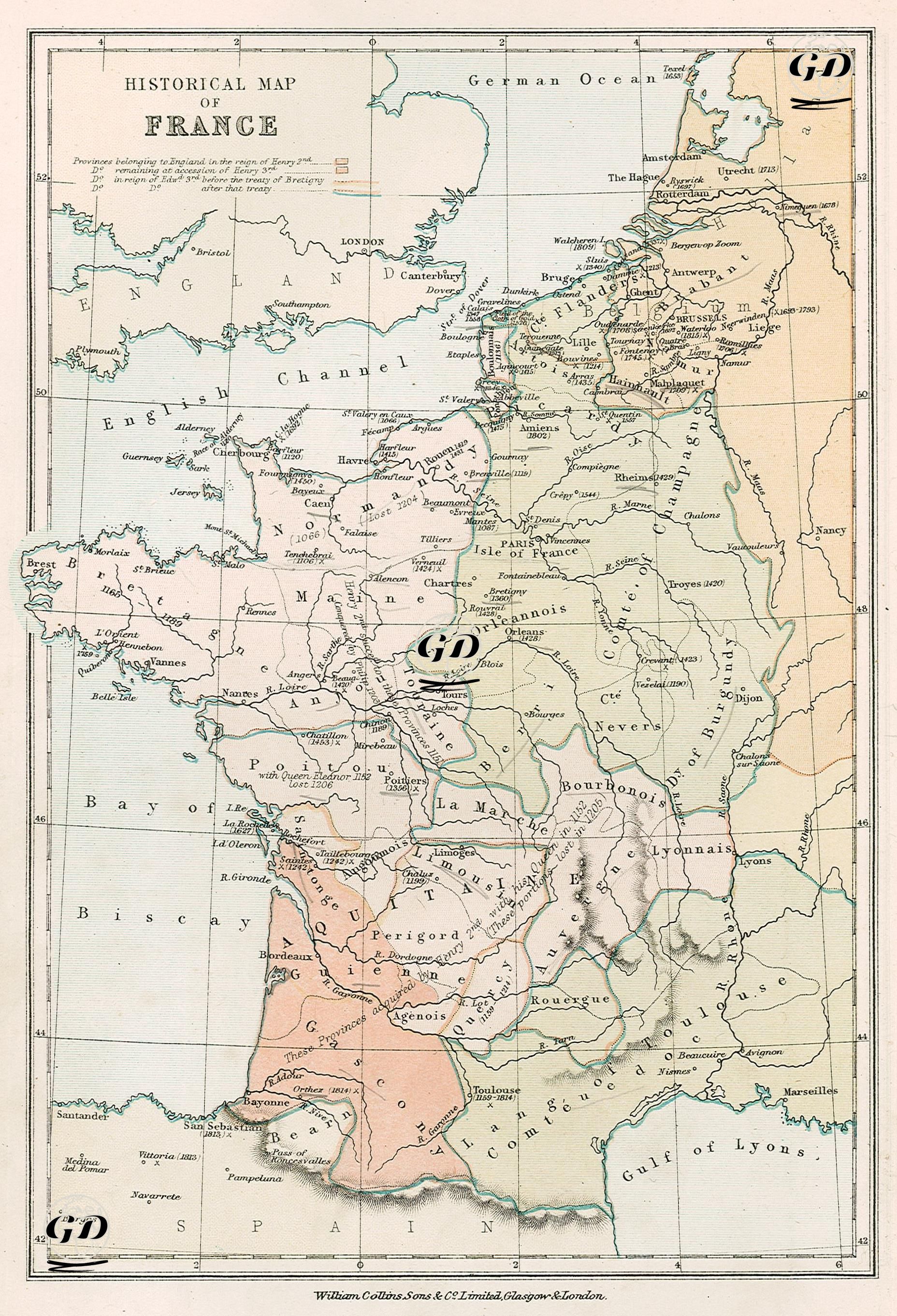
This 1878 map depicts the political geography of France during the Middle Ages and early Modern Period, as well as its historical territorial relations with England. The map particularly highlights political and military developments from the 12th to the 15th centuries. The legend in the upper left corner of the map shows England's territorial holdings in France, divided into four color-coded sections according to four different historical periods: 1- Provinces belonging to England during the reign of Henry II; these areas are shown in dark pink. The transfer of these regions to English rule began in 1152 with the marriage of King Henry II of England (1154-1189) to Eleanor, Duchess of Aquitaine. Thus, the King of England inherited a vast French territory. This marriage gave England a vast sphere of influence in Southern France (e.g., Aquitaine, Gascony, Poitou, Angouleme, Perigord, Agenois). The map's mention of "With Queen Eleanor 1152" clearly documents this event. 2- The territories that remained in English hands upon Henry III's accession to the throne; during this period, the French crown waged an active struggle to reclaim English-controlled territories. 3- The territories held by England before the Treaty of Brétigny (1360) during the reign of Edward III; this represents the period during which England's claims to France reached their peak during the Hundred Years' War (1337–1453). 4- The officially recognized possessions of England in France following the Treaty of Brétigny are shown. With this treaty, England gained the right to retain Gascony, Calais, and some surrounding territories, but relinquished its claim to the throne of the Kingdom of France. The explanations provided by this legend are crucial for understanding the map's overall structure. The map traces not only geographical but also political-legal processes. The territories depicted on the map changed hands between England and France as a result of political marriages, feudal ties, military expeditions, and treaties.