GRAVÜR DÜNYASI
Digital Engraving Library
| Date | 1878 |
| Technique | Lithography-Colored |
| Category | Maps |
| Source | The Collegiate Atlas - William Collins Sons & Co. Limited, Glasgow & London |
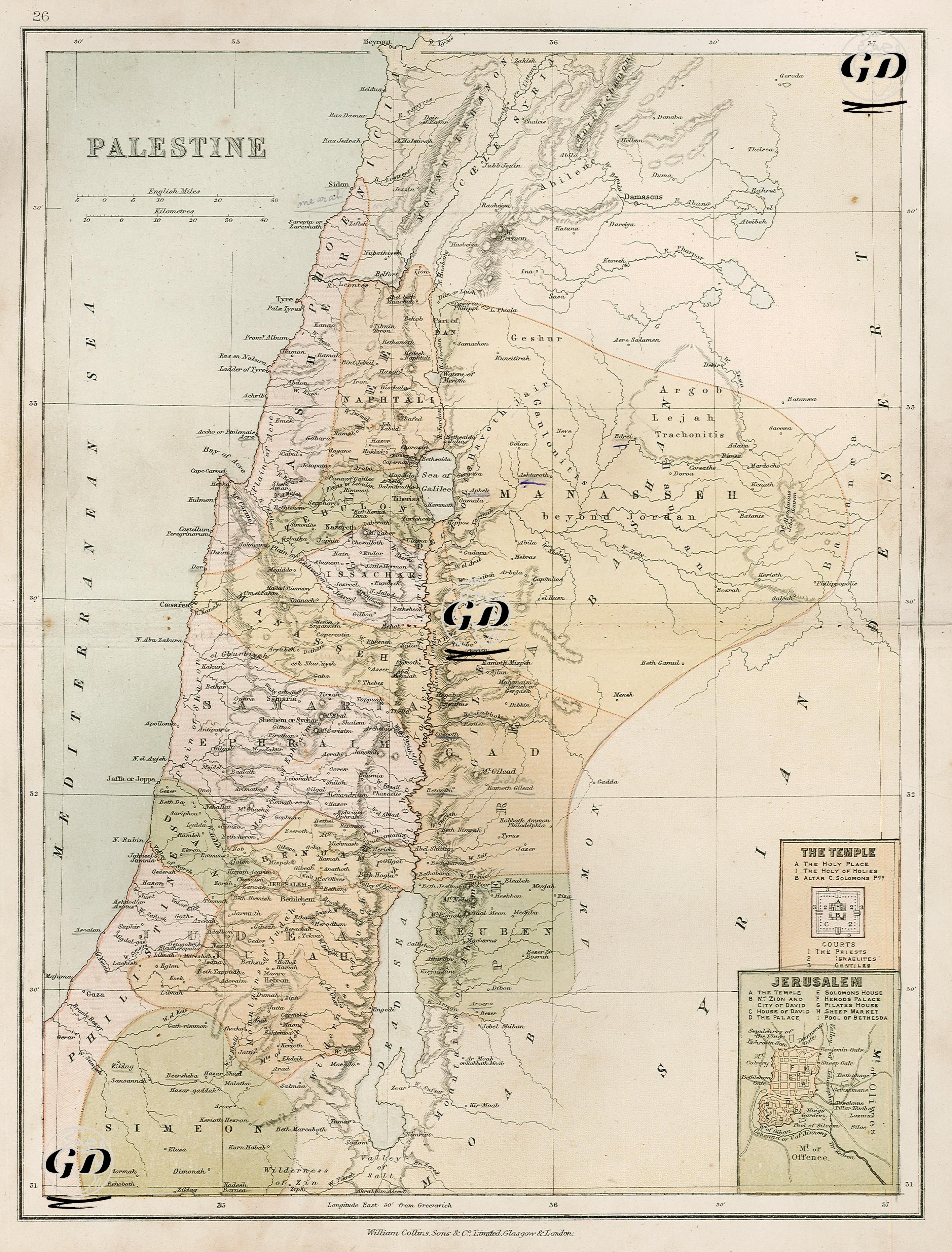
This map, published in 1878 under the title "Palestine," details the region's geographic structure and historical and biblical sites. The map, based on both the Old and New Testaments, is organized according to Israelite tribes rather than modern administrative boundaries, reflecting a settlement approach based on biblical geography. Furthermore, the map reconstructs the geography of ancient Palestine not only within the context of the Bible but also according to Christian scriptures from the Roman period onward, presenting both Jewish and Christian sacred narratives together. The main body of the map encompasses present-day Israel, the Palestinian territories, the West Bank, western Jordan, southern Lebanon, and southwestern Syria. It is bordered by the Mediterranean Sea to the west and the Arabian Desert to the east. The map extends to the regions of Zion (today's Sidon), Tyre, Damascus and Basan in the north, and extends to Beer-Sheba, Kadesh and even the borders of Egypt in the south. Key geographical features include the Jordan River, the Dead Sea, the Sea of Galilee, and the Mediterranean coastline, all meticulously depicted. The most striking feature on the map is the colored division of the lands of the twelve tribes of Israel. These tribes include Ephraim, Judah, Dan, Reuben, Simeon, Benjamin, Zebulun, Naphtali, Asher, Issachar, Gad, and Menashe, each color-coded. This approach transforms the map into not only a geographical document but also a theological and ethnographic one. Two important insets appear in the lower right corner of the map. One is a small plan titled "The Temple & The Holy Place," which schematically depicts the architectural plan of Solomon's Temple. The interiors of the sacred spaces are described with legends such as "A: The Holy Place," "B: The Most Holy Place," and "C: The Altar of Incense." The other, titled "Jerusalem," is a separate, smaller map containing a plan of the ancient city of Jerusalem. It details biblical sites such as the Temple Mount, the City of David, the Pool of Siloam, and Calvary.