GRAVÜR DÜNYASI
Digital Engraving Library
| Engraver | Sidney Hall (1788-1831) |
| Date | 1827 |
| Technique | Copper Engraving |
| Category | Maps |
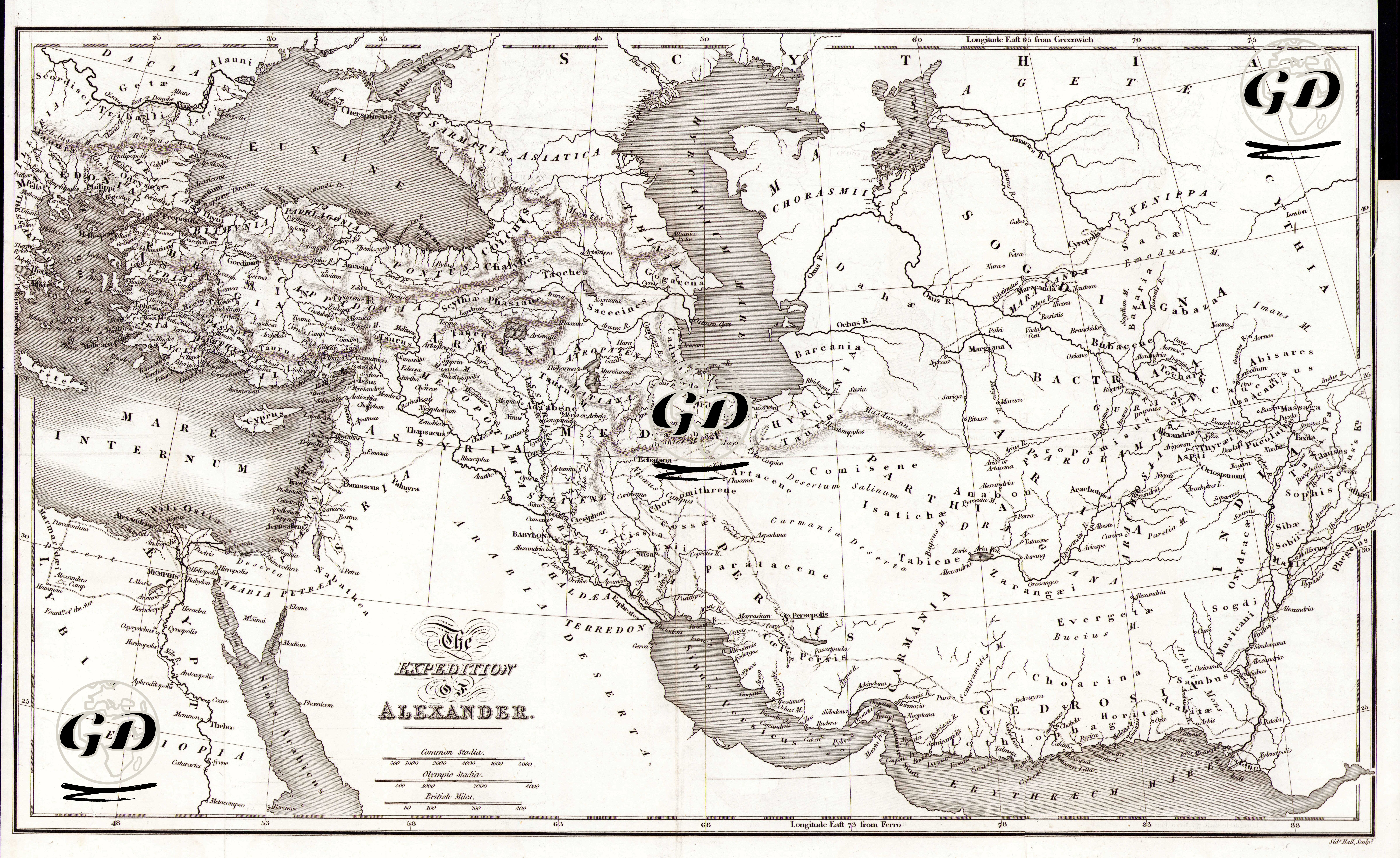
This map is an ancient geographical map that depicts Alexander the Great's military campaigns from east to west, and geographically visualizes his Asian Campaign between 334 and 323 BC. The map covers a wide area starting from Greece and extending to Anatolia, the Levant, Egypt, Mesopotamia, Iran, Central Asia and India; the place names are mostly given with Latinized ancient names. Alexander's campaign begins in Macedonia in 334 BC. He crosses the Hellespont into Anatolia and wages war against the Persian Empire, advancing to the heart of the Persian Empire with important battles such as Granicus (334 BC), Issos (333 BC) and Gaugamela (331 BC). With the conquest of cities such as Babylon, Susa, Persepolis and Ecbatana, Alexander becomes the absolute ruler of the East. His expedition extends further east, via Bactria and Sogdiana, north of Afghanistan, to the northwest of India, that is, the region of today's Punjab. On his return from India, he returns to Mekran and Persian lands via the Gedrosia (today's Baluchistan) Desert. The end of the expedition occurs with the death of Alexander in Babylon (323 BC). Key passages, rivers, ancient cities, and the probable routes of Alexander’s armies (such as Mare Internum (the Mediterranean Sea), Cilicia (Çukurova), Babylonia (Iraq/Mesopotamia), Persepolis (the ancient Persian capital in Iran), the Euphrates, the Tigris, the Oxus (Amu Darya), and the Indus) are marked in detail on the map. This work provides exceptionally rich information from the perspectives of military history, ancient geography, and geopolitical context, revealing how geography played a decisive role in Alexander’s strategic advancement and imperial expansion