GRAVÜR DÜNYASI
Digital Engraving Library
| Artist | George Dixon (1748-1795) |
| Engraver | John Reid |
| Date | 1788 |
| Technique | Copper Engraving |
| Category | Maps |
| Source | A Voyage Round The World, But More Particularly to The North-West Coast of America, Performed in 1785, 1786, 1787 and 1788, in the King George and Queen Charlotte, Captains Portlock and Dixon - Published As The Act Directs By Cap. Dixon, Oct. 14 1788) |
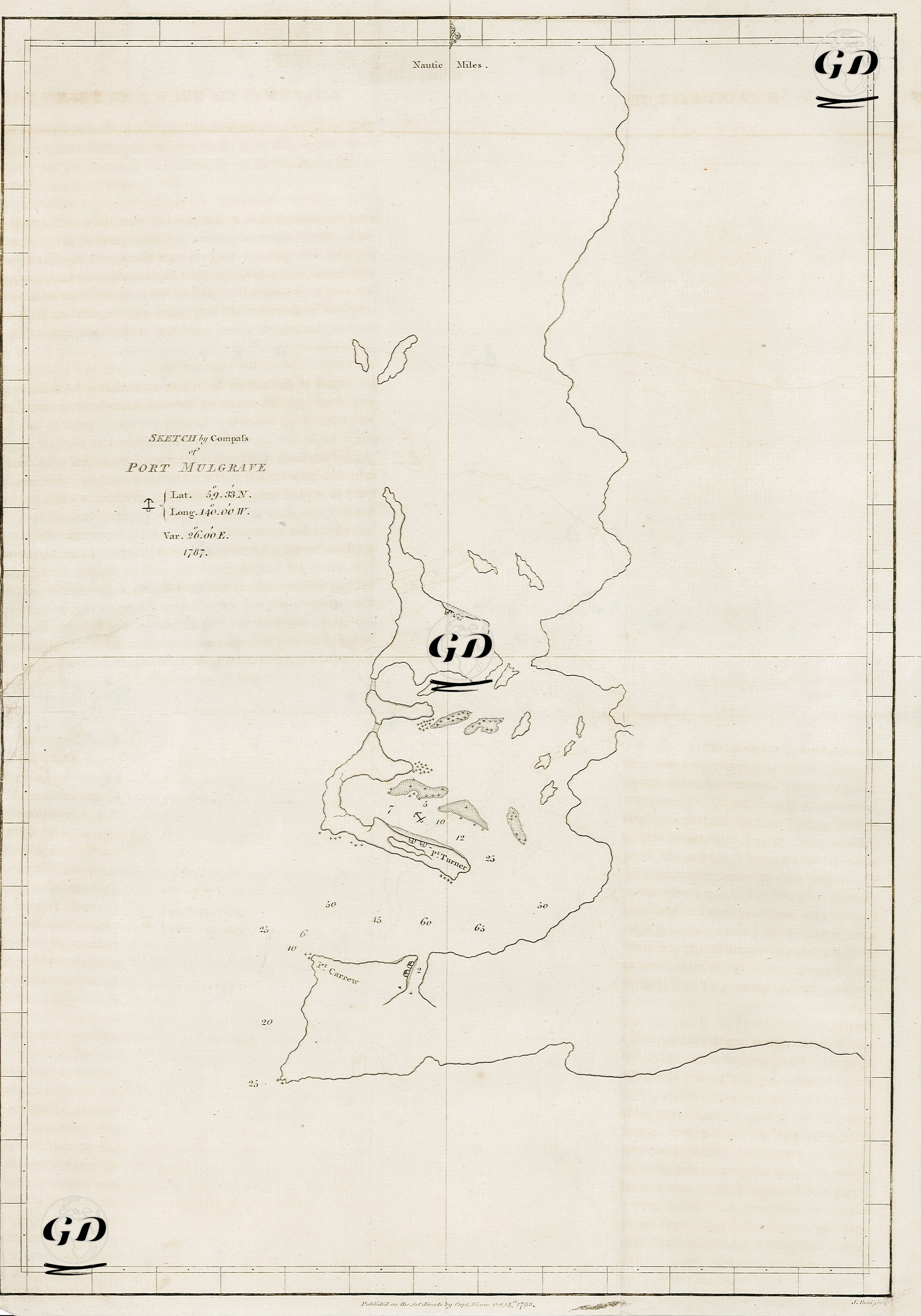
This image is an early sketch of the port of Port Mulgrave, prepared using a compass, from the voyages of exploration led by Captain George Dixon in the last quarter of the 18th century. It was published in London on October 14, 1788. This sketch was a product of expeditions undertaken by the British Royal Navy, primarily aimed at exploring the economic and strategic potential of the Northwest American coast. The expedition was led by Captains Portlock and Dixon aboard the ships King George and Queen Charlotte. One of the most important objectives of the explorations was to establish new trade routes and fur trade links in the Pacific, as well as to expand British influence against Russian and Spanish influence. This woodcut map, found in the travelogue "A Voyage Round the World," presents coastal profiles of the islands, coastlines, and geological formations observed during the 1785-1788 voyage to the Northwest American coast. These visual guides were prepared to provide visual information, especially in foggy and stormy weather, and to facilitate navigation for sailors when approaching land. Port Mulgrave, shown on the map, is located between Prince William Sound and Yakutat Bay in present-day southeastern Alaska. This region was an important stop during the exploration era, particularly for the fur trade, geographic exploration, and early contact with indigenous peoples (especially the Tlingit). During Dixon's voyage, such bays and harbors were mapped in detail, and suitable anchorages were identified for sailors. The information on this sketch map indicates the latitude of the region as 59° 53' North and longitude as 140° 00' West. A magnetic declination of 26° East was also recorded. The map includes coastlines, islands, numerical depth data (indicated by numbers such as 10, 20, 50, and 65), and the locations of some important points (e.g., "St. Etienne," "Pt. Carpenter"). It was designed specifically to help sailors determine anchorages and navigation routes.