GRAVÜR DÜNYASI
Digital Engraving Library
| Artist | D.Veremondo Rossi (Active 1755-1763) |
| Date | 1763 |
| Technique | Copper Engraving |
| Category | Maps |
| Source | Il Gazzettiere Americano |
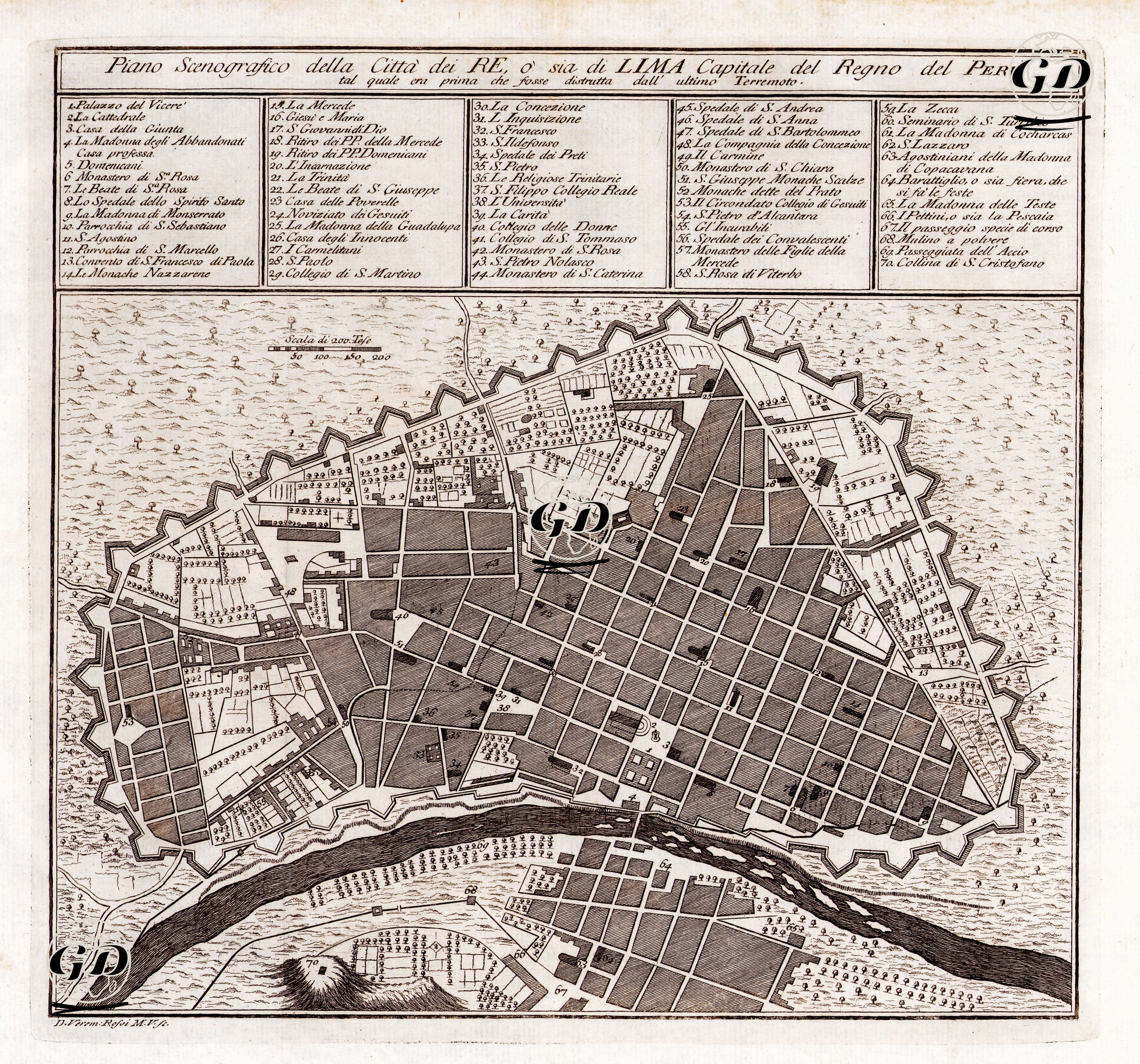
This 1763 map depicts Lima (King's City - the Spanish gave Lima its title), the capital of the Kingdom of Peru, before its destruction by the 1746 earthquake. This earthquake, which occurred on October 28, 1746, and had an estimated magnitude of 8.6, caused a massive tsunami that struck not only Lima but also Lima's port of Callao, destroying thousands of structures and human lives in the region. The port of Callao was almost completely submerged, and it is estimated that around 4,000 people died. The structures in Lima were almost completely destroyed. At the time, only a portion of the city remained intact. In this context, the map was prepared to document Lima's architectural and urban fabric before the destruction. The term "scenografico" indicates that the map is not merely a technical plan, but also a visual representation (descriptive plan) constructed according to the rules of architecture and perspective. All the fundamental elements of 18th-century colonial urban planning can be observed on the map: the central plaza (main square), the regular grid plan (grid system), the city structure surrounded by thick walls, churches, monasteries, administrative buildings, and the settlement pattern that developed along the river. The top of the map contains a numbered list of Lima's major structures and monuments. This list includes the Governor's Palace (Palacio del Viceroy), Lima Cathedral, numerous churches, monasteries, and universities. Some of these structures were completely destroyed by the earthquake, while others were later rebuilt. It also serves as an early example of preserving and documenting urban memory after major disasters. This 1763 work is considered one of the most important cartographic sources from the colonial period in Latin America.