GRAVÜR DÜNYASI
Digital Engraving Library
| Engraver | William Johnston (1802-1888) - Alexander Keith Johnston (1804-1871) |
| Date | 1856 |
| Technique | Steel Engraving (Text on Reverse) |
| Category | Maps |
| Source | Pictorial History Of The Russian War 1854-5-6 - W.R.Chambers London & Edinburgh |
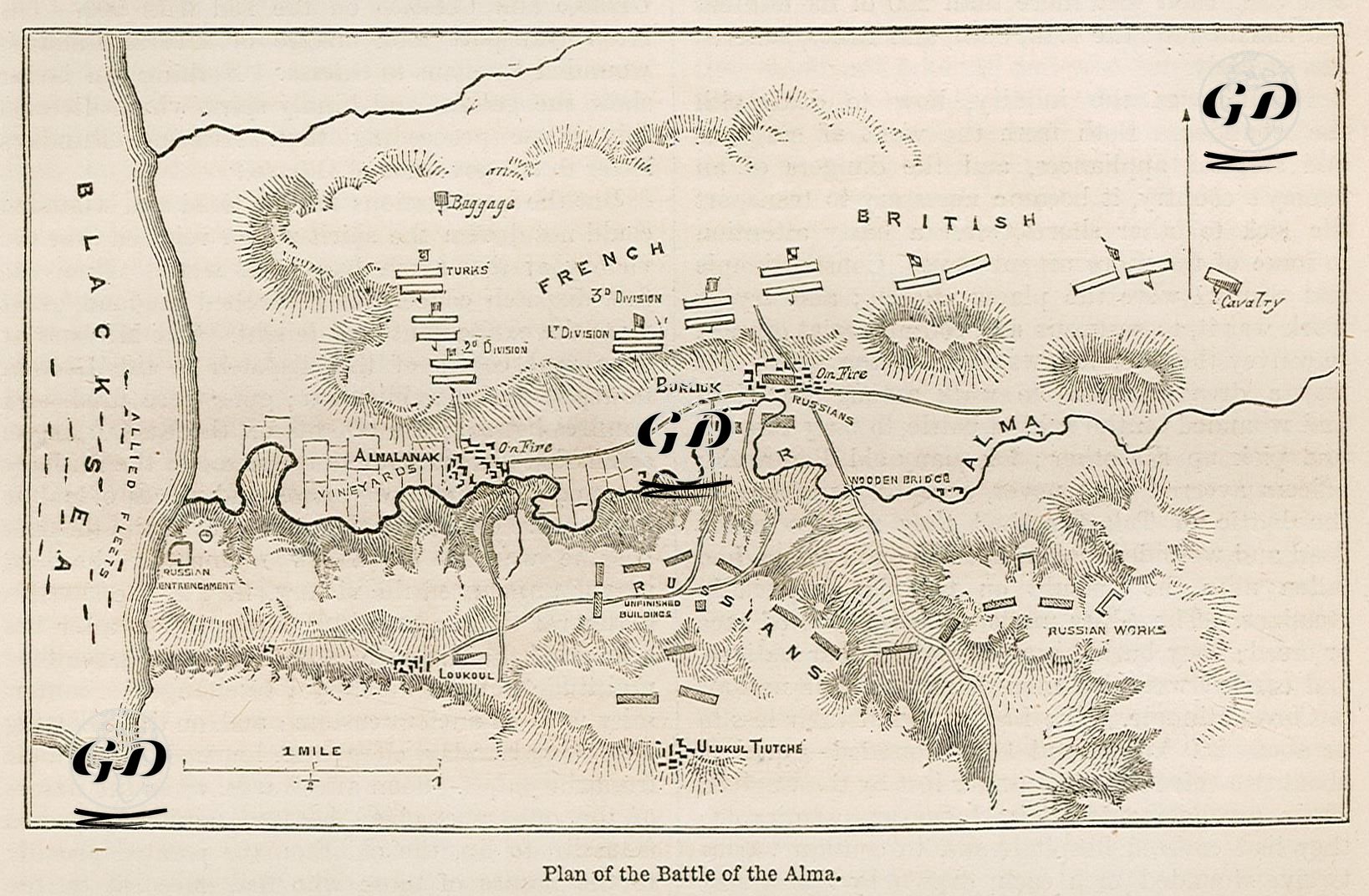
The Battle of the Alma, which took place on September 20, 1854, was the first major land battle of the Crimean War and represented the first direct attack by the Allied forces (British, French and Ottoman) against Russia. This map shows the area where the conflict took place on a tactical level, helping us understand how the war developed. On September 14, the Allied forces landed at Eupatoria (Yevpatoriya) in order to advance towards Sebastopol and capture the Russian naval base in Crimea. Advancing southeast, the Allies encountered the Russian army under the command of General Aleksandr Menshikov on the banks of the Alma River. The Alma River defenses were established to stop this advance. The upper part of the map (north) shows the line of advance of the Allied forces (British, French and Ottoman). The British army was on the right wing, the French on the left wing. The Ottoman troops were in the upper left of the map, closer to the sea. In the lower part of the map (south), the Russian army is positioned in hilly and fortified defensive areas south of the Alma River. Defensive structures marked "Russian Works" indicate the level of readiness of the Russian army. The Alma River acts as a natural defense line, and the “Wooden Bridge” is strategically important as the crossing point of the river. The “BLACK SEA” and “ALLIED FLEETS” are shown on the left side of the map. This fleet landed troops along the coast and supported the front. Villages and agricultural areas such as “Burluk”, “Almalanak”, and “Vineyards” are both geographical references and areas where the battle took place. The “On Fire” note indicates areas that caught fire as a result of the fighting. On September 20, 1854, British troops directly attacked the “Russian Works” in the center, French troops advanced by climbing a steeper slope from the left flank, while Ottoman troops mostly supported the left rear line. Zouave troops (the elite light infantry of the French army) successfully attacked by climbing the steep slopes from the west bank of the river and were the first to reach the Russian artillery positions. As a result of fierce fighting, Russian positions were captured by allied troops.