GRAVÜR DÜNYASI
Digital Engraving Library
| Artist | John Rapkin(1815-1876)-Henry Warren (1794-1879) |
| Engraver | John Rapkin (1815-1876) |
| Date | 1855 |
| Technique | Steel Engraving |
| Category | Maps |
| Source | Tallis's Illustrated Atlas and Modern History of the World: Geographical, Political, Commercial & Statistical - The London Printing and Publishing Company |
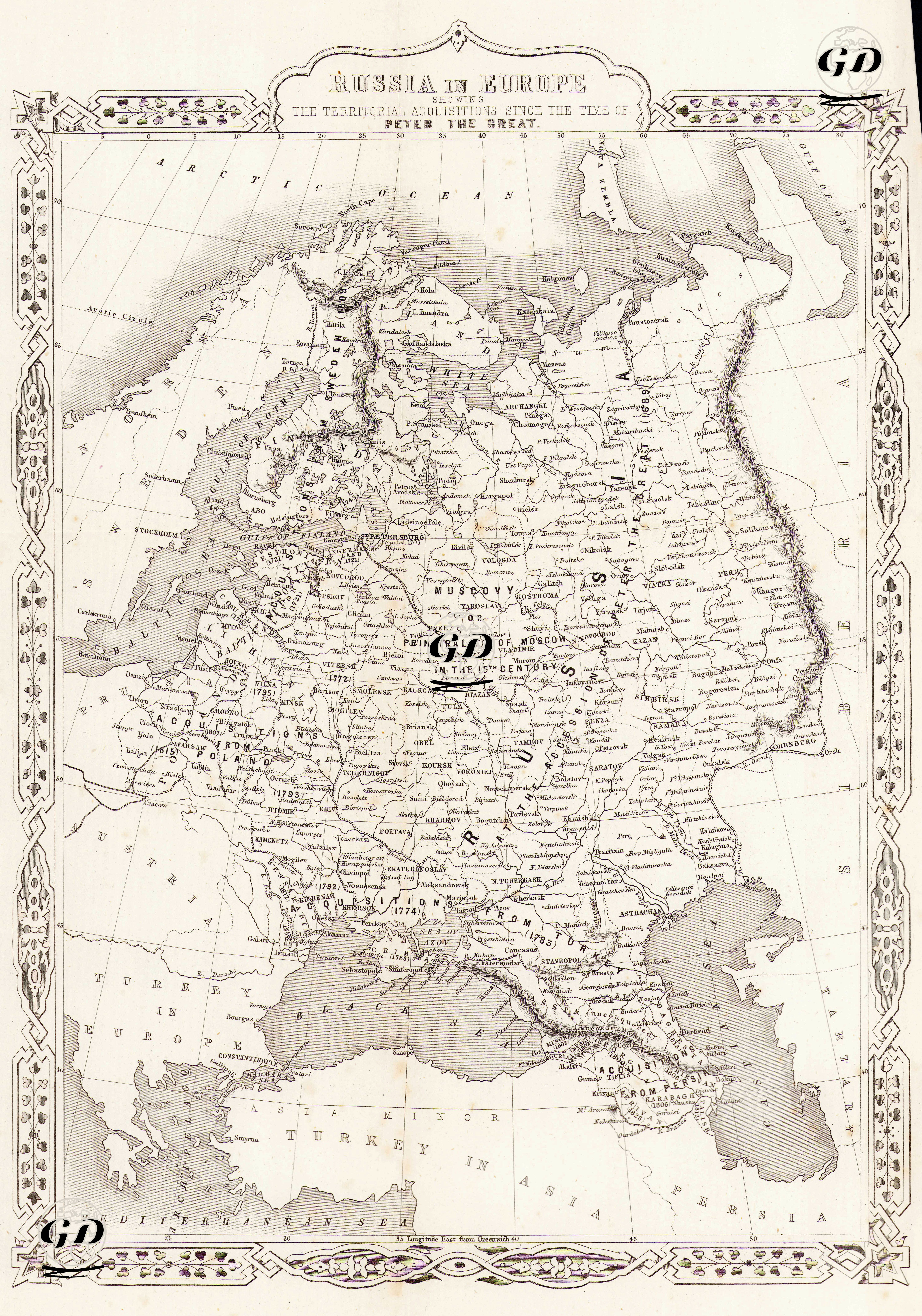
This map from 1855 shows the territorial acquisitions of the Russian Empire since Peter the Great. The top of the map reads “showing the territorial acquisitions since the time of Peter the Great.” The map focuses on the borders of the Principality of Moscow in the 15th century, and presents the expanding Russian influence in the following centuries as regions toned down in different time periods. The phrase “Principality of Moscow in the 15th century” is in the middle of the map, and the regions annexed by Russia in the 17th and 18th centuries are indicated with their years around it. For example, dates such as 1739, 1774, and 1783 in the eastern and southern parts of Ukraine are noteworthy in the context of the Ottoman-Russian wars and the annexation of Crimea. The date 1721 on the Baltic coast reflects the southern territories of Estonia, Latvia and Finland gained after the Great Northern War with Sweden. Large areas annexed to Russia as a result of the partition of Poland are shown with the dates 1772, 1793 and 1795. The map also focuses on Russia’s southern Black Sea ports and its border with the Ottoman Empire. The Crimean Peninsula is clearly marked and highlighted with the words “Acquired from Turkey 1783.” Similarly, Bessarabia, Moldova, Eastern Romania, and the Black Sea coastline of present-day Ukraine, located to the southwest of the map, are among the territories that Russia gradually acquired from the Ottoman Empire. Overall, the map visually documents Russia’s strategy of expansion westward, southward, and northward. The map’s border decorations, by Henry Warren, also reflect the cartographic aesthetics of the period.