GRAVÜR DÜNYASI
Digital Engraving Library
| Date | 1860 |
| Technique | Steel Engraving |
| Category | Maps |
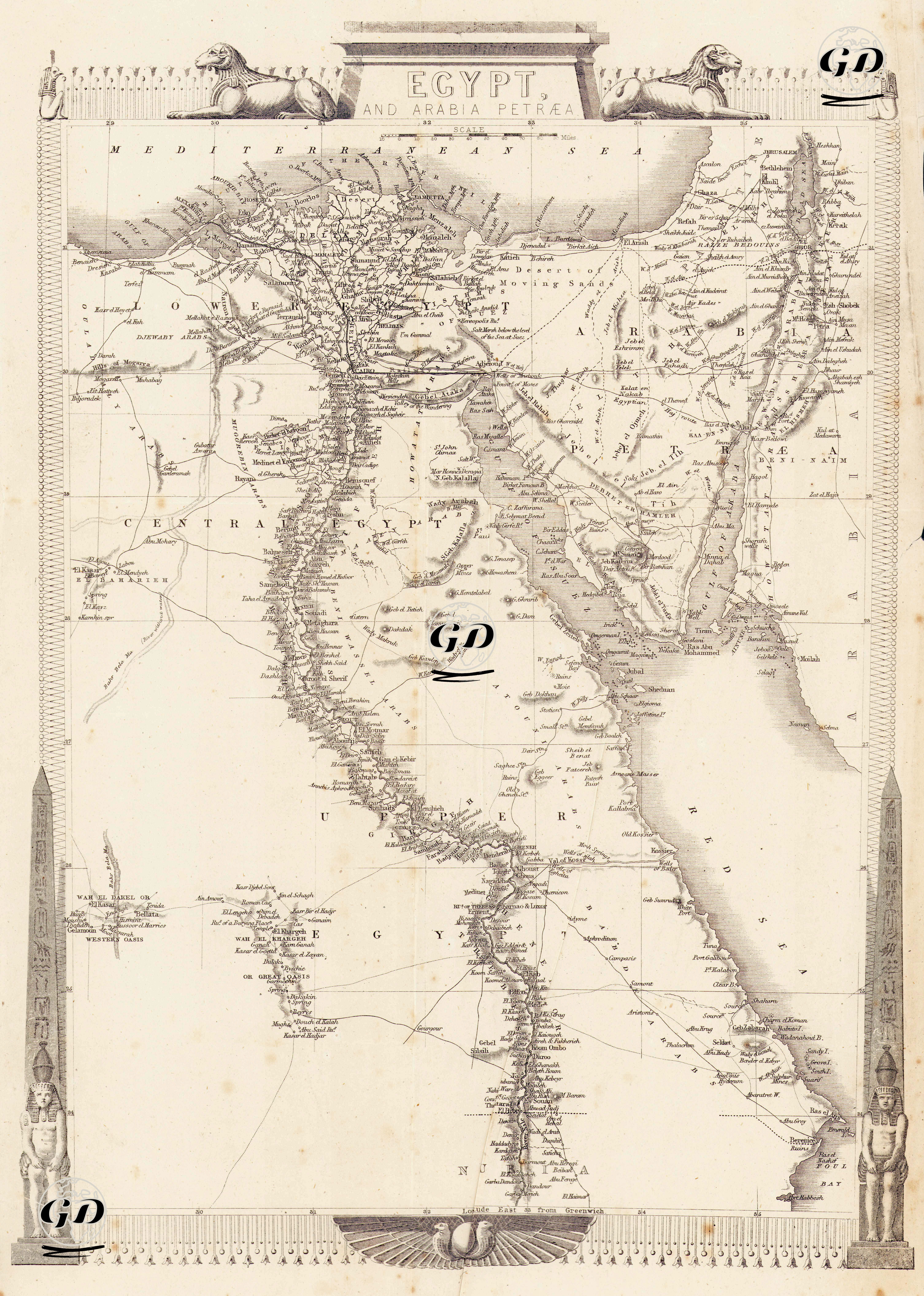
This 1860 map, titled "Egypt and Arabia Petræa," is a valuable resource, detailing city names from the ancient and Ottoman periods, place names known from sacred texts, and trade routes. To the north of the map, along the Mediterranean Sea, lie ancient and modern port cities such as Alexandria, Rosetta, Damietta, Port Said, Pelusium, and Tanis. These cities are indicative of the rich agricultural lands and ancient settlements along the Nile Delta. The geography along the Nile River, from south to north, is layered into Upper Egypt, Central Egypt, and Lower Egypt. The sacred cities of ancient Egypt, such as Thebes, Dendera, Esneh, Edfu, Aswan, and Philae, are carefully depicted. The settlements extending upstream along the Nile demonstrate both the agricultural settlement pattern and the distribution of ancient temple cities. The Sinai Peninsula is defined in the eastern part of the map under the title Arabia Petræa, and this definition attracts attention both geographically and historically. This region refers to the province of Arabia Petraea, established during the Roman Empire, and is a clearly distinguishable geopolitical region on the map. The map features prominent biblical place names such as Mount Sinai, Wady Feiran, Sarabit el Khadim, Tor, and Ain Mousa (the spring of Moses). Mount Sinai, in particular, is marked both in religious texts as the mountain where Moses received God's commands and geographically as one of the highest peaks in the Sinai Peninsula. The map also includes St. Catherine's Monastery, a site important as a center of both Christian pilgrimages and a tradition of monasticism that has persisted since the Byzantine period. The map depicts the Arabian deserts, the western coast of Sinai, and the borders of Nubia in topographic relief. Along the Red Sea, east of the Nile River, port cities such as Suez, Tor, and Cosseir (Quseir) were strategic centers for Egypt's maritime trade routes to the east. To the south, Nubia is bordered by settlements such as Abou Simbel, Korosko, Wady Halfa, and further down, Dongola; these regions are important both for ancient Nubian civilization and for Egypt's relations with its southern neighbors. To the west of the map, roads leading to the Libyan deserts mark vital stops such as the Siwa Oasis and the Baharia Oasis. The ornamentation on the upper and lower edges of the map is particularly striking. Egyptian sphinxes are displayed at the top, obelisks in the lower corners, and a depiction of an eagle-winged sun disk; these elements demonstrate the influence of ancient Egyptian iconography on 19th-century European cartography.