GRAVÜR DÜNYASI
Digital Engraving Library
| Artist | Eduard Charlemont (1848-1906) |
| Engraver | Richard Paulussen (1852-1906 ) |
| Date | 1894 |
| Technique | Photogravure |
| Category | Theatre,Opera And Ballet |
| Source | Die Theater Wiens; Das K.K. Hofburgtheater seit seiner Begründung, von Oskar Teuber und Alexander von Weilen - Gesellschaft für vervielfaaltigende Kunst, Wien |
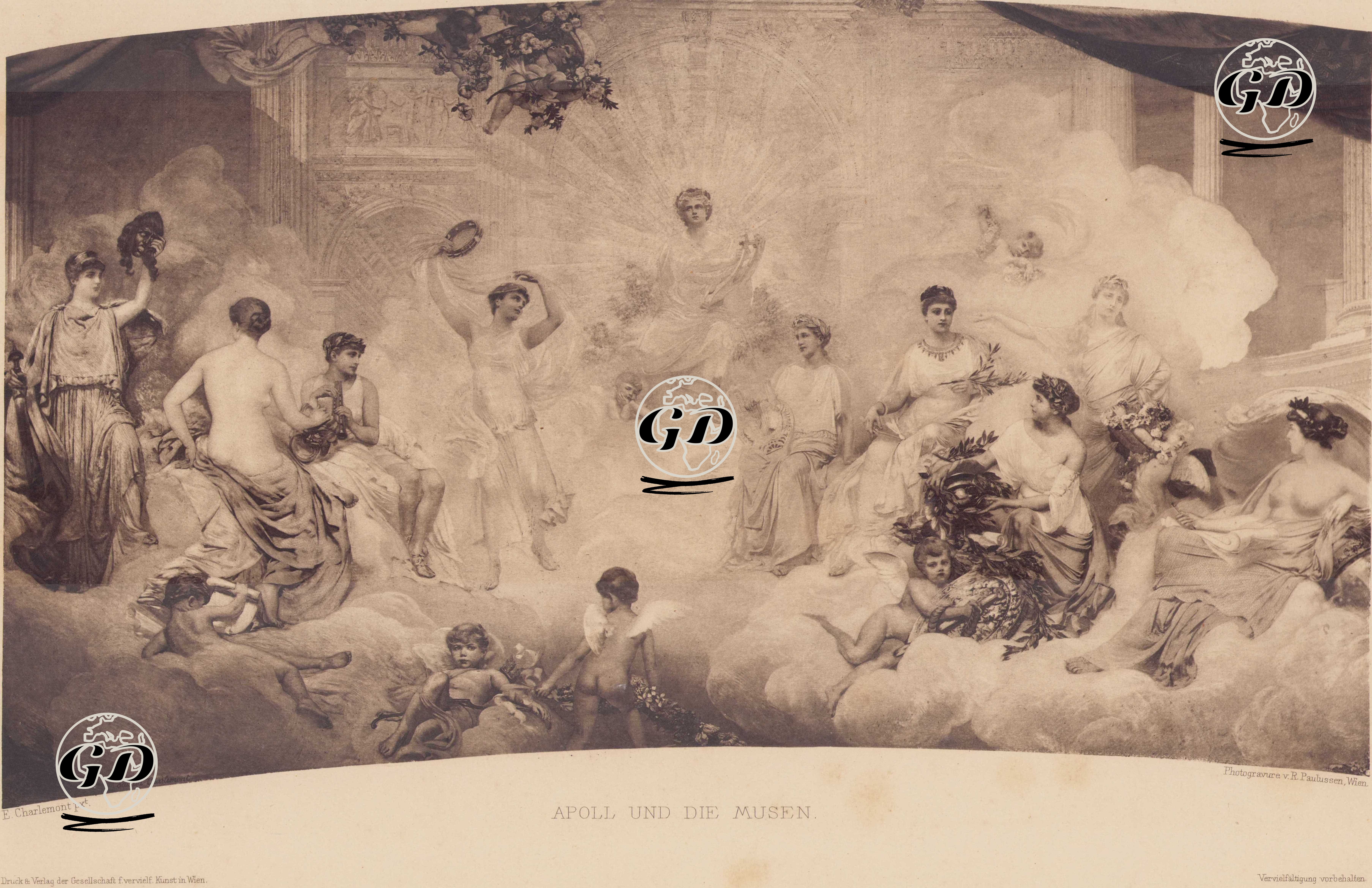
This engraving, published in 1894 in "Die Theater Wiens - Vienna Theaters, Volume 3," which documented Viennese performing arts, was designed by Eduard Charlemont and engraved by Richard Paulussen. The engraving provides a detailed depiction of the ceiling fresco titled "Apoll und die Musen - Apollo and the Muses" located in the first-floor foyer of the Vienna Burgtheater. Depicted as the luminous figure at the center of the composition, Apollo is a god associated with both the sun and the arts in ancient mythology. He is particularly considered the patron of music, poetry, dance, and knowledge. Therefore, by being positioned at the center of the stage, he is virtually depicted as a source of inspiration. The female figures gathered on the clouds around Apollo represent the nine Muses who symbolize different branches of art and science in Greek mythology. Each muse symbolizes different branches of knowledge and art through a different object in her hand: Calliope (epic poetry) with a writing tablet or pen, Cleio (history) with a scroll or book, Erato (love and lyric poetry) with a lyre or wreath, Euterpe (music) with a flute or tambourine, Melpomene (tragedy) with a tragic mask, Thalia (comedy) with a comedy mask or shepherd's crook, Polyhymnia (divine poetry) with a quiet and introverted, contemplative posture, Terpsichore (dance) with a moving figure and lyre, and Urania (astronomy) with a celestial globe or compasses. Small winged figures (putti/eros) at the bottom of the stage complete the allegorical unity. They are seen as playful figures symbolizing the joy of art and the innocence of creativity. Allegorical mythological scenes, common in 19th-century European art, were particularly popular in the ceiling decorations of theaters and concert halls. In this composition, Apollo is presented with the Muses around him, emphasizing that the theater is not only an entertainment area but also a temple of inspiration, art and knowledge.