GRAVÜR DÜNYASI
Digital Engraving Library
| Artist | Gustav Klimt (1862-1918) |
| Engraver | Richard Paulussen (1852-1906 ) |
| Date | 1896 |
| Technique | Photogravure |
| Category | Theatre,Opera And Ballet |
| Source | Die Theater Wiens; Das K.K. Hofburgtheater seit seiner Begründung, von Oskar Teuber und Alexander von Weilen - Gesellschaft für vervielfaaltigende Kunst, Wien |
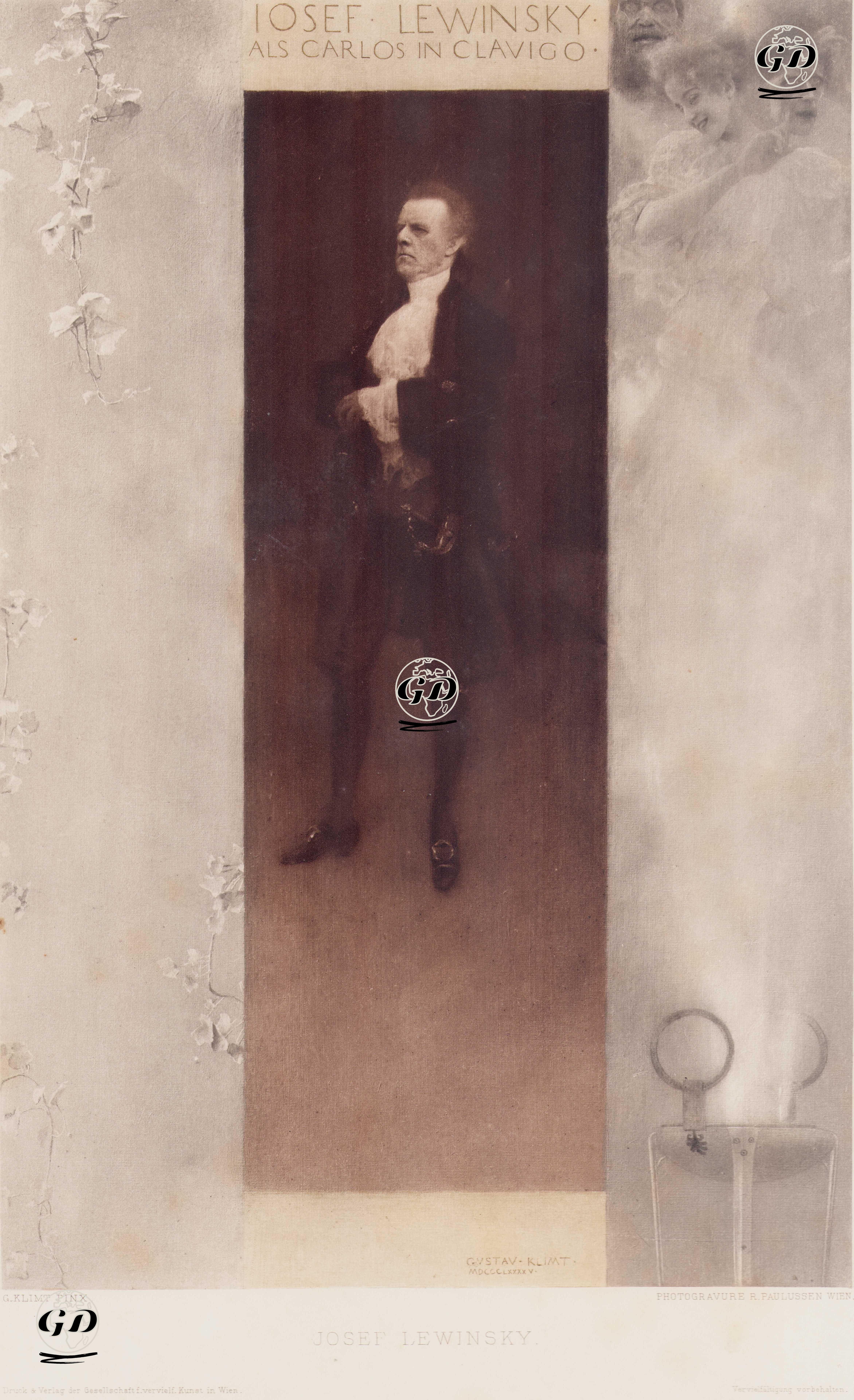
This iconic work by Gustav Klimt, commissioned by the Society for Reproductive Art (Gesellschaft für vervielfaltigende Kunst) in 1894, depicts Josef Lewinsky, one of the era’s leading actors, as Carlos in Goethe’s play Clavigo, on stage. The original painting (66 x 44 cm, oil on canvas), completed in 1895 as an oil painting, is today in the collection of the Österreichische Galerie Belvedere, Vienna. The engraving was published as part of Oskar Teuber’s comprehensive three-volume work, Das k.k. Hofburgtheater seit seiner Begründung (The Imperial-Royal Theater Since Its Foundation, 1896, Volume 2/2), as part of the “Die Theater Wiens” series documenting Viennese performing arts. The composition does not merely document the physical presence of an actor; At the same time, it interprets the multi-layered nature of the art of theatre, its mental associations and the depth of representation on a metaphorical level. At the center of the engraving, Josef Lewinsky, born in 1835 and one of the most respected actors of the era, is depicted in a dramatic pose against a black background. The character's psychological weight is intensely conveyed through his baroquely elegant costume, physical tension, and determined gaze. However, the true depth of the work lies in the environmental motifs and allegorical elements. In the hazy area in the upper right corner, a laughing female figure wearing a Dionysian headdress appears, flanked by an ancient tragic mask and an elderly face. These figures allude not only to the play's characters but also to the Dionysian origins of theater and the ritualistic nature of on-stage performances. Immediately below, an object depicted as a classical tripod incense offering (probably the sacred tripod cauldron of Delphi) evokes the theater's connection to ancient sacrificial traditions and the quasi-religious atmosphere of the stage. All these symbolic elements, along with the Symbolist tendencies that first clearly appear in Klimt's art, also reflect the influences of Japanese aesthetics based on simplicity and surface order. The elegantly linear Art Nouveau floral motifs on the left side balance this symbolic intensity, adding a touch of modernist ornamentation to the composition. The typographic title on the gold panel at the top both establishes the narrative framework and is an early example of the artist's interest in graphic design. Within this multilayered structure, Klimt visualizes not only the representation of an actor but also the spirit of the theater, its ritualistic past, and its connections to contemporary art. "Josef Lewinsky als Carlos" is a striking work in which Klimt's early portraiture is directly connected for the first time with the Symbolist narrative, reconstituted as a medium not only on the stage but also in the artist's subconscious and aesthetic vision.