GRAVÜR DÜNYASI
Digital Engraving Library
| Date | 1853 |
| Technique | Woodblock Engraving (Newspaper-Text on Reverse) |
| Category | Ottoman Empire And Turkey |
| Source | The İllustrated London News (December 24 1853-Page 557) |
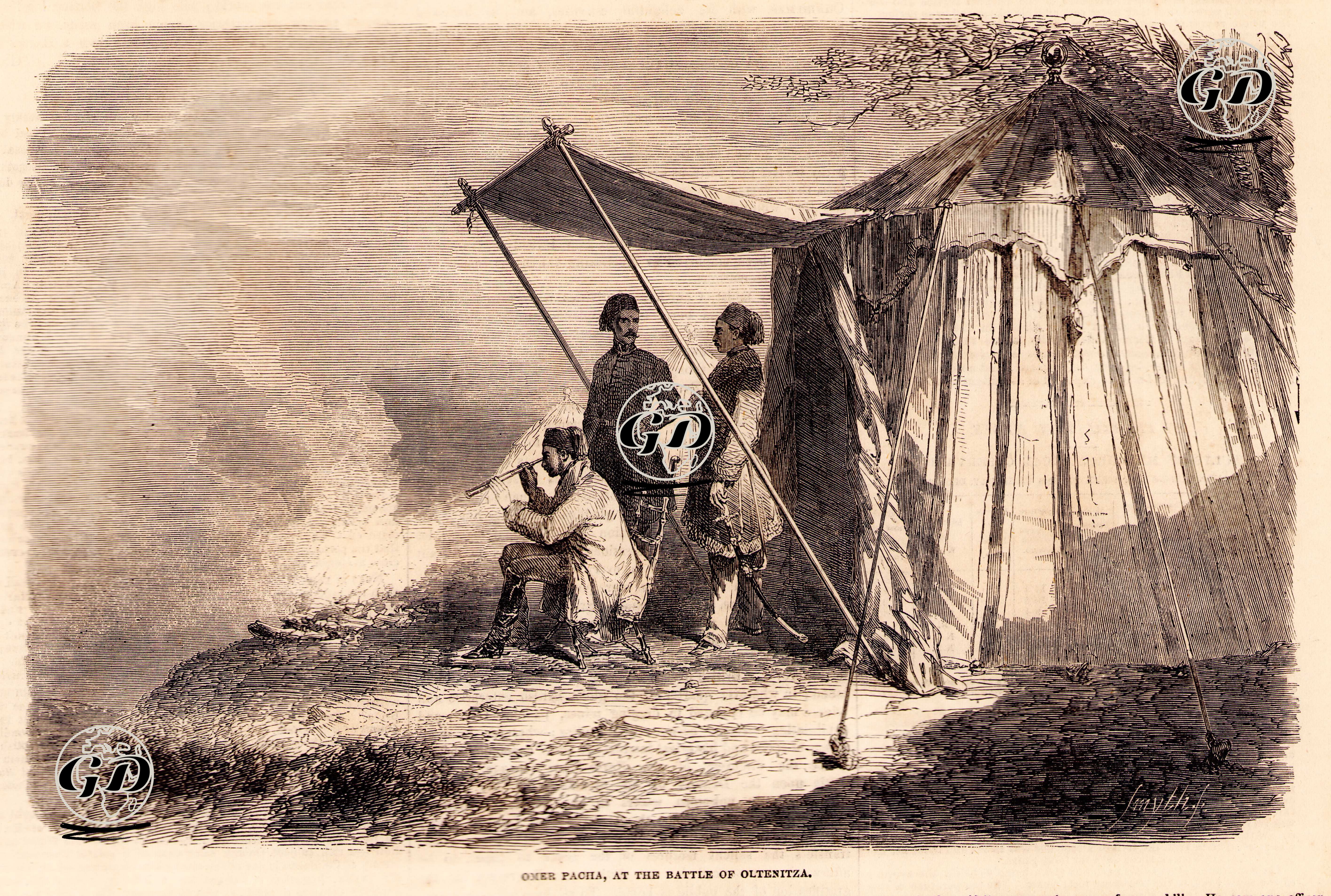
During the Battle of Oltenitsa (November 2-11, 1853) between the Ottoman and Russian armies in Oltenitsa (today's Romanian territory, then Wallachia), located on the northern bank of the Danube River, Ömer Lütfi Pasha was the commander-in-chief of the Ottoman army on the Danube front. It was one of the first significant land battles of the Crimean War. Against the Russian forces threatening Ottoman lands along the Danube River, on October 28, 1853, Turkish forces crossed the Danube and advanced into Wallachia and occupied the fortress in Oltenitsa and its surroundings. On the morning of November 4, 1853, Russian forces under the command of Peter Andreviç Dannenberg attacked the Ottoman positions with approximately 6,000 infantry, 20 cannons and 1,000 cavalry. The Ottoman defense was quite strong with previously prepared trenches, fortifications and artillery emplacements. In the intense fighting that lasted approximately 5 hours, the Russians attacked repeatedly but were unable to overrun the positions. They eventually retreated, leaving over 300 dead and hundreds wounded. Ömer Lütfi Pasha (1806-1871), who stood out with his military intelligence, the importance he gave to discipline, his understanding of European education and his experience in front-line management, achieved significant successes especially on the Balkan front of the war and was influential in the modernization process of the Ottoman army. When the war began, he was appointed as the general commander of the Ottoman Land Forces. His primary duty was to stop the Russian advance along the Danube River line. He successfully defended critical positions on the current Bulgaria-Romania border, especially Vidin, Kalafat and Oltenitsa, against the Russians. He played critical roles not only on the battlefield but also in internal security issues such as the suppression of rebellions in the Balkans. By the end of the war, he had risen to the rank of Grand Vizier (1861-1863). In addition to his military successes, he also held civil positions, but he was not as effective in politics as he was in the military. He died in 1871 and was buried in Istanbul. In the articles and images published in the European press, he was portrayed as a modern and European Ottoman commander, a figure whose military genius and discipline rivaled those of Western generals. The engraving depicts the famous commander of the Ottoman army, Ömer Pasha, at his field headquarters during the Battle of Oltenitza. The figure sitting and observing the front with his binoculars is Ömer Pasha. His careful stance, foresight and commander charisma are highlighted.