GRAVÜR DÜNYASI
Digital Engraving Library
| Date | 1877 |
| Technique | Woodblock Engraving (Newspaper-Text on Reverse) |
| Category | Ottoman Empire And Turkey |
| Source | The Graphic (December 01 1877-Page 525) |
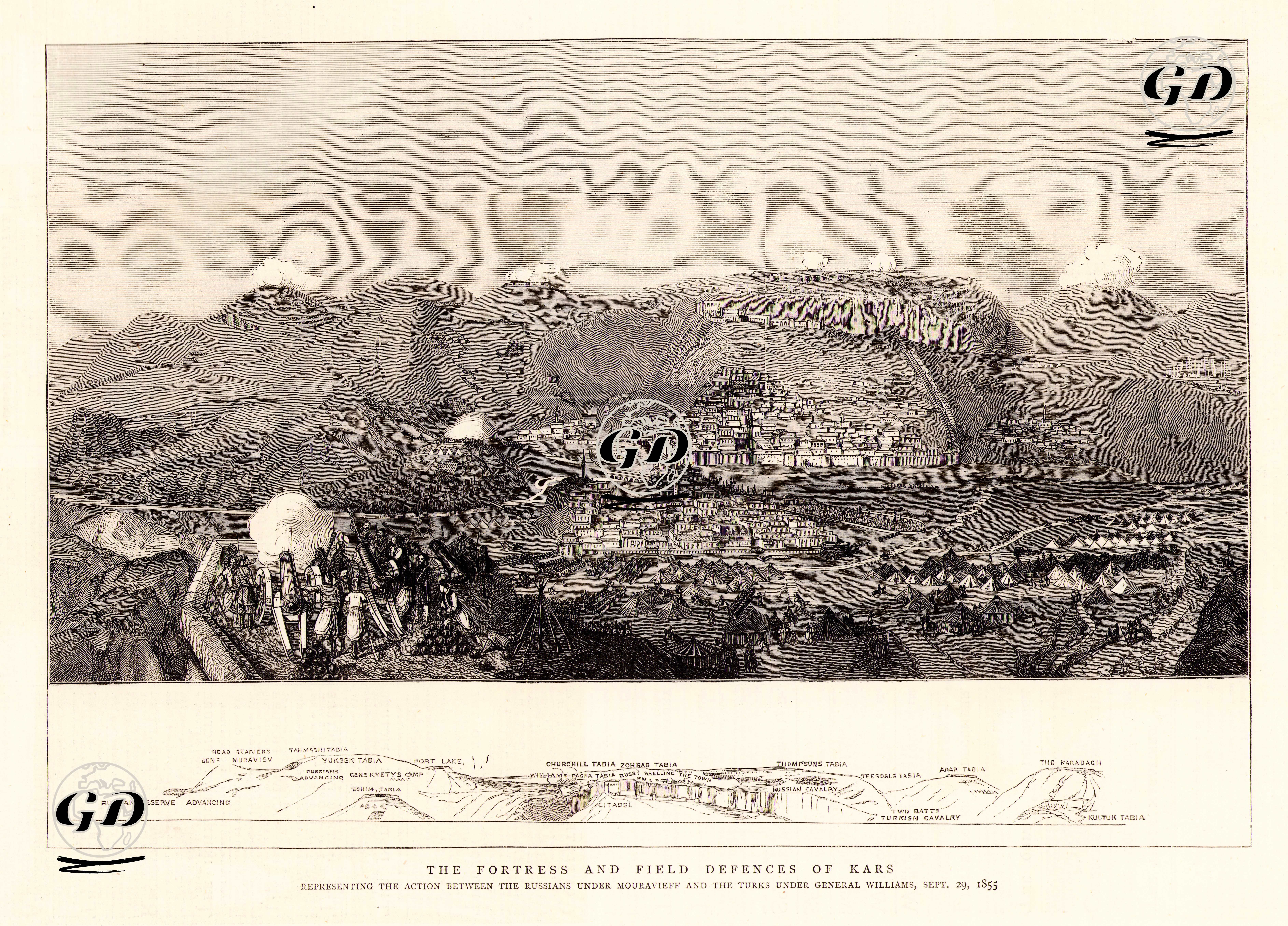
This engraving depicts in detail the Battle of Kars, which took place on 29 September 1855, in the context of the Crimean War, and particularly the defensive fortifications around Kars Castle. Kars was the most important Ottoman fortress on the eastern border and was under siege by the Russian army under the command of General Muravyov throughout 1855. Tahmasb Fort was a fortification located southeast of Kars, a critical part of the city's defensive system. It was also a high point fortified with artillery positions. On the morning of 29 September 1855, the Russian army under the command of General Muravyov launched a large-scale attack on the forts east and southeast of Kars. The main target of the attack was Tahmasb Fort and the Ottoman trenches around it. By capturing this point, the Russians would be able to establish superiority in the centre of Kars with artillery fire. However, the Ottoman side had fortified the defense very well under the leadership of officers such as General William Fenwick Williams (British officer, in Ottoman service) and Ismail Pasha (Kmety), of Hungarian origin. The Ottoman soldiers prevented the Russians from approaching the redoubt with bayonet charges, artillery fire and hand grenades. Fighting continued throughout the day around Tahmasb Redoubt. The Russians suffered approximately 8,000 casualties, while the Ottomans lost several thousand soldiers. The Russians were forced to retreat without capturing the position. The engraving is a military-topographical panorama. In the lower part, there is a plan-diagram with the names of the mountains and redoubts given. This is a beautiful example of combining a work of art with a map. In the front part of the engraving, Turkish soldiers are shown defending by their cannons, while in the middle, the city center of Kars and the inner castle are shown. The Russian forces, positioned on the slopes and ridges of the mountains, are attacking from various redoubts, and the hot conflict is visualized with exploding cannons and smoke effects.