GRAVÜR DÜNYASI
Digital Engraving Library
| Artist | J.Hine |
| Engraver | G.Price |
| Date | 1858 |
| Technique | Steel Engraving |
| Category | Ottoman Empire And Turkey |
| Source | The History of the War with Russia: Giving Full Details of the Operations of the Allied Armies By Henry Tyrrell (The London Printing and Publishing Company) |
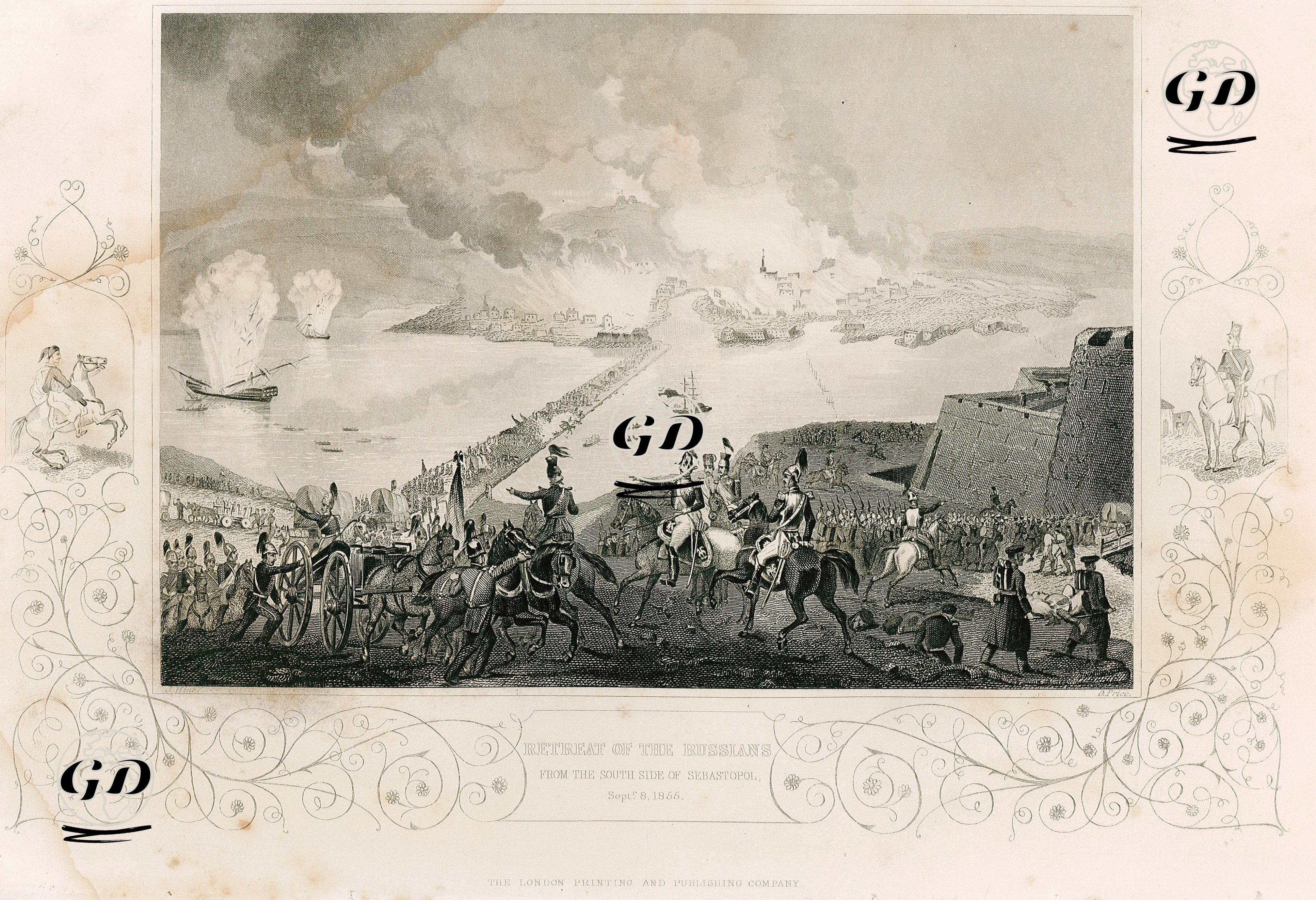
This impressive and dramatic scene depicts one of the most critical moments of the Crimean War, the fall of Sevastopol. Sevastopol was the main base of the Russian Black Sea Fleet and was the site of the longest and bloodiest siege of the war (October 1854 – September 1855). The French capture of the Malakoff Redoubt on September 8, 1855 and the British assault on the Redan fortifications on the same day led to the collapse of the Russian defenses. On the morning of September 9, the Russian army evacuated the city and withdrew to the northern shore of the Sevastopol Bay (Severnaya Storona), and the military structures behind were blown up by the Russian Army and by the Allied forces. The engraving presents a panoramic view of the dramatic climax of the siege. The view is drawn with a commanding view of the port of Sevastopol, and the transition from the south bank to the north bank is clearly shown. In the lower left corner of the engraving, a large Russian force is emerging from the city with horsemen and artillery carriages. This orderly retreat, which maintains military discipline, emphasizes that the Russian army has not dispersed despite its withdrawal from the city. In the background, the city of Sevastopol is seen in flames, and black smoke rising from the fortresses and warehouses is dramatically depicted. In the foreground of the engraving, officers and generals of the Allied forces (probably French) are probably watching the field.