GRAVÜR DÜNYASI
Digital Engraving Library
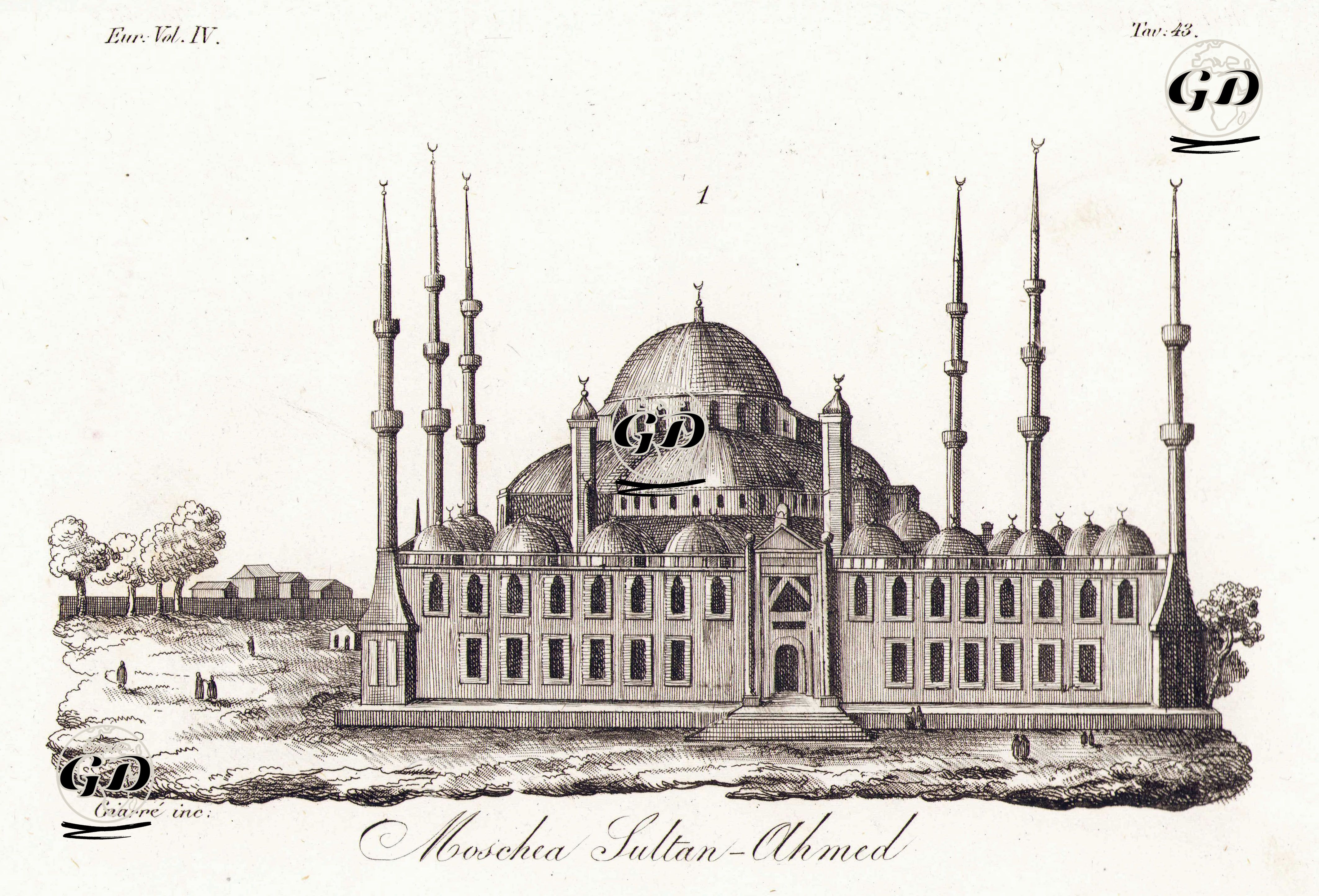
| Engraver | Luigi Giarre (1772-1841) |
| Date | 1827 |
| Technique | Copper Engraving |
| Category | Ottoman Empire And Turkey |
| Source | Il Costume Antico E Moderno O Storia Del Governo, Della Milizia, Della Religione, Delle Arti, Scienze Ed Usanze Di Tutti İ Popoli Antichi E Moderni, by Giulio Ferrario Vol. 4 (Europa) |
One of the most magnificent monuments of Ottoman classical architecture, the Sultanahmet Mosque began construction in 1609 and was completed in 1616 by Sedefkar Mehmet Ağa, a student and successor of Mimar Sinan, under the patronage of Sultan Ahmed I. The mosque is located on Istanbul's historic peninsula, directly opposite Hagia Sophia, a symbol of Byzantine heritage. The mosque's interior is covered with İznik tiles in blue, green, and white. The heavily colored hand-drawn ornamentation, particularly on the semi-domes and the interior of the main dome, gives the building its distinctive character. For this reason, Europeans often refer to the Sultanahmet Mosque as the "Blue Mosque." The building's design includes a main dome, six minarets, and eight side domes. The interior is decorated with over 20,000 hand-painted İznik tiles, each featuring over fifty tulip patterns. The lower sections are simpler, while the upper galleries offer a richer appearance with floral, fruit, and cypress motifs. In addition, more than 200 stained glass windows filter the light and give the space a mystical atmosphere. The mihrab, the most important element, is made of finely crafted marble and enriched with a muqarnas niche and inscription panels. The Sultanahmet Mosque represents not only the pinnacle of Ottoman architectural history but also, rising alongside Hagia Sophia in Istanbul's skyline, a magnificent symbolic dialogue between East and West, Islam and Byzantine heritage.