GRAVÜR DÜNYASI
Digital Engraving Library
| Artist | Frederic Leighton (1830-1896) |
| Engraver | Lumb Stocks (1812-1892) |
| Date | 1870's-1880's |
| Technique | Steel Engraving |
| Category | Ottoman Empire And Turkey |
| Source | London, I.S. Virtue & Co. Ltd. |
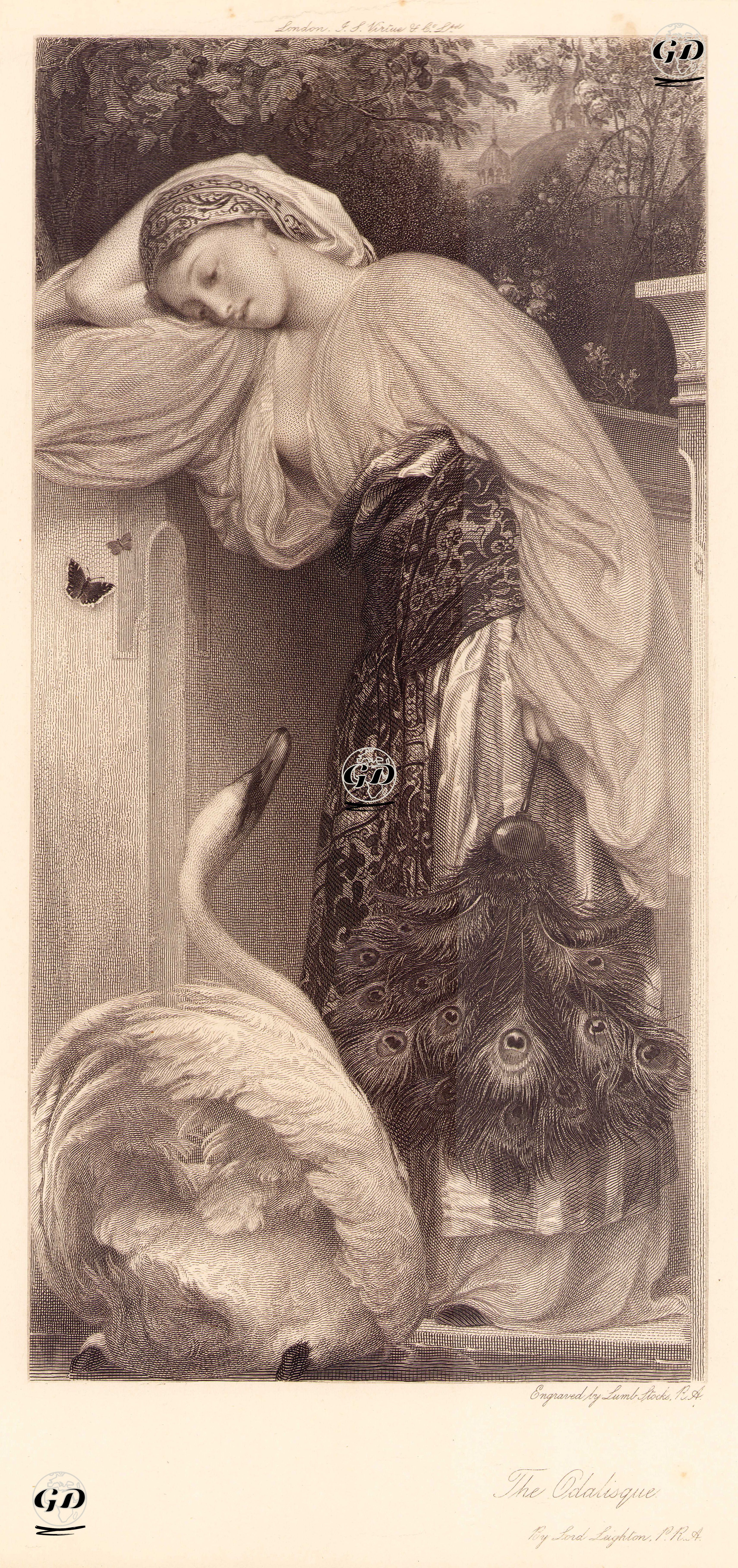
This engraving, titled "Odalık," was painted by Frederick Leighton and molded by Lumb Stocks. This work, one of the Orientalist themes frequently explored in 19th-century European painting, reflects Western artists' imaginative constructions of the Ottoman harem. The composition depicts an elegant woman from an Eastern harem, leaning against the marble railing of a bathhouse or pool. Her melancholic facial expression evokes an almost melancholic and inner resignation. This is further highlighted by the deliberate contrast between the conditions of forced servitude or slavery associated with the concept of "odalık" in 19th-century Europe and the free-flowing nature of the swan. One of the striking elements of Leighton's painting is the rich color and pattern detailing in the woman's clothing and accessories. The vibrant fan of peacock feathers contrasts with the white, finely crafted garments. Symbolic animals such as butterflies and swans add both elegance and allegorical meaning to the scene. The swan, with its soft wings, forms a graceful wreath, while the domes and minarets of an Eastern palace create an exotic atmosphere in the background. The engraving simultaneously reflects Victorian audiences' imaginations of the East and the tendency toward exoticism in Western art. The woman's sculptural pose reflects Leighton's classical training and the influences of ancient art, while the profound emotion in her face demonstrates the Romantic era's emphasis on individual melancholy. Therefore, this engraving can be considered not only a depiction of a harem scene but also a cultural document of how 19th-century Orientalist art shaped the West's view of the East.