GRAVÜR DÜNYASI
Digital Engraving Library
| Artist | Thomas Allom (1804-1872) |
| Engraver | Thomas Abiel Prior (1809-1886) |
| Date | 1838 |
| Technique | Steel Engraving |
| Category | Ottoman Empire And Turkey |
| Source | Constantinople And The Scenery Of the Seven Churches of Asia Minor Illustrated…, With an historical Account of Constantinople, and Descriptions of the Plates… (Fisher, Son & Co. London & Luai De L'Ecole, Paris) |
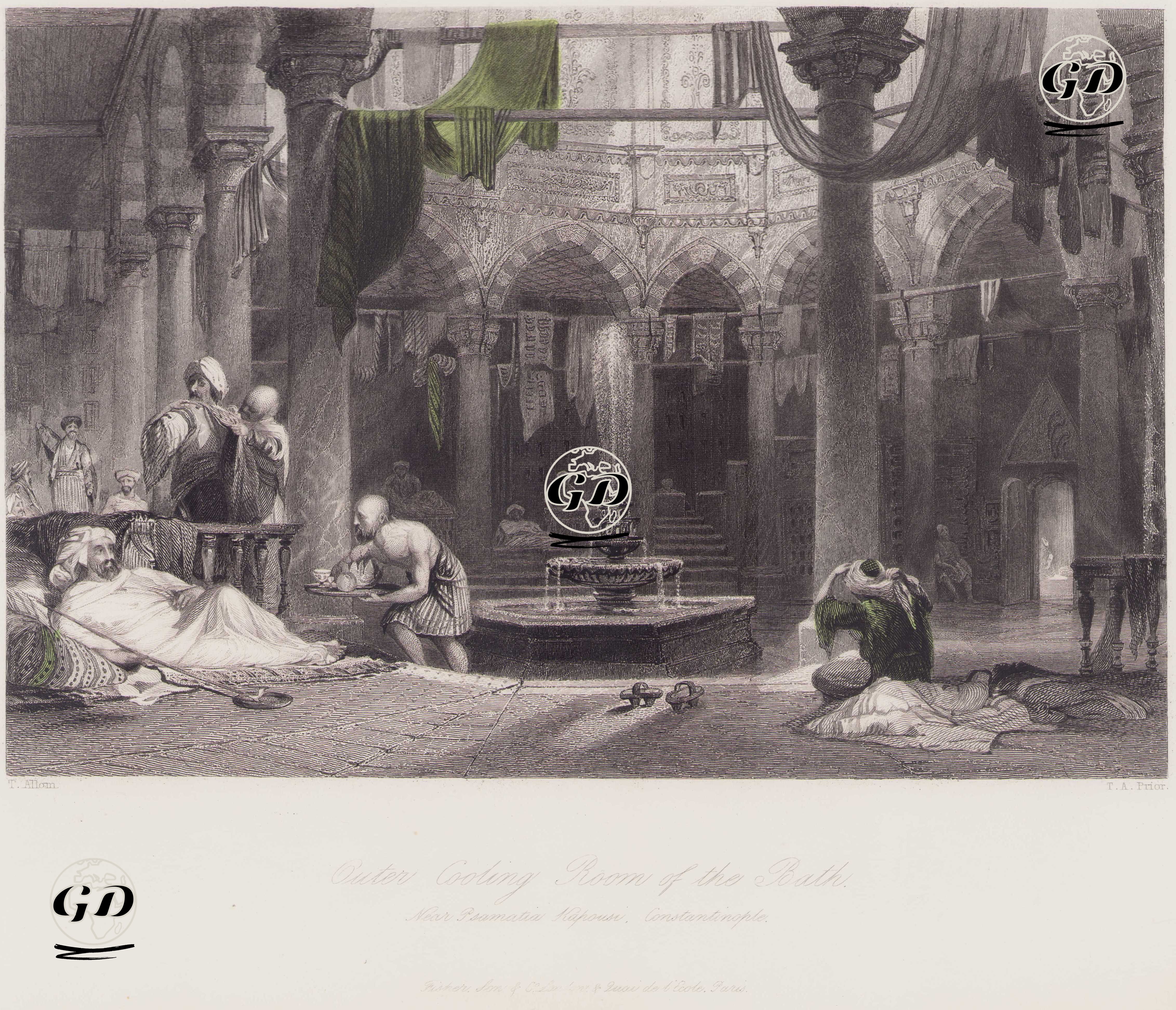
This engraving depicts in detail the dressing room (cooling section) of the men's section of the Kapıağası Yakup Ağa Hamam in Samatya, built by Mimar Sinan in 1547 and considered one of Istanbul's oldest historical monuments. Hamams, a key element of Ottoman urban culture, functioned not only as places for personal cleansing but also as spaces for social life, conversation, and relaxation. Therefore, hamams were considered shared cultural spaces within the Ottoman social order, regardless of class. The elegant fountain in the center of the engraving, along with the surrounding columns and arches, reflects the grandeur of classical Ottoman hamam architecture. The magnificence of the space is enhanced by the wall decorations, the inlays on the columns, and the interplay of light and shadow under the dome. The figures resting, conversing, or serving around the fountain reveal the bath's multifaceted function. A figure reclining on a divan in the foreground symbolizes the relaxation and tranquility provided by the bathhouse, while the attendant, standing nearby, evokes the essential rituals of Ottoman bathhouse culture. The towels and fabrics hanging from the ceilings in the background are details that enhance the scene's realism. The bathhouse consists of two main sections: the cold room (the dressing room) and the hot room (the warmth and heat). The cold room depicted in the engraving is renowned for its large domed courtyard, marble fountains, and coolness. This area is used to gradually reduce the body's temperature at the end of a bath session. According to information in the book "Constantinople And The Scenery Of The Seven Churches of Asia Minor Illustrated…" (which includes the engraving), 130 of the city's 88,115 buildings are public bathhouses visited daily by households.