GRAVÜR DÜNYASI
Digital Engraving Library
| Artist | J.R.Wells |
| Date | 1877 |
| Technique | Woodblock Engraving (Newspaper-Text on Reverse) |
| Category | Ottoman Empire And Turkey |
| Source | The Illustrated London News (December 08 1877- Page 541) |
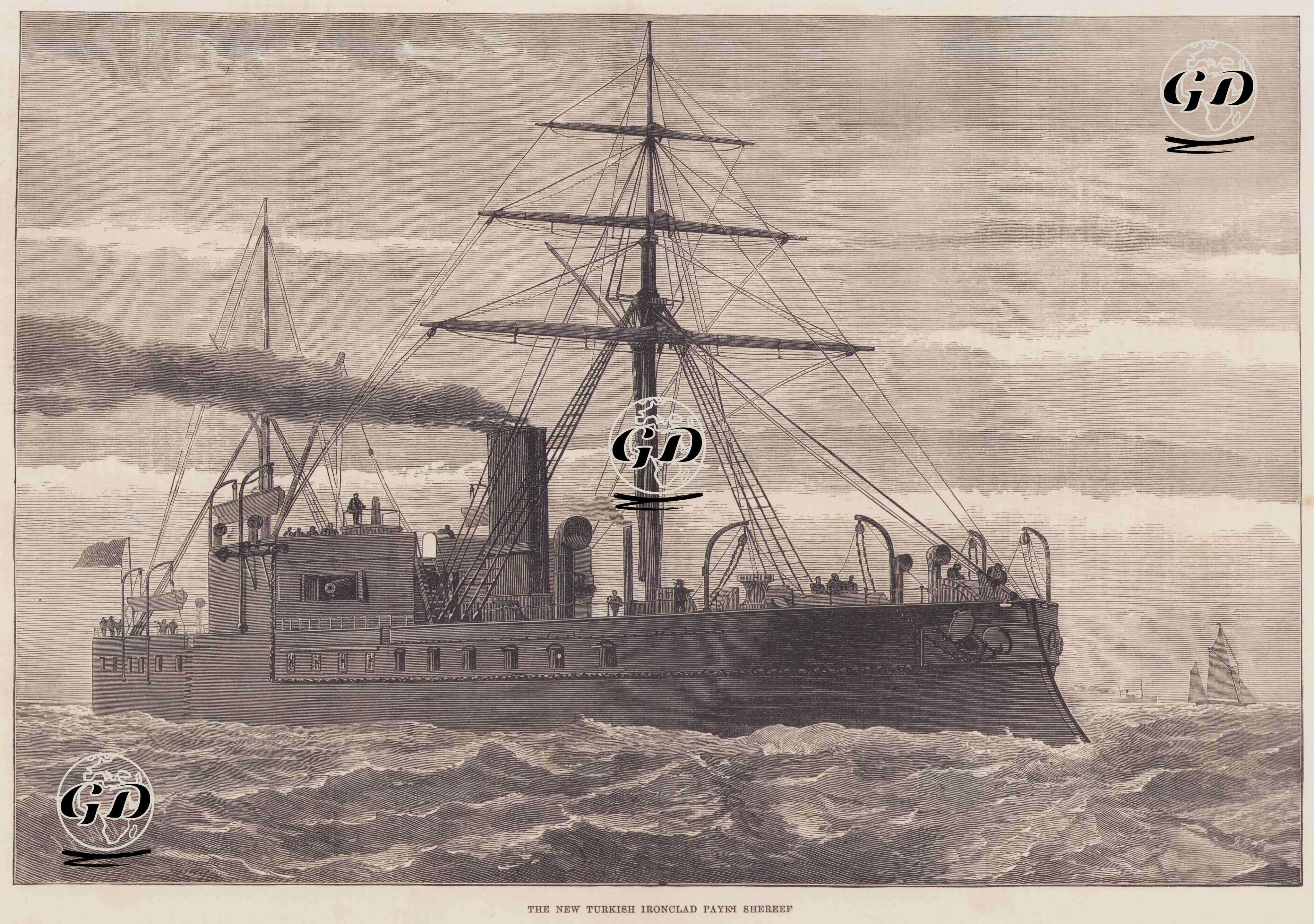
This engraving depicts the armored battleship HMS Belleisle, ordered by the Ottoman Navy under the name Peyk-i Şeref, but which could not be delivered to the Ottomans due to the outbreak of the 1877-1878 Russo-Ottoman War (93 War) and Britain's policy of neutrality, and was subsequently purchased by the British Royal Navy. When considered alongside the news text published in The Illustrated London News on December 8, 1877, the engraving is not merely a technical depiction of a ship, but also a visual document of a critical historical moment in the final quarter of the 19th century where international politics, maritime technology, and Ottoman-British relations intersected. Peyk-i Şeref was designed as a modern armored corvette with twin-screw propellers, built at the Messrs. Samuda Brothers shipyard for the Ottoman Sultan. The technical specifications detailed in the news report (245 feet length, 52 feet width, 22 feet depth, and 4700 tons displacement) clearly demonstrate the Ottoman Navy's efforts to adopt the most advanced maritime technologies of the time. The central battery system, featuring four 25-ton Armstrong guns positioned to fire in all directions, reflects a design philosophy that aimed to bring the ship's firepower to the level of contemporary European battleships. The armor layout is similarly suited to modern warfare requirements: the armor reaches 12 inches in thickness in the midsection, extending from below the waterline to the main deck, thus providing more intensive protection for the machinery and boilers. The depiction of the ship as a fully equipped battleship at sea in the engraving aligns with the narrative of high maneuverability and technical superiority emphasized in the text. In particular, the ship's ability to complete a 420-yard circle at full speed in 3 minutes and 30 seconds is presented as a remarkable performance among 19th-century battleships. This emphasis also reflects the Illustrated London News' aim to showcase the engineering achievement and naval power of this ship, built in British shipyards, to its readership. However, the engraving not only documents a technical achievement but also indirectly illustrates how the Ottoman Empire's attempts at military modernization were hampered by diplomatic balances among the great powers. The fact that the Peyk-i Şeref joined the British Royal Navy instead of the Ottoman Navy reveals the practical consequences of the neutrality principles applied during wartime and the fragility of the Ottoman's externally dependent armament policy. In this respect, the engraving offers much more than a portrait of a ship: it is a historical testimony that concretizes the tension between the Ottoman naval power ambitions and the limitations of European power politics in the context of the Russo-Turkish War of 1877-1878.