GRAVÜR DÜNYASI
Digital Engraving Library
| Date | 1877 |
| Technique | Woodblock Engraving (Newspaper-Text on Reverse) |
| Category | Ottoman Empire And Turkey |
| Source | The Illustrated London News (May 12 1877-Page 436) |
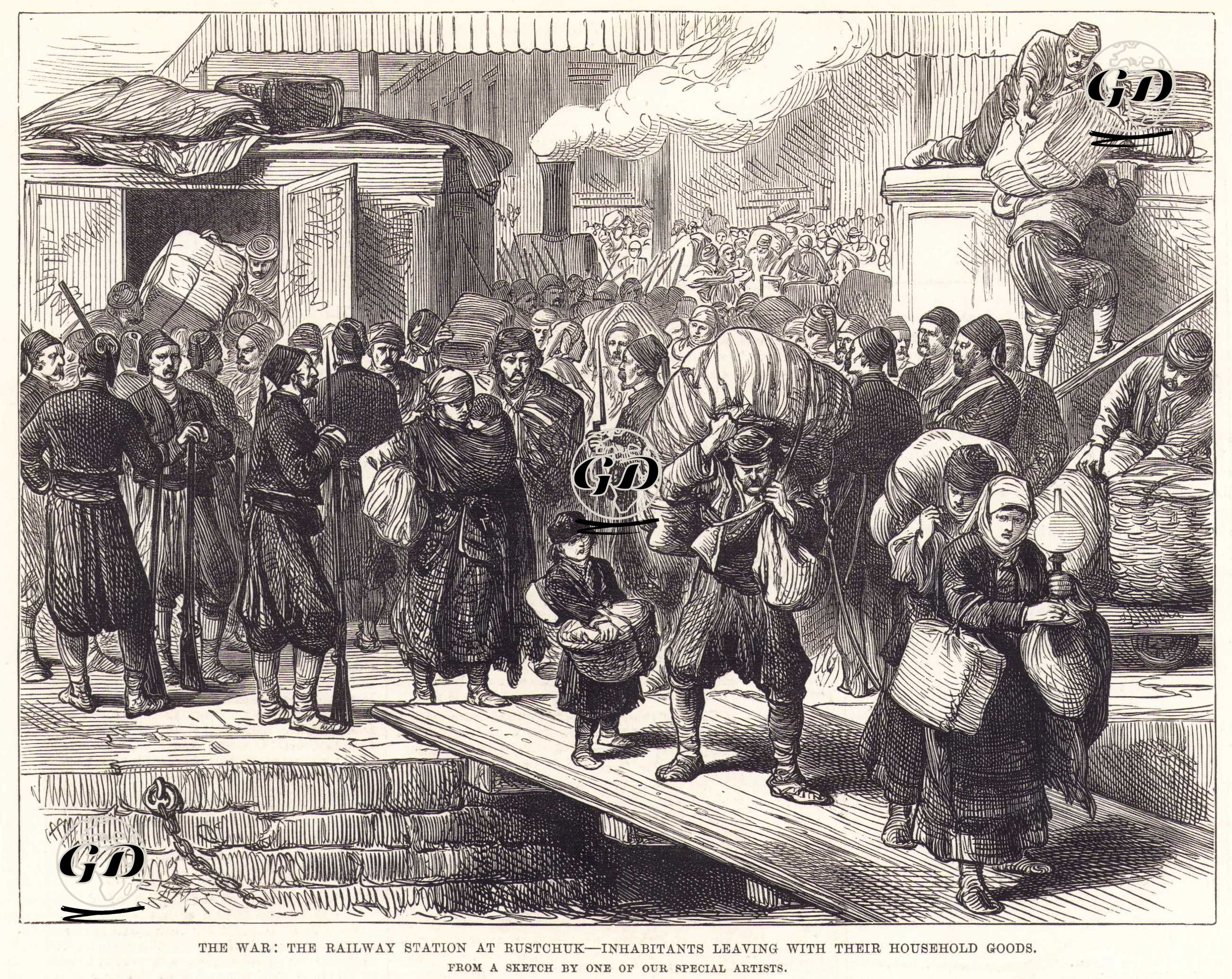
This engraving depicts the crowds at the Ruse train station, as reported in the May 12, 1877, issue of The Illustrated London News. According to the report, this scene depicts the chaos and despair that resulted when people fleeing neighboring towns piled into the station, carrying their household goods, provisions, and clothing. The engraving visually conveys the fear and shock that the arrival of the Russian army as "liberators" in the region had inflicted on families who had long enjoyed peace. In the foreground, the hurried movements of men carrying heavy loads and women carrying their children on their backs or in their arms. Many of the people have hastily packed essential household items such as bundles, chests, sacks, copper pots, blankets, and beds. This demonstrates the suddenness of the flight of the residents of Ruse and its surroundings, and the imminent danger that caught them off guard. The station building and wooden platform structures are visible in the background. The piled-up items create a virtual scene of migration within the station. The engraving also reflects the civilian impact of the 1877–1878 Russo-Turkish War on the Balkan peoples. According to the news report, this scene demonstrates that while the arrival of the Russian army was officially presented as "liberation," for the families in the region, it actually meant fear, panic, and displacement. Therefore, the engraving emphasizes the humanitarian crisis rather than the military dimension of the war.