GRAVÜR DÜNYASI
Digital Engraving Library
| Artist | Melton Prier (1845-1910) |
| Date | 1877 |
| Technique | Woodblock Engraving (Newspaper-Text on Reverse) |
| Category | Ottoman Empire And Turkey |
| Source | The Illustrated London News, (March 3 1877-Page 196) |
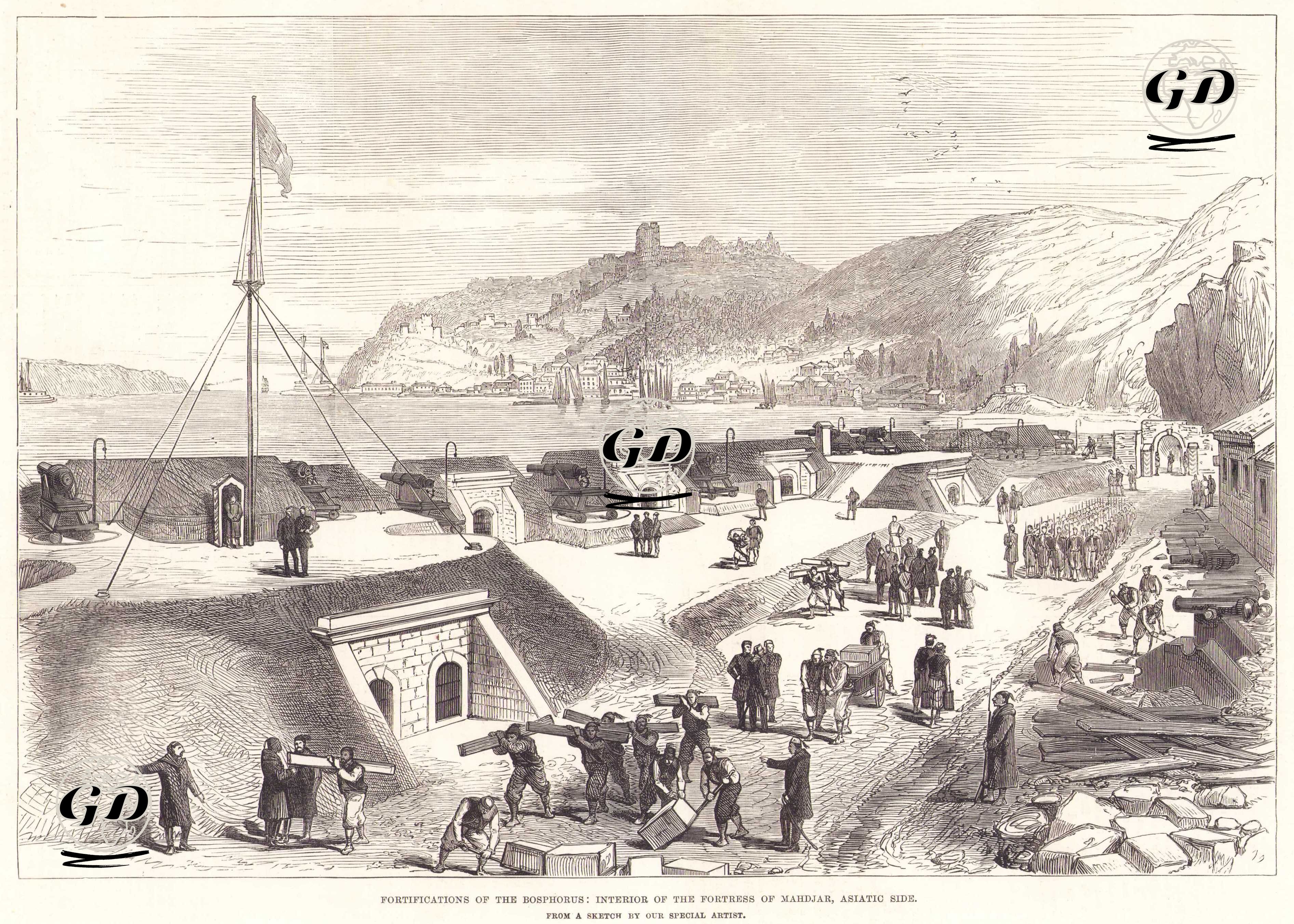
Macar Castle is situated at the narrowest and most strategic point of the Bosphorus, between Anadolu Kavağı and Beykoz, close to the Black Sea. According to a news report in The Illustrated London News, the castle was named after the imprisonment of a Hungarian nobleman there during the Ottoman-Austrian wars. While the exact date of the castle's initial construction is unknown, it was incorporated into the Bosphorus defense chain along with other fortifications in the region in the mid-15th century (during the reign of Mehmed the Conqueror). Complementing fortresses along the Bosphorus such as Rumeli Hisarı (1452) and Anadolu Hisarı (1395), it served as a forward position protecting the entrance to the Black Sea. Magyar Castle was refortified during the Russo-Turkish Wars (1768–1774 and 1828–1829) and subsequently reinforced with the contributions of British and French engineers during the Crimean War (1853–1856). The cannon batteries, casemates (underground ammunition depots) and observation points seen in the engravings belong to the defensive architecture of this period. In the second half of the 19th century, the castle was incorporated into the Bosphorus defense system during the reign of Sultan Abdulhamid II and continued to serve as an artillery outpost and ammunition depot. It lost its military function and was partially abandoned in the early 20th century.