GRAVÜR DÜNYASI
Digital Engraving Library
| Artist | Thomas Allom (1804-1872) |
| Engraver | Joseph John Jenkins (1811-1885) |
| Date | 1838-1839 |
| Technique | Steel Engraving |
| Category | Ottoman Empire And Turkey |
| Source | Constantinople And The Scenery Of the Seven Churches of Asia Minor Illustrated…, With an historical Account of Constantinople, and Descriptions of the Plates… (Fisher, Son & Co. London & Rue St. Honore, Paris) |
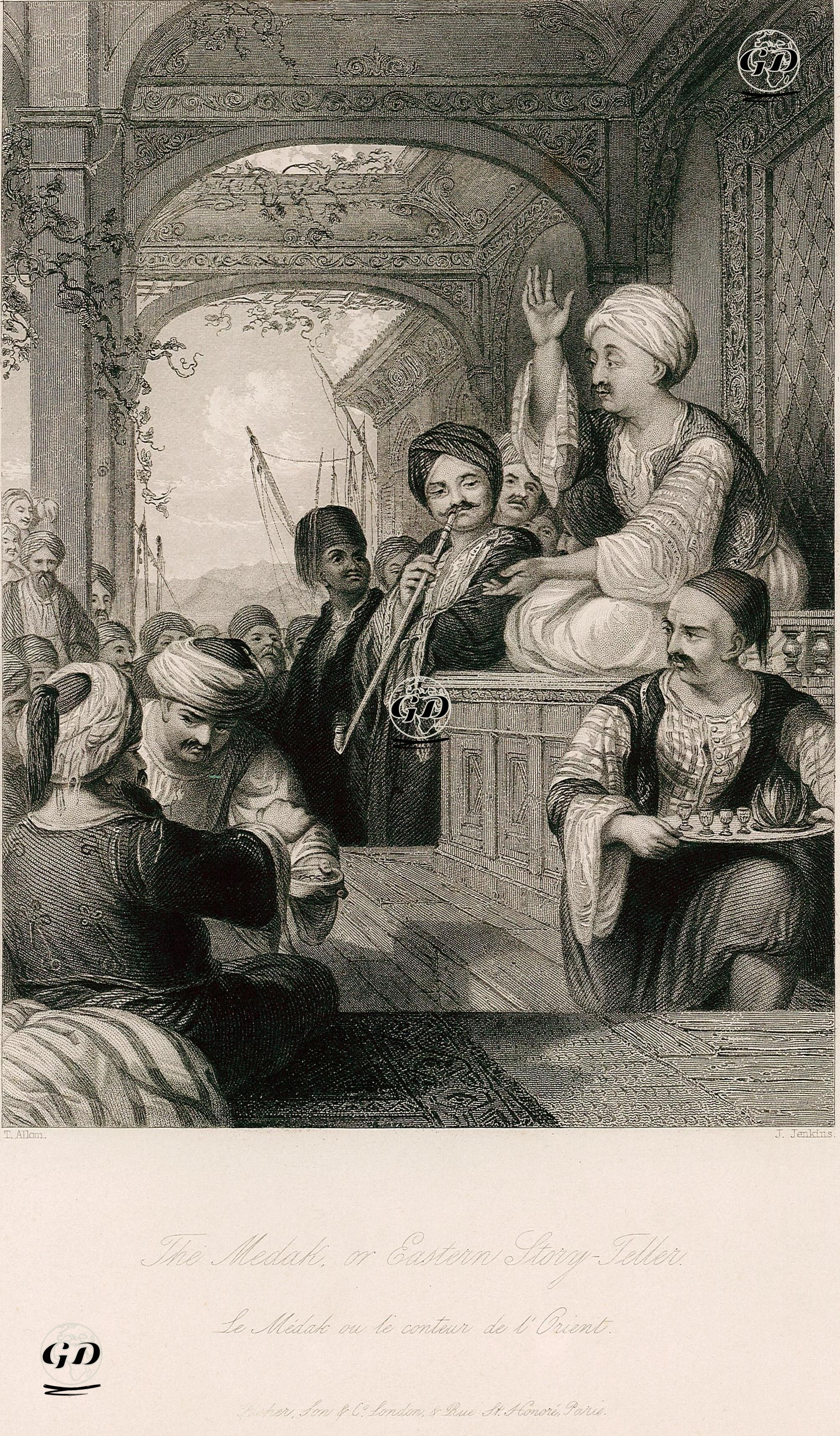
The engraving depicts the storyteller tradition, one of the most characteristic figures of entertainment in 19th-century Ottoman society, and Kız Ahmed, one of its most famous representatives. In the engraving, Kız Ahmed is depicted as a storyteller, seated at a small table in a coffeehouse scene, captivating the crowd with her facial expressions. The audience around her listens with deep attention to her narrative. During a time when theater was banned in Ottoman culture, storytelling, as a one-person theater, was an indispensable form of entertainment in social life. A source of joy in everyday life, the Meddah was a solitary stage performer. He would impersonate different social groups, nations, and characters through masterful use of voice tone, accent, gestures, and facial expressions. He often based his narratives on oriental tales, the Arabian Nights, or stories circulating among the people. Sometimes, he would present humorous and educational stories based on a proverb, providing a moral. In this respect, the Meddah was both an entertainer and a moral teacher of the period. As stated in the book "Constantinople And The Scenery Of The Seven Churches of Asia Minor Illustrated…" (which includes the engraving), Kız Ahmed was not only a storyteller but also a coffeehouse owner. She increased her income by entertaining her customers in her own establishment and, on special occasions, was invited to other coffeehouses for exorbitant fees. Especially during holidays, the front of her coffeehouse would be crowded with stools. Ahmed would tell stories until dawn, and the crowd would listen with such rapt attention that they would forget even to drink coffee or tobacco. When Kız Ahmed paused to collect money with a coffee cup in hand, the crowd would relight their sticks with the sound of flints, the coffee pots would be refilled, and everyone would eagerly await the rest of the story. The depiction of Kız Ahmed in this engraving aims to convey to Western audiences the unique cultural flavors of Ottoman society. This work is a reflection of Ottoman coffeehouse culture, the oral tradition of literature, and the sense of humor. The figure of the storyteller, with his narratives that bring together Istanbul's multicultural social structure and diverse ethnic and social groups, offers a unique window into daily life during the period. Therefore, the engraving is significant not only as a visual record of a coffeehouse scene but also as a representation of Ottoman entertainment, social interaction, and cultural diversity.