GRAVÜR DÜNYASI
Digital Engraving Library
| Engraver | Augustin François Lemaitre (1797-1870) |
| Date | 1840 |
| Technique | Copper Engraving |
| Category | Ottoman Empire And Turkey |
| Source | Turkey Volume Of L'Univers Pittoresque, Paris |
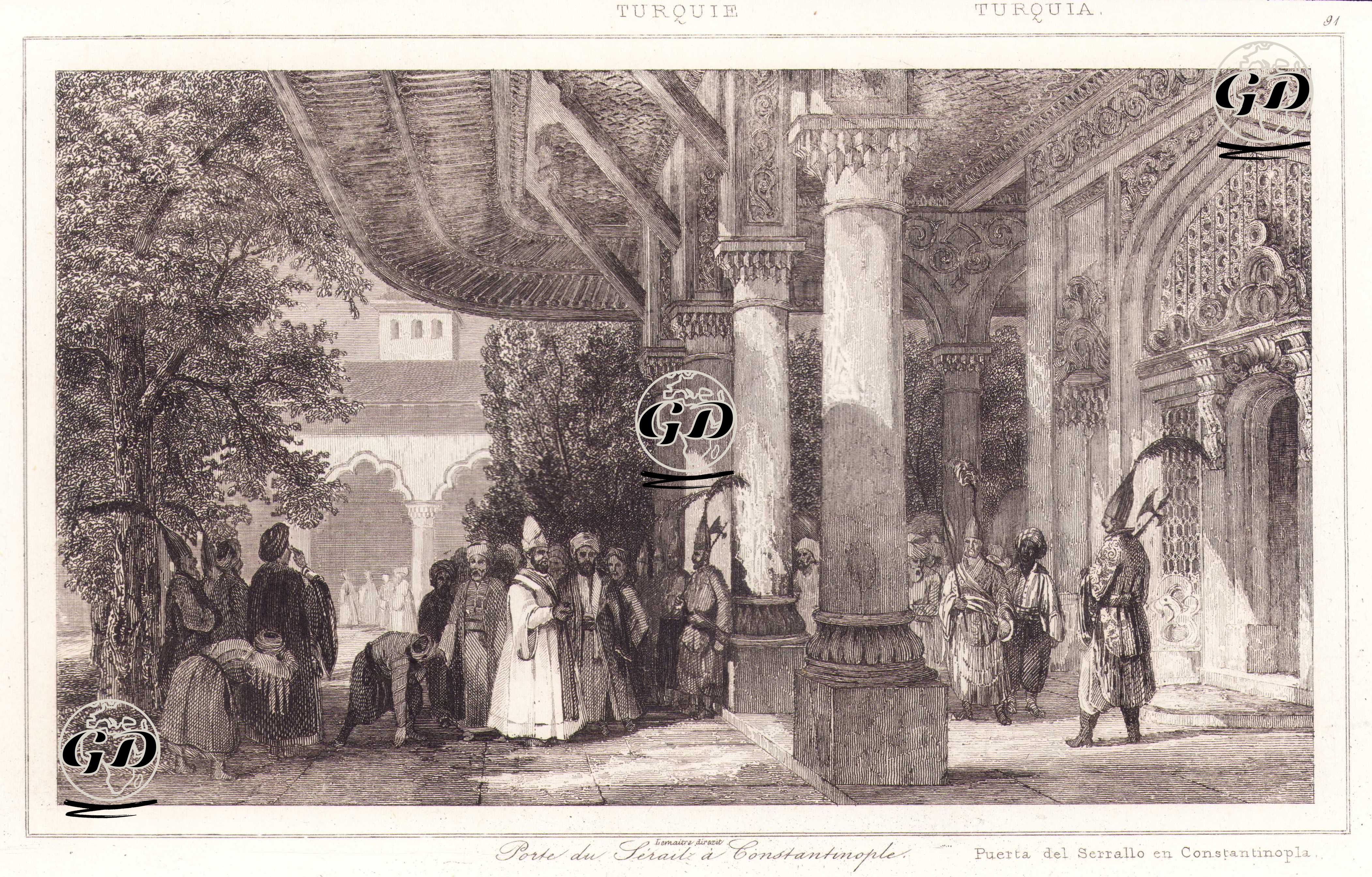
This engraving depicts the Arz Odası (Court Room), or the Kubbealtı Divan (Council of the Council), at Topkapı Palace, the heart of the Ottoman Empire's administrative and judicial mechanisms. The information about the Arz Odası (Court Room), or the Kubbealtı Divan (Council of the Council), in the book containing this engraving, titled "Entrance to the Arz Odası (Court Room) of Topkapı Palace," is summarized as follows: In the Ottoman state administration, the Divan was not only a court where justice was administered; it was also the center where laws were made, diplomatic matters were discussed, and the most important decisions of the imperial bureaucracy were made. Here, cases were heard, laws were enacted, decrees were issued, soldiers were paid, and foreign ambassadors were prepared before they were allowed into the sultan's presence. Located in the second courtyard of the palace, the Kubbealtı is a simple, two-domed structure, with no furnishings other than divans. These long sofas, which give the place its name, extend along the wall, are approximately seventy centimeters high and are covered with cushions. Divan meetings were held four days a week under the Grand Vizier's chairmanship. The Rumelian and Anatolian kazaskers and the Istanbul judge, assisting the Grand Vizier, formed the high court. Ottoman law was based on Quranic principles, and cases were resolved swiftly and decisively. Disciplinary punishments such as bastinado (a type of beating) could be applied if the parties unnecessarily prolonged the proceedings. The scene depicted in the engraving is both a symbol of this process and a reflection of the seriousness of Ottoman state officials. In the foreground, high-ranking state officials and sergeants are seen. In the background, the door through which plaintiffs and ambassadors were admitted to the Divan is noteworthy. This door, also known as the place where criminals were punished, gave rise to the popular expression "door-to-door." In palace ceremonies, the Divan played a significant role not only for its judicial function but also for political rituals such as the distribution of royalties and the reception of foreign ambassadors. The Ottoman splendor, ceremonial order, refreshments, and kaftan-dressing ceremonies, especially during the receptions of ambassadors, left a deep impression on Western observers. These scenes were reflected in the works of numerous travelers and artists. Therefore, this engraving is not merely an architectural depiction but a visual representation of Ottoman justice, diplomatic protocol, and state power.