GRAVÜR DÜNYASI
Digital Engraving Library
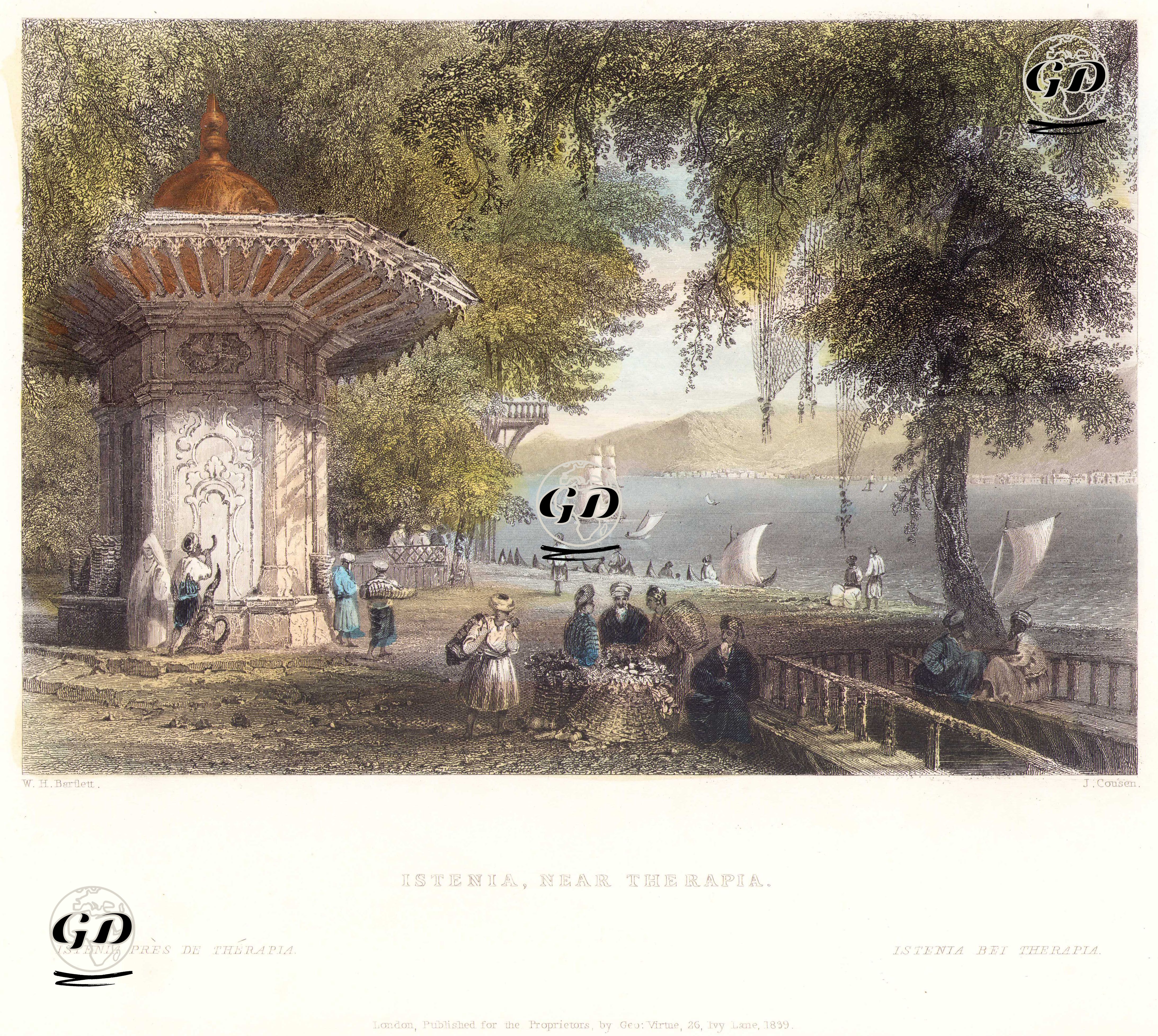
| Artist | William Henry Bartlett (1809-1854) |
| Engraver | John Cousen (1804-1880) |
| Date | 1839 |
| Technique | Steel Engraving-Original Hand Colored |
| Category | Ottoman Empire And Turkey |
| Source | The Beauties Of The Bosphorus (London Published For Proprietors By Geo. Virtue 26 Ivy Lane, 1839) |
As one of the most beautiful villages on the Bosphorus, Emirgan attracted the attention of 19th-century travelers for both its natural beauty and its social life. Although the engraving refers to it as "Istenia–İstinye," the place depicted is actually Emirgan, formerly known as Mirgün. In 1635, when Sultan Murad IV granted the area to Emirgüne's son Tahmasb Kulu Han (Yusuf Pasha), the area was first known as "Emirgüne Garden," then "Mirgün Garden," and then "Mirgün," and over time, the entire region became known as Emirgan. The most striking structure in the engraving is the Abdülhamid I Fountain, commissioned by Sultan Abdülhamid I in 1782 and now a symbol of Emirgan. This marble fountain, with its eight facades, domes, and wide eaves, was built alongside a mosque and a bathhouse. Because the Sultan had the fountain built in memory of his wife Hümaşah Kadın and his son Şehzade Mehmed, the building is also known by these names. Considered an elegant example of the Turkish Baroque style, the fountain's facades feature reliefs, inscriptions by Es'ad el-Yesari, the Sultan's signature, and Quranic verses carved by Mehmed Emin. The information about Emirgan in "The Beauties of the Bosphorus," which includes this engraving titled "Istenia, Near Therapia," is summarized as follows, along with my own interpretation: Located at one of the most beautiful points on the Bosphorus, this charming little village, known to the Greeks as "Mirgheun," is inhabited predominantly by Greeks. While the opposite shore appears rocky, barren, and bleak, the coastline on which Emirgan is located is adorned with houses and trees, shimmering like a pearl with its verdant texture. The most striking architectural element seen in the engraving is the elegant fountain built in the "Moorish style." This structure, built of pure white marble that is almost dazzlingly white, is located at the point where the village's main street opens onto the Bosphorus. The fountain, almost dazzling in its whiteness, is shaded by the branches of a magnificent maple tree. This magnificent maple, with its broad branches spreading over the dome, and two similar trees, create a cool shade around it. The coffeehouse piers and wooden terraces located in these shadows surrounding the fountain have become daily gathering places for the public. This demonstrates that the fountain is not only an architectural element but also a center of social life. Emirgan's social scene has also captured the attention of Western observers. Crowds dancing in the current of the Bosphorus in boats, women carrying water from the fountain in earthenware pots, fruit vendors offering abundant and delicious fruit ready to be loaded onto boats for transport to the city markets, fishermen's nets, and the white sails of passing ships glistening in the sunlight are among the details that depict the vibrant daily life of the village. The sounds of music rising from the coffeehouses, the roar of the waves, and the harmonious sounds of leaves in the breeze define Emirgan in a kind of pastoral harmony. The entire landscape appears so cool, shady, and tranquil that it's no wonder nature lovers have chosen this place as a village. The village's interior is also striking. A wide street leading to the sea rises amidst vineyards and olive groves, reaching into the hills. The well-maintained gardens belonging to the Ottoman statesman Ahmet Pasha, and the small forest beyond, have been described as a recreational area where Turkish and Greek women often strolled during the summer months. Here, crowds enjoying a sense of dolce far niente (sweet idleness), sometimes held parties and sometimes gathered wildflowers in the shade of the trees. Wealthy Greek merchants also held a prominent place among Emirgan's residents. Their summer mansions, with their freshly painted facades, add to the village's cheerful atmosphere and enhance its charm. Travelers noted these summer mansions as an integral part of the village and considered Emirgan one of the most popular settlements on the Bosphorus with both its nature and its colorful social life.